Memory written over centuries: how unique manuscripts are being restored in Kazakhstan
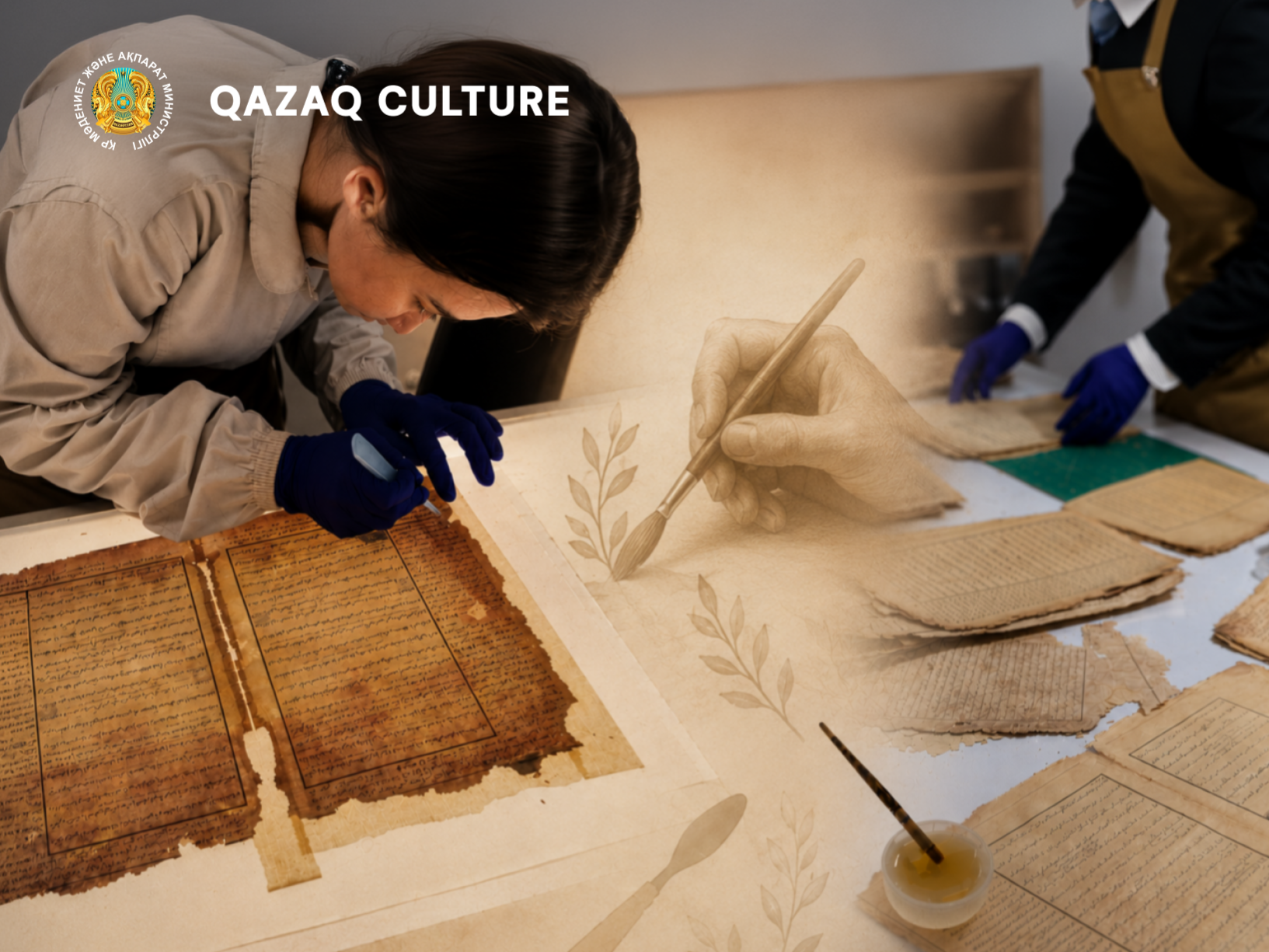
The country's historical memory is preserved not only in museums and archives, but also on the pages of rare manuscripts, ancient books, and unique written records that have survived centuries ago. Preserving these documents requires not only careful handling but also extensive scientific, restoration, and research work. Today, restorers are the specialists who literally bring cultural heritage back to life, preserving it for future generations.In Kazakhstan, this work is systematically carried out by the National Center for Manuscripts and Rare Books, established to study, preserve, and introduce valuable written sources related to the country's history into scientific circulation. The Center's collections contain unique manuscripts and rare editions.We spoke with Alma Tastemirova, Head of the Restoration and Conservation Department at the National Center for Manuscripts and Rare Books, about how manuscripts are restored today, how long it takes to restore a single document, the role modern technologies are playing in this field, and why the profession of restorer requires not only knowledge but also a special responsibility to history. What role does manuscript restoration and conservation play today in preserving the country's historical memory?Manuscript restoration and conservation play a crucial role in preserving the country's historical memory. This work helps prevent the loss of unique written sources, preserve the knowledge of past eras, and ensure cultural continuity between generations.Manuscripts and rare books are not just archival documents, but living testaments to history, reflecting the spiritual, scientific, and cultural heritage of a people. Therefore, their preservation requires not only careful handling but also a professional scientific approach.Today, modern methods of chemical and physical stabilization allow us not only to restore the condition of documents but also to stop further deterioration of paper, ink, and bindings, ensuring their long-term preservation.At the National Center of Manuscripts and Rare Books, this work is carried out systematically: specialists are engaged in restoration, conservation, scientific study, and popularization of the written heritage, ensuring its preservation and accessibility for future generations.What manuscripts and rare books does the Center work with?The Center works with various types of manuscripts and rare books, which arrive in varying conditions. These include both printed and handwritten editions.Unique copies are particularly valuable. Among them are a 1909 collection of Abai Kunanbayev's works, published in St. Petersburg at the initiative of Alikhan Bukeikhanov, as well as a handwritten Quran by Kenesary Khan.In addition, there are valuable Eastern manuscripts, in particular, manuscripts from the Sharkh Vikaya collection: one of them dates back to the 16th century. There is also a 17th-century manuscript—Haravi's commentary on Ghazali's Ihya Ulum ad-Din—and other rare written heritage items.All of these materials are of great historical and cultural significance and require a particularly careful and professional approach during restoration and conservation.— In what condition do the books arrive, and how long does it take to restore them?— Manuscripts most often arrive at the Center in a severely damaged condition. These may be documents with damaged paper, missing fragments, traces of improper storage, or exposure to unfavorable conditions. Sometimes, unprofessional restorations are encountered, using materials that will only worsen the document's condition over time.The restorer's primary goal is not simply to restore the manuscript's appearance, but to preserve its authenticity, stabilize its condition, and prevent further deterioration. Therefore, the work begins with diagnostics: specialists examine the material, the extent of the damage, and select safe methods and restoration compounds.The process itself is multi-stage: cleaning, strengthening the base, restoring lost fragments, and conservation. Depending on the complexity, work on a single copy can take anywhere from several weeks to several months. For example, the restoration of Abai's 1909 book took about a month and a half, and the restoration of Kenesary Khan's Quran took about six months.– What modern technologies are used in restoration?– Today, modern technologies, including artificial intelligence tools, are being actively introduced into the field of document restoration and conservation. AI is primarily used at the diagnostic stage: it helps analyze damage, select suitable adhesives and materials, and speeds up the search for scientific literature and methodological information.Furthermore, modern technologies allow for more accurate assessment of the condition of paper, ink, and bindings, which helps develop the safest document restoration process.It is important to understand that the majority of restoration work is still performed manually. Restoration requires high precision, professional experience, and an individual approach to each copy. Therefore, artificial intelligence today serves more as an auxiliary tool that assists specialists but cannot completely replace the manual work of a restorer.– How is the process of returning or identifying manuscripts related to the history of Kazakhstan being carried out abroad?– The process of identifying and returning manuscripts related to the history of Kazakhstan is being conducted in several directions simultaneously.First and foremost, this involves scientific research in foreign archives, libraries, and museums where valuable written sources relating to the history and culture of Kazakhstan may be stored. International cooperation is also developing: joint projects, research expeditions, and exchange programs with foreign scientific and cultural organizations are being implemented.Government initiatives also play a significant role, particularly the "Archive 2025" program, which has included efforts to identify, return, and digitize historical documents.Furthermore, digitalization is being actively implemented. Even if the original manuscript remains abroad, a digitized copy allows the document's contents to be returned to scholarly circulation, making it accessible to researchers, and preserving the historical heritage for future generations.– How is the preservation of manuscripts currently ensured, and is digitization ongoing?– The preservation of manuscripts and rare books is ensured through a comprehensive approach. The Center maintains special storage conditions: temperature, humidity, and lighting are controlled, and microclimate containers and specialized equipment are used. Preventive conservation measures are also regularly carried out, and access to the originals is restricted to minimize the risk of damage.Digitization is an important part of this work. All restored books and manuscripts are required to be made into electronic copies. This allows researchers and readers to access the materials without having to work directly with the originals.At the same time, the manuscripts themselves continue to be stored in specialized conditions with strictly controlled environmental parameters, ensuring their long-term preservation for future generations.– What challenges are currently facing the field of restoration and the training of specialists?– Attention to the profession of restoration is gradually increasing, as the preservation of historical and cultural heritage is becoming increasingly important. However, the field still requires further development of its training system.Basic educational programs are already in place in Kazakhstan, implemented through the National Library of the Republic of Kazakhstan and the National Center for Manuscripts and Rare Books. However, there remains a need for more systematic and long-term professional education, as well as expanded practical training for specialists.One of the main challenges remains the need for continuous knowledge refreshment. Modern technologies, new restoration materials, and methods require specialists to regularly improve their skills and learn from international experience. Moreover, the profession itself requires high precision, patience, and a great deal of responsibility, as the work involves working with unique monuments of written heritage.