Aisha-bibi
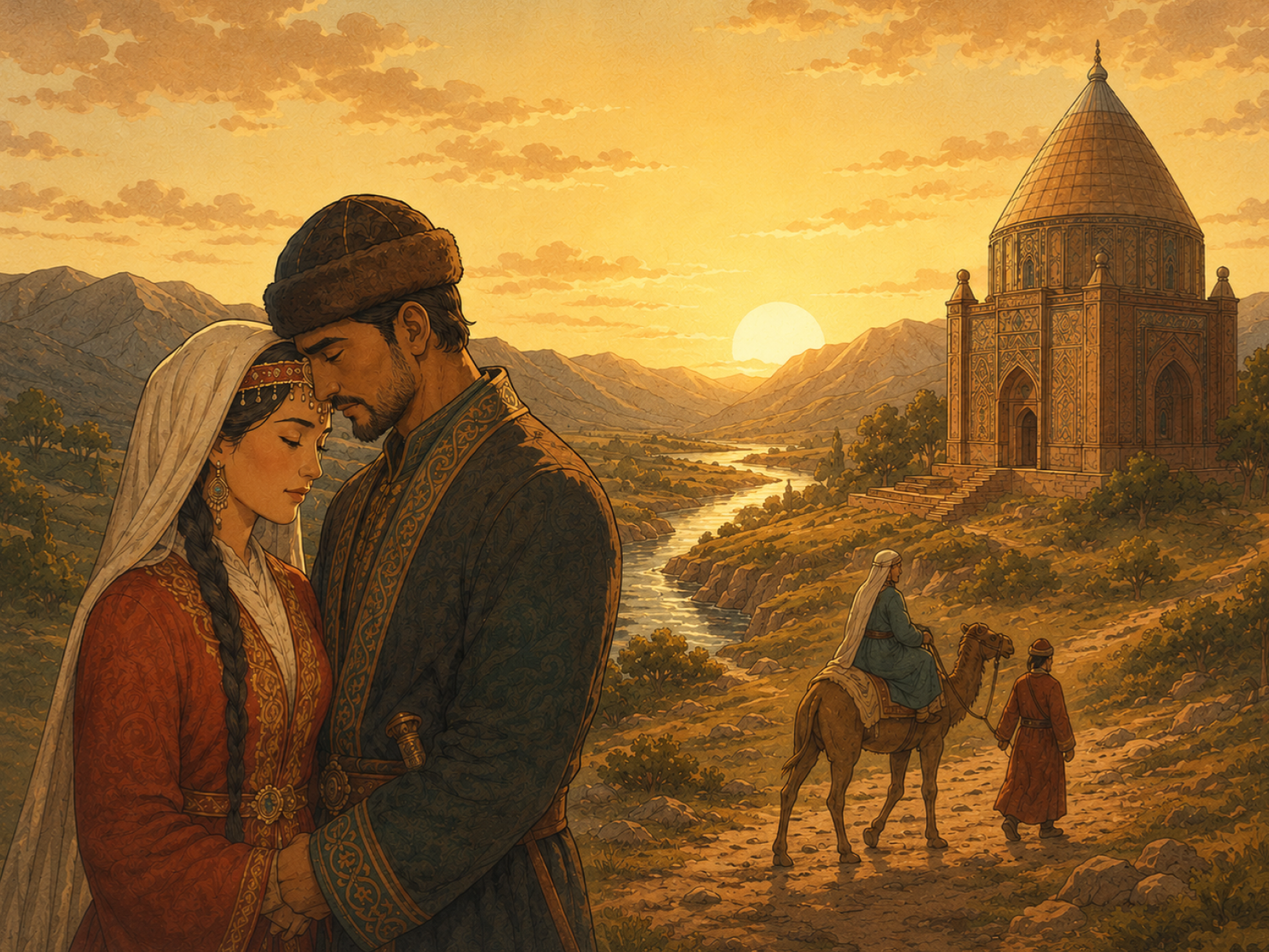
In ancient times, the city of Taraz was ruled by Karakhan, a young, fair, and courageous ruler. He cared for the people, defended his native land, and was respected by warriors and elders.
One day, fate brought him to a remote village where a girl named Aisha lived. She was renowned throughout the region for her beauty, but even more so, people valued her intelligence, modesty, and kindness to others.
Upon seeing Aisha, Karakhan fell in love with her. The girl also became deeply attached to the young ruler. Before leaving, he promised to return and ask for her hand in marriage.
Keeping his word, Karakhan soon sent respected matchmakers to Aisha's family. However, the elder who had raised the girl refused to bless the young couple. He believed that the ruler of Taraz was unsuitable for his ward and did not want to let her go far from her home.
Unable to go against the elder's wishes, Karakhan returned to Taraz. He hoped that with time the elder would change his mind. But months passed, and still no agreement was reached.
Aisha's yearning for her beloved grew stronger with each passing day. Finally, she decided to set out for Taraz herself.
Her faithful Babaja Khatun, who had cared for the girl since childhood and loved her like her own daughter, accompanied her on the journey.
The journey was long and difficult. The travelers crossed vast steppes, climbed hills, and forded swift rivers. During the day, the heat sweltered them, and at night, the howls of steppe animals echoed around them.
Despite her fatigue, Aisha did not complain.
"It's only a short distance to Taraz," she told her companion. "Soon we'll see the city and meet Karakhan."
One day, the travelers stopped to rest by the Asa River. The water was cool and clear. After the long journey, Aisha decided to refresh herself and ordered Babaja Khatun to lay out her clothes on the bank.
No one noticed when a poisonous snake slithered into the folds of her headdress. Emerging from the water, Aisha donned her clothes. At that very moment, the snake bit her.
The girl screamed and fell to the ground. Babaja Khatun rushed to her side but knew nothing about how to help. The poison was quickly spreading through her body, and Aisha's strength was ebbing.
Realizing that she would be unable to bring her to the city on her own, Babaja Khatun sent a messenger to Karakhan.
Upon receiving the terrible news, the ruler immediately rushed to his beloved. He ran as fast as he could, but upon arriving at the riverbank, he saw that Aisha was dying.
Karakhan sank down beside her.
"I came because I didn't want to live my life away from you," the girl said, barely audible.
Realizing that saving his beloved was impossible, Karakhan called to his spiritual mentor, who was standing nearby, and asked him to bless their union.
The ritual was performed. Karakhan quietly spoke three times near Aisha:
"Aisha, you have now become bibi."
Hearing his voice, the girl calmed down. Soon, her heart stopped beating.
Karakhan could not come to terms with the loss for a long time. He ordered Aisha buried on the very spot where her life had ended, and invited the finest craftsmen to build a beautiful mausoleum over her grave.
The architects decorated the walls with patterned terracotta tiles. Each ornament was unique. In the interweaving of lines, they sought to convey both Aisha's tenderness and Karakhan's deep sorrow.
Babaja Khatun remained near the grave. She tended the burial place of her ward, kept the lamp burning, and told visitors the story of her love.
After her death, his faithful companion was buried nearby. A mausoleum was also erected over her grave.
They say Karakhan remembered Aisha until the end of his days. He bequeathed that he be buried in Taraz so that the resting place of his beloved would always remain before his eyes.
Centuries passed, generations changed, ancient cities and states disappeared. But the mausoleum of Aisha-Bibi survived and became a symbol of pure love and fidelity.
An ancient legend reminds us: sincere feelings do not fade even after separation, and the memory of a loving heart can outlive the ages.