Aksak kulan
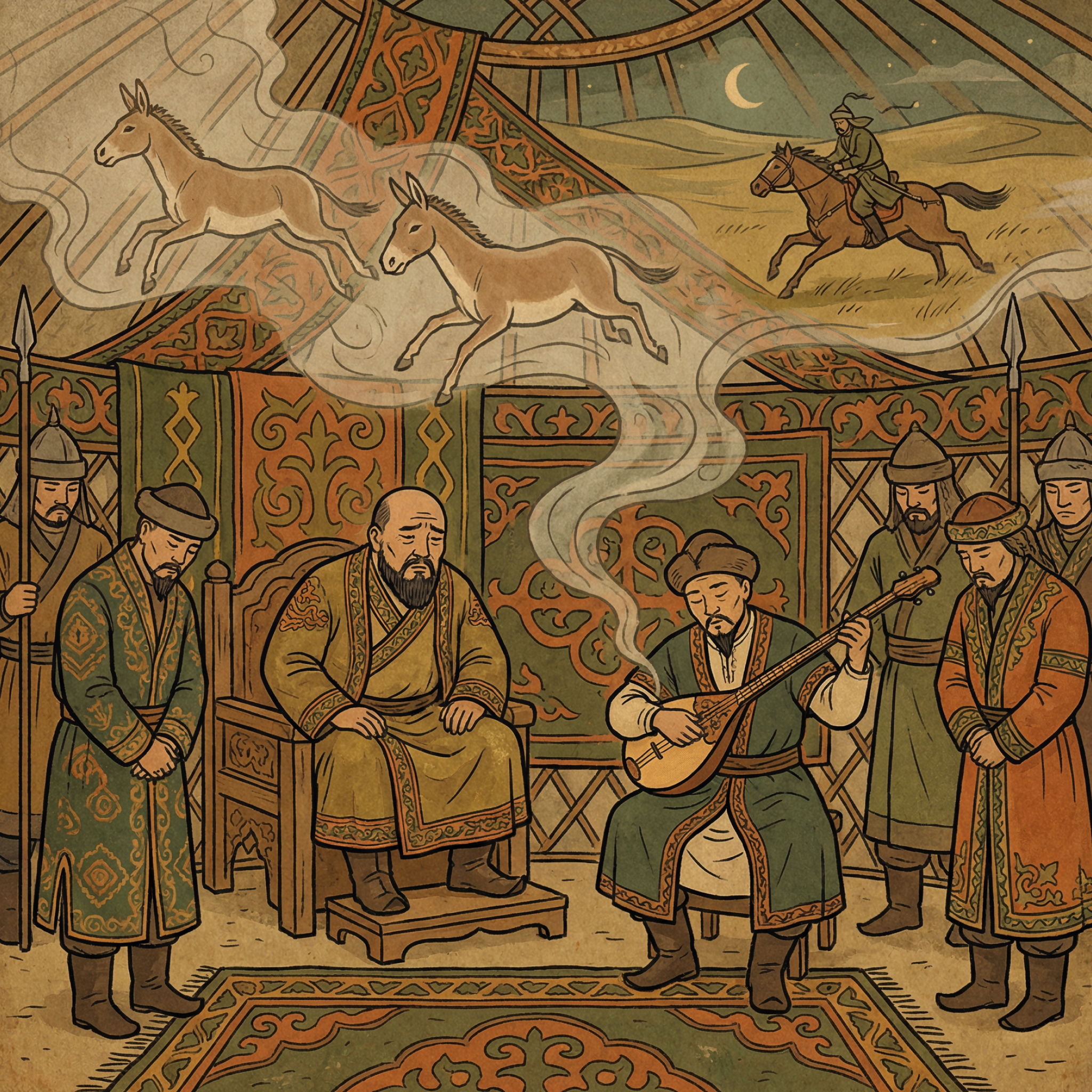
They say Zhoshi Khan's only son passionately loved hunting kulans. But the khan wouldn't let him go alone, saying, "Hunting kulans isn't like chasing hares; it's dangerous." And yet, one day, the prince, hiding from his father, rode out into the steppe alone. Soon, he saw a herd of kulans grazing peacefully. His eyes lit up with joy. He snatched a gray arrow from his quiver and began mercilessly striking down the innocent animals. In the heat of the hunt, he didn't even notice how his arrows ran out. Then the herd leader, sensing his helplessness, furiously kicked the young man in the chest with his hooves and left him dead in the middle of the deserted steppe. When his son went missing, the khan sensed trouble in his heart, but he couldn't bear to hear the terrible truth. He declared, "Whoever dares to tell me of my son's death will have molten lead poured into his mouth." After such words, who would dare bear the bad news? No one dared speak, or even hint.
One day, a servant ran up to the khan, seated on his throne:
"Your Serene Highness, there's a man standing at the gate. He says he knows the prince's fate."
The khan commanded,
"Let him enter!"
A stranger entered, holding a dombra. The khan said to him,
"Stranger, conceal nothing, and tell me everything you know!"
Then the kuyshi took the dombra and replied,
"What I know will be revealed by two strings and a tiek,"
and his fingers touched the strings. From the very first notes of the kyui, the rumble of a galloping horse's hooves was heard. The khan's heart sank: was his only son, the light of his eyes, already returning home? His face brightened, hope blazing. But at that very moment, such a despairing lament, such grief at irreparable loss, burst from the highest string that his soul was overwhelmed. The dombra wept like a human being, moaned like a human being. The khan's face immediately darkened, as if shrouded in a black cloud, his shoulders slumped. The hope he had already reached out to with all his heart vanished, and a heavy melancholy settled upon his chest.
Then the kyui recounted how the prince cried out in joy upon seeing a herd of kulans, how a gray arrow whistled, bringing death, how the hooves of the animals thundered as they fled. The khan's thoughts raced. Why did the Almighty grant him the ability to understand the language of the kyui? The melody soared to its peak, reached its peak—and suddenly the rushing rush broke. And it seemed to the khan as if the last breath of a dying man had burst from the very chest of the dombra.
The khan's face turned pale, and he jumped up. His eyes turned bloodshot, and he bit his finger in rage. Meanwhile, the kyui player returned to the first, mournful theme. The kyui weakened, fading, as if telling of a man leaving this world with an unfulfilled dream, as if the last light was fading in someone's eyes.
The khan covered his tear-stained face with his hands and sat motionless for a long time. But soon he regained his composure and, determined not to go back on his word, said:
"You have brought me the news that my only son has perished in the steppe. Accept your punishment." And he added:
"Let it no longer proclaim either good or evil; let it henceforth be silent forever."
After this, he ordered molten lead to be poured into the dombra's throat.