The Legend of Korkyt-ata
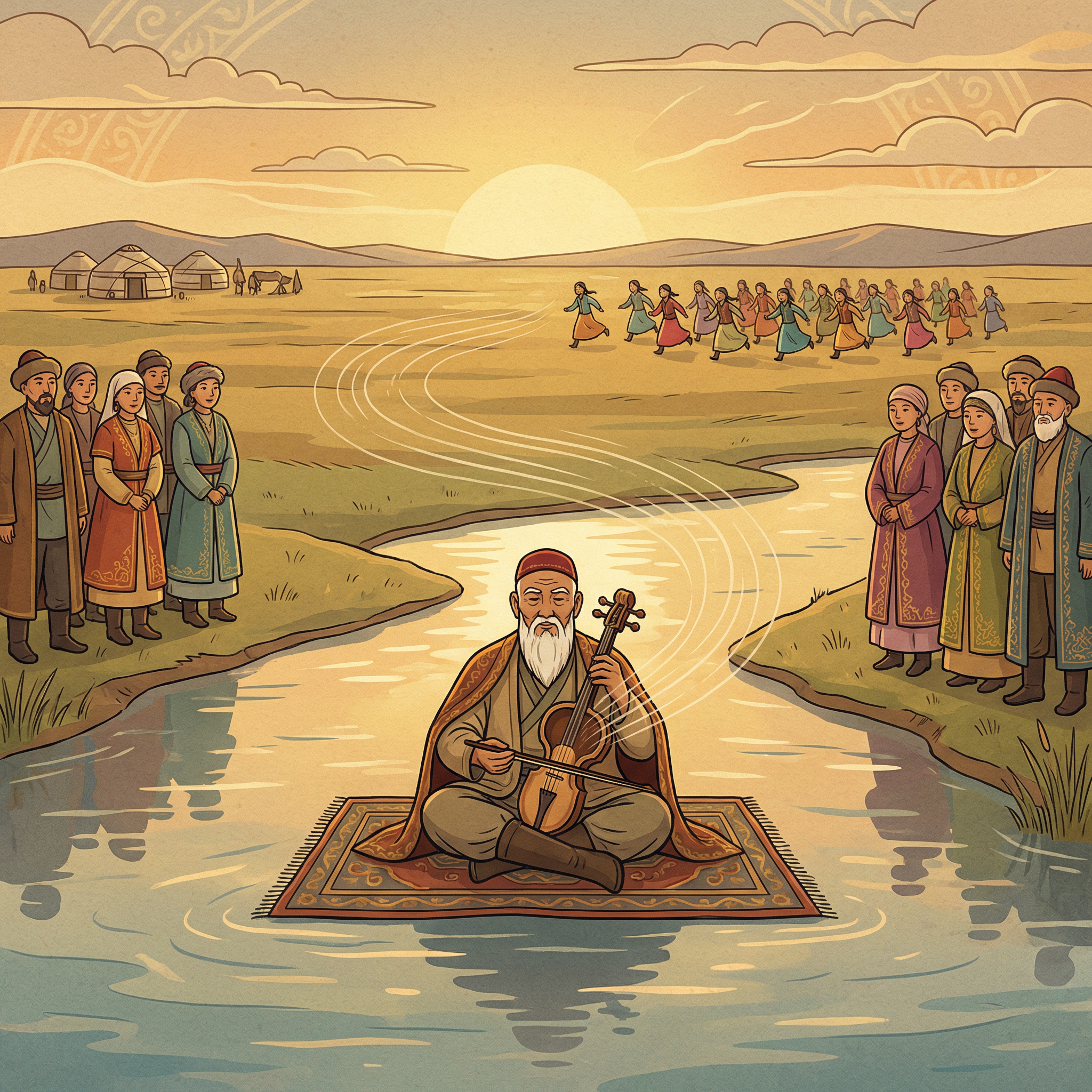
Korkyt, not submitting to death, wandered the four corners of the world, seeking a way to escape mortality. But wherever he went, he saw a grave being dug before him.
Eventually, realizing he could not escape death, he came to the banks of the Syr Darya River. He spread a carpet over the flowing water of the river, seated his sister beside him, and began to play his kobyz while sitting on that carpet. The melody flowing from the kobyz was very mournful, a sorrowful tune that stirred the heart. Korkyt played tune after tune, as if bidding farewell to his homeland, his people, and his life. The people along the river, hearing the deep sound of the kobyz, could not resist and gathered on both banks of the Syr, listening in silence.
Meanwhile, in the evening, the daughters of the nomadic people sitting further away from the river also heard the melodious sound of the kobyz. "There must be an artist nearby," they thought with curiosity, and forty girls rushed towards that direction. But the journey was long. Thirty-nine girls, exhausted from running, perished on the way. Only one lame girl walked slowly and reached the bank of the Syr. The moment she saw Korkyt, she too closed her eyes.
According to legend, the grave of that lame girl was placed on top of a hill, opposite where Korkyt Ata lay, about one kilometer away. People still call it "Aqsaq qyzdyń belgisi" (The Sign of the Lame Girl) to this day.
While Korkyt was playing his kobyz on the carpet, the current of the Syr pushed the carpet against a bend and stopped it. There, his grave was already prepared. At this moment, the angel of death, Azrael, also arrived. Instantly, Korkyt, with mystical power, multiplied himself, appearing as forty Korkyts. Azrael was bewildered, unable to distinguish which one was the real Korkyt. Then, the command of the Almighty was heard:
— Take the soul of whichever of the forty blinks first!
When the living Korkyt blinked, his soul was taken. Korkyt Ata was placed in the prepared grave there. Since then, people have revered and respected the resting place of Korkyt Ata as a sacred site.