Good is returned with good
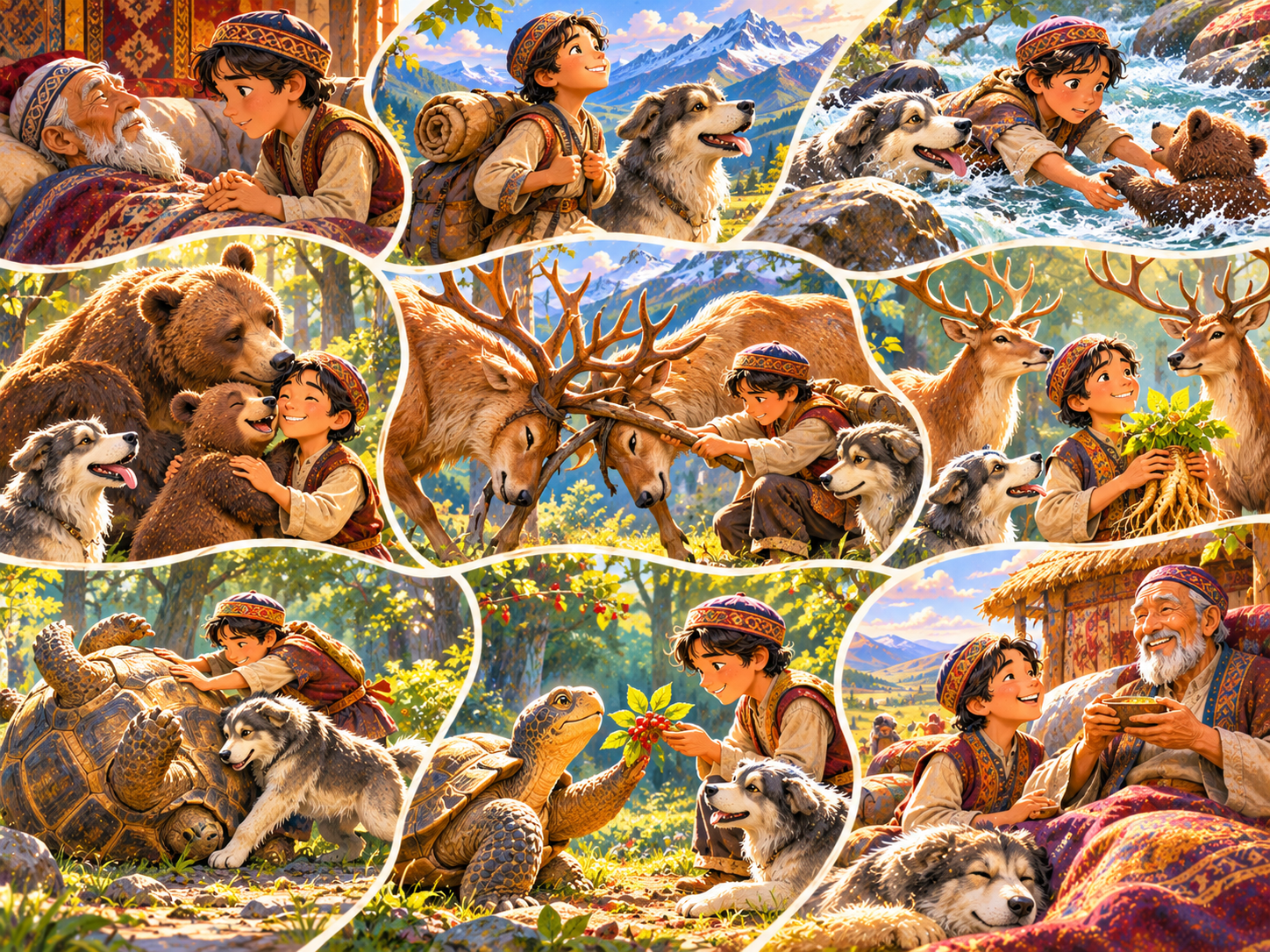
Long ago, in a village, there lived a boy named Esirkegen. He was kind and compassionate. If someone was in trouble, he was the first to rush to their aid, and he took the sorrow of others to heart.
Next door lived an old man named Khasen. One day, the old man fell gravely ill. He grew worse day by day. He almost stopped eating and couldn't get out of bed.
All the villagers worried about him, but Esirkegen was especially worried.
"If only I could find a miracle herb that would heal our grandfather Khasen!" the boy dreamed.
One day, he was sitting in the shade of a house, thinking about this out loud.
Suddenly, someone said:
"Instead of wasting my time on idle dreams, I'd better go to the mountains and search!"
Esirkegen looked around in surprise.
There was no one around. Only at his feet lay a large, bluish-gray dog, Kokzhal, who belonged to Grandfather Khasen.
"Don't look for it, I'm talking to you!" said the dog. "If you decide to go for the healing herb, take me with you."
The boy couldn't believe his eyes. However, there was no time to be surprised: he had a new hope of helping the sick old man.
The next day, Yesirkegen and Kokzhal quietly left the village and headed for the distant mountains.
They walked for a long time. Finally, they reached a turbulent river, rushing noisily down a rocky gorge.
The tired travelers stopped on the bank. Yesirkegen took some dried bread and kurt from his travel bag, shared the provisions with his faithful friend, and rested a little.
"Now try casting a line," suggested Kokzhal. "They say a wonderful fish, the khanbalik, lives in this river." The boy cast his line and watched the float.
Suddenly, he noticed a small creature being carried along by the swift current.
"Kokzhal! Come here quickly!" Yesirkegen shouted.
The dog dived into the water, overcame the current, grabbed the creature by the ear with his teeth, and with difficulty pulled it ashore.
The boy ran closer and gasped.
"Why, it's a bear cub!"
The cub lay motionless. Yesirkegen gently touched it and felt its body still warm. Its heart was beating faintly.
"It must have swallowed too much water and lost consciousness," the boy said.
He began to help the cub.
When it finally came to, Yesirkegen treated it to dried bread and kurt.
The cub explained that it had been swimming with its mother but had accidentally gotten caught in a strong current. The water had carried it far from shore. Before he could finish his story, a menacing roar was heard from the forest.
A huge she-bear emerged onto the shore, followed by another cub.
Seeing the humans near her cub, the she-bear grew furious.
"You scoundrels!" she growled. "Are you trying to eat my baby?!"
She was about to pounce on Yesirkegen and Kokzhal, but the rescued cub hurried toward her.
"No, Mom! Don't touch them! They saved me!"
The cub told its mother how the river carried it away and how the boy and the dog pulled it out.
The she-bear immediately calmed down.
"Forgive me, my dear friends. I was very afraid for my cub. How can I repay you?"
Yesirkegen told her about the sick old man Khasen and asked her to help find a healing herb.
The she-bear paused. "I don't know of a plant that instantly cures any illness. But there is one special herb. Every fall, I eat it before hibernation and sleep until spring. They say this herb slows the heart and keeps the body strong for a long time. Perhaps it will help your old man."
The bear brought the herb and handed it to the boy.
Yesirkegen thanked her, carefully wrapped the gift, and put it in his bag.
After that, the friends continued on their way.
They climbed higher and higher into the mountains. Cliffs towered all around, and thick pine trees grew on the steep slopes.
Suddenly, Kokzhal became alert.
He pricked up his ears, listened, and rushed into the dark thicket.
Yesirkegen hurried after him.
The deeper they went into the forest, the more distinct their heavy breathing became.
Finally, the travelers saw two deer. Their enormous, branched antlers were so tightly intertwined that the animals couldn't separate.
One deer cried out plaintively, "Help us, good man! We argued, got angry, and started butting. Our antlers became entangled, and now we can't free ourselves. We're completely exhausted. A little more and we'll die of hunger."
Yesirkegen examined the antlers carefully.
Then he cut a sturdy pine branch, peeled it, and carefully slid it between the intertwined branches.
He turned the branch one way, then the other—and the antlers separated.
The deer joyfully jumped to their feet.
"Thank you, good man!" said one of them, whose name was Kerbugy. "How can we repay you? In a few days, our antlers will fall off on their own. People value them highly. Take them if you wish."
But Yesirkegen shook his head. "I don't need your horns. An old man in our village is seriously ill. He can't eat at all. I'm looking for medicine that could help him recover."
The deer exchanged glances.
"We know of a certain plant," said Kerbugy. "It's called golden root. It gives strength and helps a person regain his health."
The deer set off to search for the golden root and soon brought the boy three medicinal plants.
Thanking their new friends, Yesirkegen and Kokzhal continued their journey.
Soon, the dog ran ahead and stopped near a large rock.
"Yesirkegen, come here!" he called.
The boy approached and saw that it wasn't a rock at all, but a huge turtle, rolled over on its back.
It wiggled its paws helplessly, but couldn't get up.
Yesirkegen carefully turned the turtle over and set it down.
"Thank you, my dear!" the turtle said. "I was crawling along the cliff, lost my footing, and slid down. If it weren't for you, I would have died here. How can I repay you?"
"We don't ask for anything for ourselves," the boy replied. "Just help me find medicine for our sick grandfather."
The turtle paused.
"I've lived for a hundred and fifty years, but I've never seen such a healing herb. But I have another amazing plant."
She pulled out a small stalk with tiny yellow flowers.
"This herb awakens kindness in animals toward humans. Take it. Perhaps one of the animals or birds will tell you where to find the medicine you need."
The boy thanked the turtle and carefully hid the plant.
He and Kokzhal set off again.
The road was becoming increasingly difficult. The friends climbed steep rocky slopes, skirted deep crevices, and picked their way between enormous boulders.
Suddenly, a loud voice rang out above them:
"Hey, human! Why are you walking in the mountains without a weapon? Is this how you hunt?"
Yesirkegen raised his head.
On a huge rocky outcrop stood a mighty mountain argali. Its large, curved horns towered majestically above its head.
"We're not hunting at all," the boy replied. "We're looking for medicine for a sick neighbor."
The argali looked at him intently.
"So you've come here for a good cause. Then listen carefully."
He pointed to a distant peak, covered in eternal snow.
"Do you see the highest mountain?"
"I see it."
"A small, colorful-winged bird lives there. It builds a nest among the steep cliffs, where neither beast nor man can reach." Her egg can heal your sick old man. But there's one condition: the bird must give it of its own free will. Only then will it retain its healing power.
Yesirkegen thanked the argali and set off for the distant peak.
The climb proved very difficult.
By the time the boy and the dog reached the middle of the snowy slope, their strength was almost exhausted.
They stopped to rest.
Suddenly, small, colorful wings flickered above them.
It was the very bird the argali had spoken of.
It perched on a rock and spoke:
"I know you're seeking a cure for the sake of another. Your deed is a good one. But it's already autumn, and I only lay eggs in the spring. Only two eggs a year. Soon my chicks will leave the nest, and there will be no new eggs until next spring."
The boy looked sad.
The bird continued:
"Don't despair. Come back early in the spring." For such a kind man, I will try to lay another egg.
Yesirkegen gratefully accepted her promise.
Having said goodbye to the bird, he and Kokzhal set off for home.
Returning to the village, the boy began to help old Khasen.
Every day, he added a little of the golden root given to him by the deer to his soup and tea.
Gradually, the old man felt a little better. He still couldn't get out of bed, but his strength began to return.
One day, Yesirkegen remembered the herb the bear had given him.
He added it to his boiling tea.
The old man drank the tea and soon fell into a long, deep sleep.
Time passed.
Finally, early spring arrived.
Yesirkegen called Kokzhal again, packed his travel bag, and set off for the mountains.
Along the way, they passed a river and suddenly noticed that a lone pine tree on the bank was engulfed in flames. Bees circled anxiously around the tree.
Without thinking, Esirkegen rushed to put out the fire.
When the flames died down, he saw a bee's nest in the hollow of the pine tree. Last year's honeycombs, still covered in wax, were still inside.
The bees gathered around their savior.
"Thank you, kind man!" they buzzed. "You saved our home and us. Take this wax as a gift. If you coat something with it, it will last a long time."
The bees wrapped the wax in a leaf and gave it to the boy.
Esirkegen thanked them and continued on his way.
After some time, the boy and Kokzhal again reached the high, snowy peak.
The colorful bird was already waiting for them.
It flew out to greet them and carefully laid a small egg on the snow.
"Here is my gift," the bird said. "But remember: if the egg is left in a warm place, it will quickly spoil and lose its healing power. How will you carry it home?"
Yesirkegen remembered the bees' gift.
"We'll cover the egg in wax!" he replied joyfully. "Then it will survive the journey."
The boy carefully wrapped the egg in beeswax, tucked it into his bag, and hurried back to the village with Kokzhal.
Upon reaching home, Yesirkegen went straight to old Khasen.
He had just woken up from a long sleep. He was sitting up in bed, coughing slightly. The family didn't even notice that the sick man had finally opened his eyes.
Seeing the boy, the old man asked in a weak voice:
"Dear Yesirkegen, I'm so thirsty! Please bring me a cup of water." The boy approached the samovar, poured water, and, turning away, carefully mixed it with the contents of the miraculous egg.
Then he handed the cup to the sick man.
The old man drank the water.
From that day on, he felt noticeably better.
Gradually, his strength returned, his appetite returned, and his weakness disappeared. And a few days later, Khasen had completely recovered.
All the villagers were overjoyed.
A grand celebration was held in honor of the old man's recovery. Relatives, neighbors, and friends gathered.
In front of all the guests, Khasen told an amazing story about how a little boy set out on a dangerous journey to save a sick man.
He spoke of bears, deer, turtles, argali, bees, and a small, spotted-winged bird.
And everyone who listened to his story understood: Yesirkegen was able to receive help from nature because he himself never refused to help others.
Thus, the boy's good reputation spread far beyond the village. And the story of his journey became a fairy tale, passed down from generation to generation.
After all, good deeds done from the heart never go to waste.