Swallow Saint
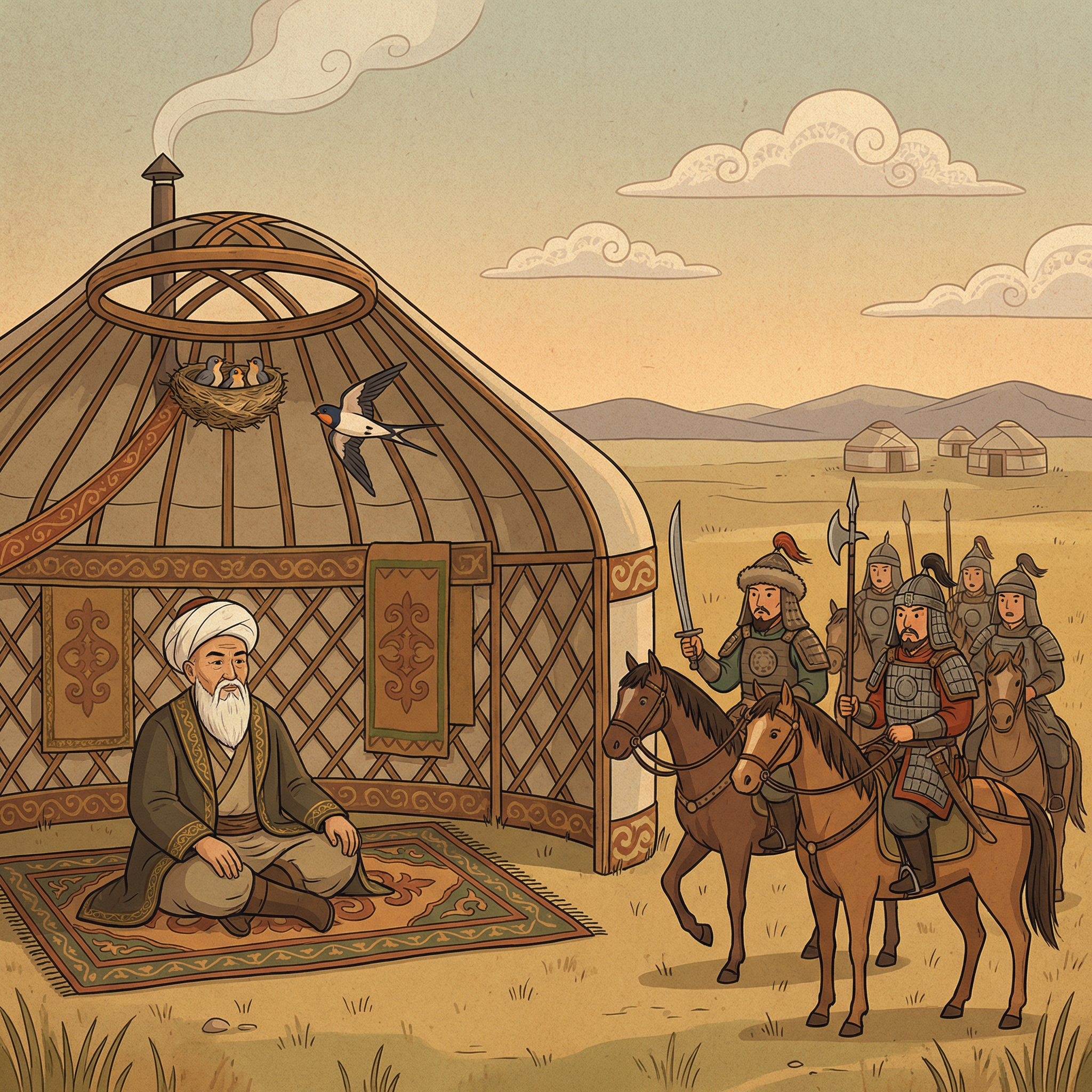
During difficult times for the people, during an era of enemy invasions, the Kazakh steppe endured many trials. During one of these harsh periods, the chief bi of the Elder Zhuz, the wise orator Tole bi, sought a way to protect his people and relied on patience and reason.
When the Dzungar invasion intensified, people began to flee their homes to escape danger. However, Tole bi, unlike the others, did not migrate with the rest and did not dismantle his yurt, remaining in place. Soon, the Dzungar army entered the village. They found the village deserted, with only a single house standing in the middle, smoke rising from its chimney. Seeing this, the Dzungar kontaishi was surprised and, wanting to know who this man was who had not been afraid to stay behind when the rest of the people had left, sent his men to him. The warriors burst into the house and asked Tole bi why he had not left with the rest. Then the bey began speaking calmly:
"This year, a swallow built a nest under my shanyrak. She was incubating her eggs and had already hatched her chicks. The swallow is a bird that does no harm to humans; on the contrary, it is considered a sign of goodness. It is said that she protected the ark of the Prophet Nuh when the flood engulfed the world, and she also protected humans from a snake. I decided not to dismantle my house until her chicks had fledged. I didn't want to destroy the nest and make the chicks squeal pitifully just because the enemy had come to the very threshold. And if someone were to destroy your homes and make your children cry, would it make you feel any good?"
Tole bi's calm and just words gave the Dzungars pause. Hearing this story, the Dzungar kontaishi is said to have said:
"This is no ordinary man, but a saint." After this, he ordered his troops not to touch either Tole bi's house or the entire village where he remained.
Thus, the wise bey, wanting to protect just one swallow's nest, managed to save an entire village from enemy attack. From then on, they say, the people began calling Tole bi "Karlygash aulie."