Taukudyret
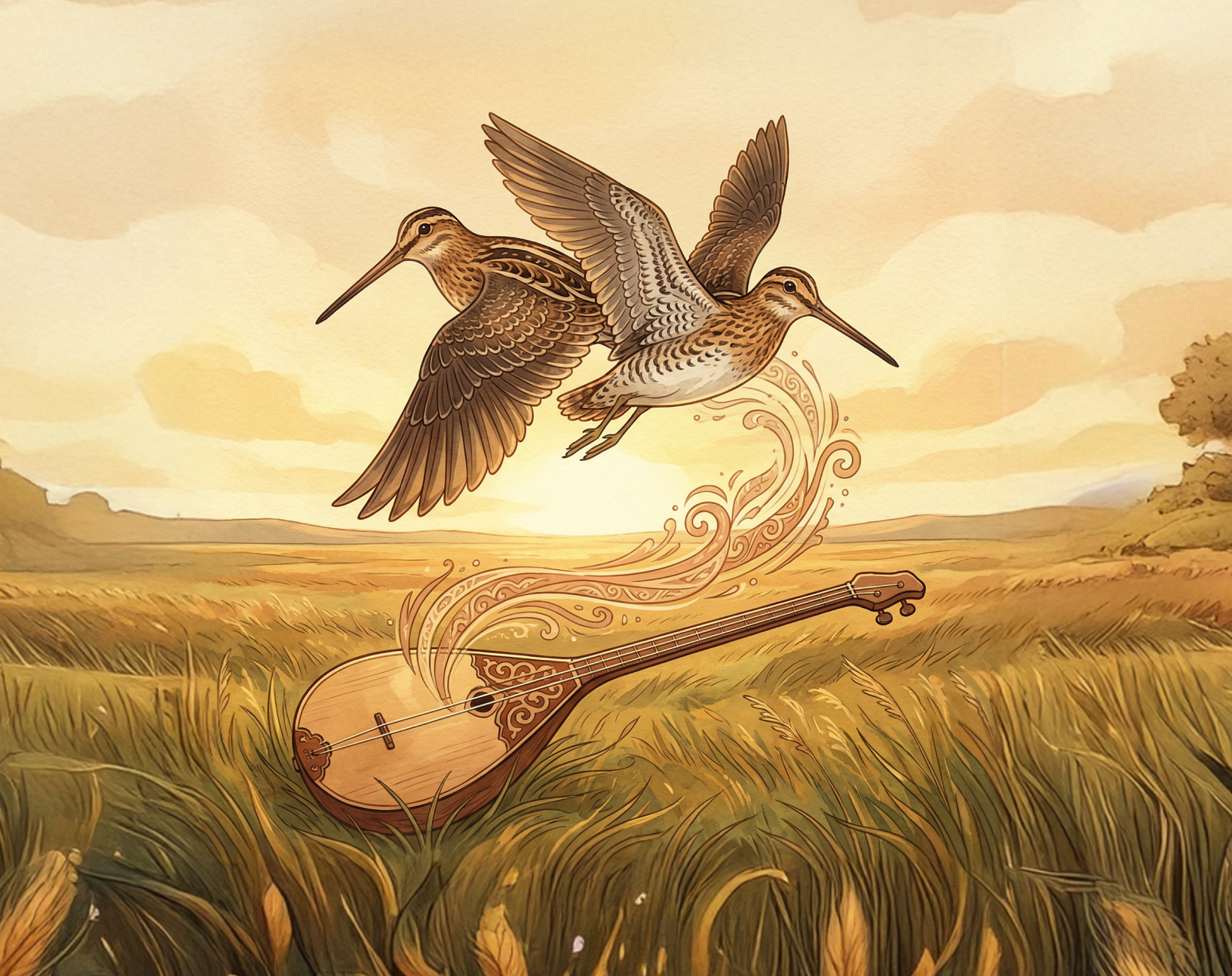
In ancient times, the dombra had only one string, and the taukudiret bird had only one wing. The male taukudiret's single wing grew on the right side, while the female's wing grew on the left.
Even with one string, the dombra could produce sound, but deep down, it seemed to sense something was missing. And the taukudiret poured out its anguish day and night to Tengri, begging for two wings so it could soar freely in the heavenly heights, and endlessly cried out, "Kudiret-au, kudiret."
And then one day, the male taukudiret thought.
"Instead of grieving endlessly, let's try to fly," he said to the female. Then, clinging to each other, they flapped their wings in unison. At that very moment, their bodies lifted off the ground, and the birds soared into the sky. The ground remained far below, and the two birds glided freely through the air. The wind caught their wings and carried them even higher. Their hearts fluttered with joy, and both taukudiret cried out gratefully, "Kudiret-au, kudiret! And for this, praise be to you!"
From then on, they say, Tengri began to grant the taukudiret chicks two wings.
Hearing this, the dombra player fell into deep thought.
"If the bird took flight when two wings joined, what would happen if the dombra also had two strings?" he thought. And so he decided to string a second string on the dombra. When he touched the two-stringed dombra with his fingers, a wondrous sound flowed forth, the likes of which no one had ever heard before. The dombra player's joy knew no bounds. And at that very moment, he dedicated his first kui to the taukudiret bird. In this melody, he spoke of her former melancholy, and of how she called out to Tengri: "Kudiret-au, kudiret," and of the joy with which the two birds, leaning on each other, rose into the sky.
And indeed, when you listen to this kui, in some places it seems as if the dombra itself is repeating: "Kudiret-au, kudiret..."