The technology of making a Kazakh sabre
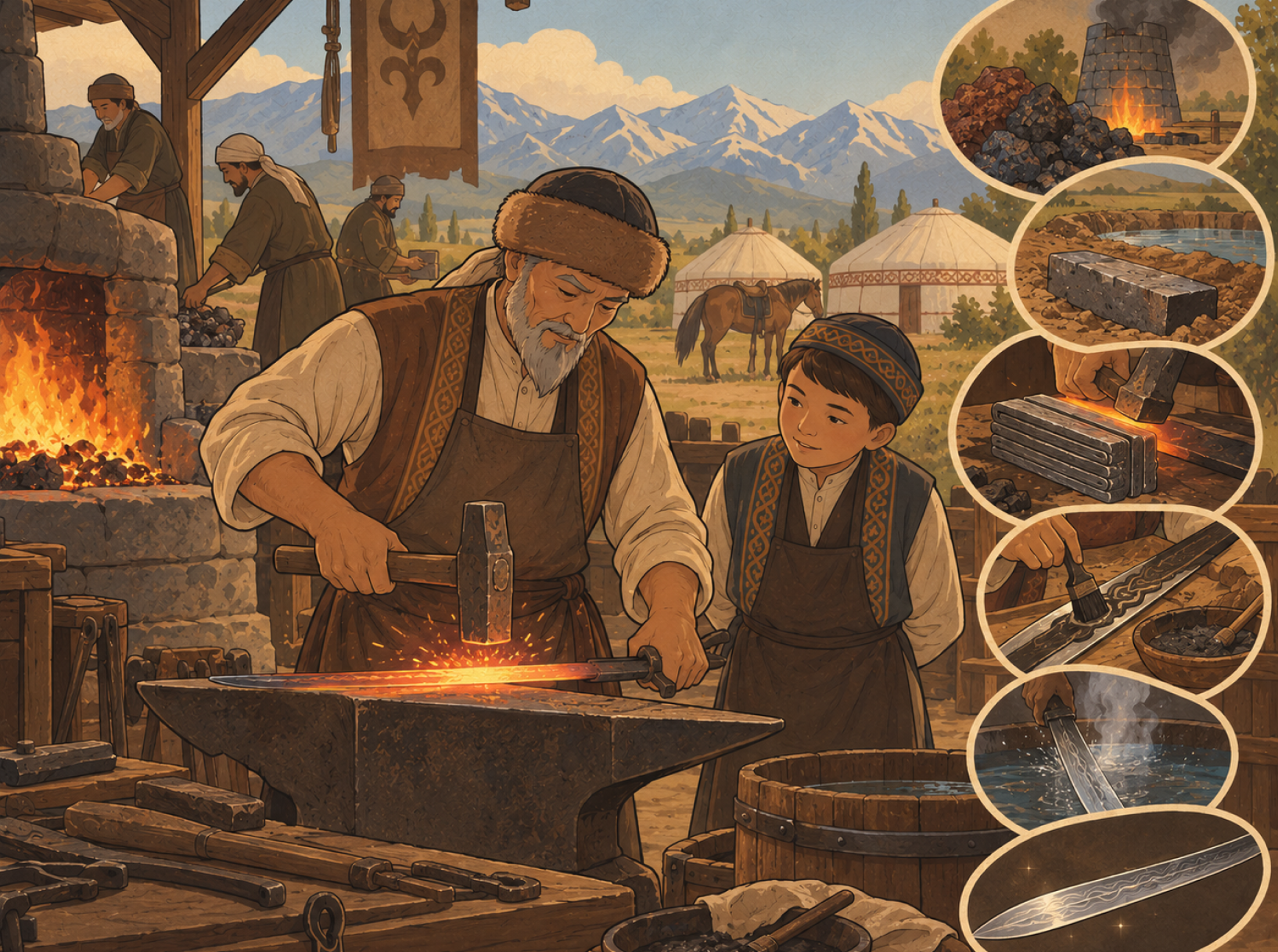
Making a sabre was a complex and time-consuming process for Kazakh blacksmiths. According to the writer Talasbek Asemkulov, a craftsman had to do more than simply produce high-quality metal: he also had to achieve a special combination of hardness and flexibility in the blade.
First, iron ore was mixed with charcoal and smelted in a special furnace about two meters high. The resulting metal contained many impurities. It was poured into clay molds, producing elongated billets.
The next stage was an unusual purification process. The iron was buried in moist, saline soil for several years. After six or seven years, and sometimes as many as ten, it was dug up, broken into pieces, and carefully processed. The resulting oxide was ground in a stone mill, washed and boiled several times, and then the metal was smelted again.
To make the blade strong yet resilient, the billet was repeatedly heated, folded, and forged. With each folding, the number of metal layers doubled. For example, after twelve such operations, their number reached 4,096. This multilayer structure gave the weapon additional strength.
Heat treatment was equally important. Before hardening, certain sections of the blade were covered with a special protective mixture. This prevented the metal from heating evenly: after being immersed in the quenching liquid, the exposed areas became harder, while the protected areas retained greater flexibility.
According to Asemkulov's description, this procedure could be repeated 16–17 times, with the pattern of the applied mixture changed each time. As a result, a distinctive pattern formed on the surface of the blade, while the metal itself acquired a heterogeneous structure.
The blacksmith's main task was to achieve a balance. The cutting edge had to remain hard and retain its sharpness, while the main body of the blade had to remain flexible and withstand impact loads. A fully hardened sabre could become too brittle and break.
Thus, the quality of the weapon depended not only on the shape of the blade, but above all on the complex processing of the metal, which required the craftsman to have many years of experience and a precise understanding of the material's properties.