312 new cultural sites: how Kazakhstan's cultural sphere has changed in seven years
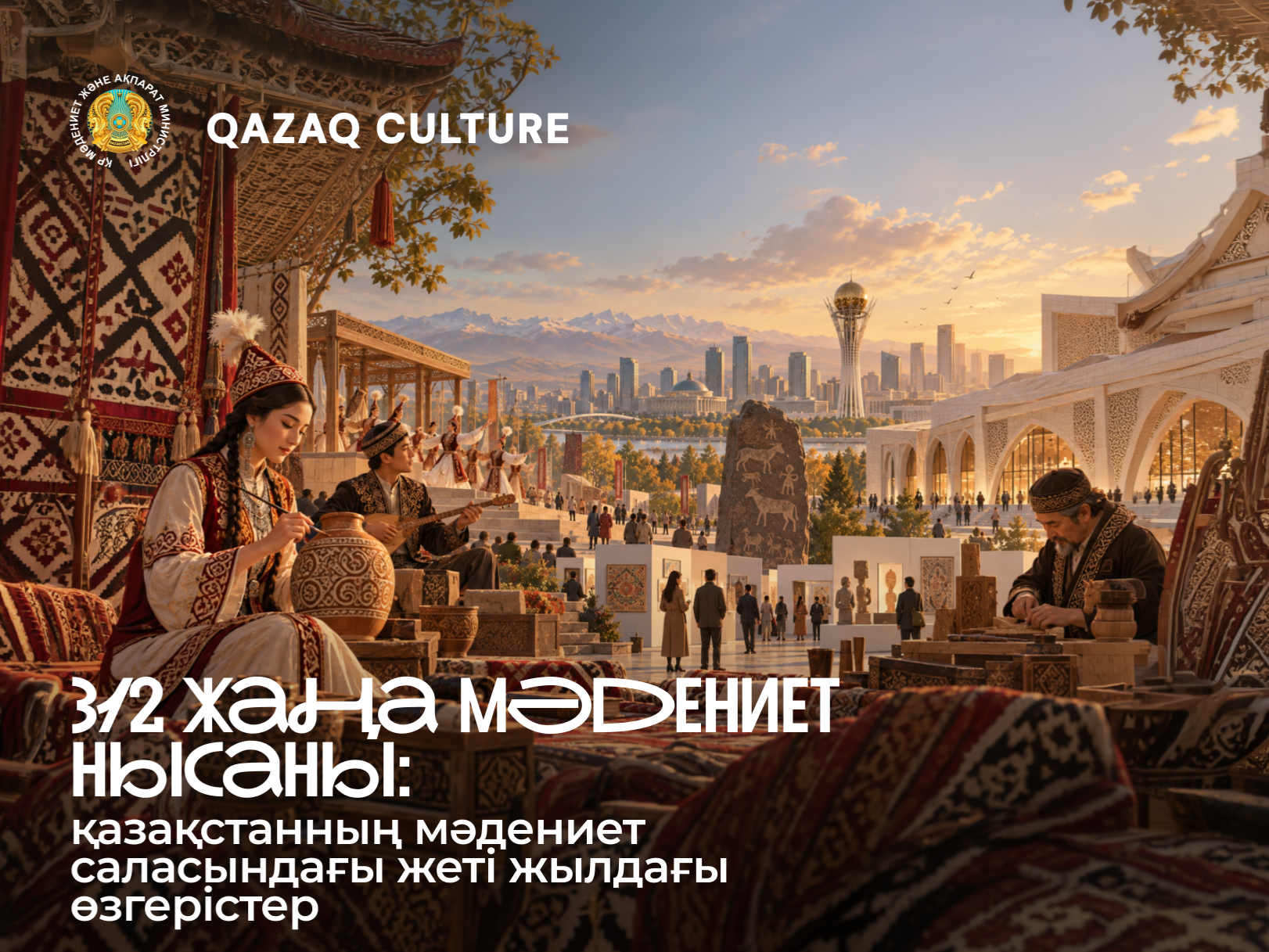
Over the past seven years, at the initiative of President Kassym-Jomart Tokayev, Kazakhstan has implemented a range of measures aimed at developing the cultural sector, preserving national heritage, supporting domestic art, and modernizing cultural infrastructure.
During this period, 312 new cultural facilities were built across the country, including theaters, museums, libraries, and community centers. Along with the construction of new institutions, existing facilities were renovated, their facilities were updated, and the availability of cultural services in the regions was expanded.
Particular attention was paid to the development of the library network and creative education. A roadmap for modernizing libraries through 2027 is being implemented, and the facilities of regional community centers are being strengthened. Construction of a 500-bed dormitory for students of creative arts institutions has begun in Almaty, a representative office of the Kazakh National University of Arts has opened in Petropavlovsk, and work is underway to establish a University of Culture and Art in Shymkent.
Theatrical Arts Development
Theatrical development has become a key focus. Over the past seven years, five new state theaters have been established in Astana, Atyrau, Kyzylorda, and Shymkent. The Kalibek Kuanyshbayev Theater in Astana, the Sabit Mukanov Theater in Petropavlovsk, and the Turkestan Musical and Drama Theater have received new buildings.
Construction of theaters in Aktobe and Konayev continues, and projects are being developed in Shymkent, Kyzylorda, and Semey. The Mukhtar Auezov and Natalia Sats Theaters are also undergoing reconstruction.
The status of leading cultural organizations has also been enhanced. Over the past six years, 10 national institutions have received "National" status, and 10 national and regional organizations have received "Academic" status. A significant decision was the establishment of the honorary title "Kazakhstannyn khalyk ärtіsі" (Kazakhstan's People's Artist) after almost three decades.
Along with the development of infrastructure, the national repertoire has expanded. The ballets "Kozy Korpesh - Bayan Sulu," "Altyn Gul," and "Akbala," the historical drama "Zhoshy Khan," and the opera "Appak. Kypchak Daughter" premiered at national theaters. The "Gulder" ensemble was also revived, and the State Classical Guitar Quintet and the multinational ensemble "Birlik" were created.
Modernization of Museums and Preservation of Cultural Heritage
Significant changes have occurred in the museum sector.
Over the past seven years, the number of museums in the country has increased by 36 (from 250 to 286), and the number of collections has increased by 68,669 units. Construction has been completed and five visitor centers have been opened. These are the "Tañbaly" visitor centers in the Almaty region, "Otyrar" and "Ordabasy" in the Turkestan region, "Ulytau" in the Ulytau region, and "Saraishyk" in the Atyrau region.
New visitor centers are being developed, including "Sauran" and "Gaukhar-Ana" in the Turkestan region and "Esik" in the Almaty region.
"Altyn Orda" halls have opened in two museums, as well as a Paleontology hall and a Crafts Center.
One of the major projects was the open-air archaeological park "Bozok." A major renovation was completed at the Abylkhan Kasteyev State Museum of Arts.
A significant achievement was the digitalization of museum collections. In 2025, the E-museum platform was launched, bringing together information on 284 museums across the country. The digital catalog included over 66,000 museum items, 750 3D models, and 15 virtual tours.
At the same time, international museum cooperation expanded. Kazakhstani collections were presented at exhibition venues in Russia, Italy, France, China, and Azerbaijan. In 2025, works from the A. Kasteyev National Museum of Art were exhibited at the Tretyakov Gallery, while national projects were showcased at the Venice Biennale and the Guimet Museum of Asian Arts in Paris. In 2026, the International Kazakhstan Museum Congress – the Museology Forum "Kazakhstan – France 2026" – was held.
Mechanisms for protecting historical and cultural heritage and regulating archaeological activities were also improved. Turkestan's special status as the country's spiritual, historical, cultural, and tourist center has been enshrined at the legislative level. Regulatory mechanisms for archaeological activities and licensing in the field of historical and cultural heritage have been improved.
Development of Domestic Cinematography
Significant results have been achieved in the film industry over the past seven years. From 2019 to 2025, 150 film projects were implemented with state support, 124 of which have been completed. The Law "On Cinematography," adopted in 2019, laid the systematic foundation for the industry's development.
One of the key results has been the growth of domestic film distribution. While 94 Kazakhstani films were released in 2024, this number has risen to 103 in 2025. The combined box office revenue of domestic films in 2025 amounted to approximately 30 billion tenge.
The international standing of national cinema has also strengthened. The films "Akyn," "Scheme," and "Ademoki's Training" received awards at international film festivals in Tokyo, Berlin, and Warsaw. In 2024 alone, seven national films won 34 international awards, and "Bayryna Salu" was Kazakhstan's nominee for an Oscar.
According to the World Intellectual Property Organization's Global Innovation Index 2024, Kazakhstan rose from 61st to 31st place in the "National Feature Films" category, joining the top three in Asia.
The geography of Kazakhstan's film promotion has also expanded. Days of Kazakh Cinema were held in more than 30 countries. At the same time, Kazakhstan is developing cooperation with foreign filmmakers, focusing on national animation and expanding Kazakh-language content.
International Cooperation and Promotion of National Culture
Over the past seven years, Kazakhstan has significantly expanded its cultural presence on the global stage. Domestic art was presented at international festivals, exhibitions, and competitions, and Culture Days became a key tool of cultural diplomacy.
Over the past seven years, Kazakhstan Culture Days have been held in 15 countries.
In 2023 alone, Kazakhstan Culture Days were held in Uzbekistan and Azerbaijan. Events commemorating the 800th anniversary of Sultan Baybars were held in Cairo, including the opening of the Sultan az-Zahir Baybars Mosque. In subsequent years, cultural exchanges continued with Turkmenistan and other countries.
In 2025, the Kazakhstan Cultural Center opened in Beijing, becoming a permanent platform for promoting national art and traditions. That same year, Aktau was designated the Cultural Capital of the Turkic World.
Cooperation with UNESCO occupies a special place. According to industry documents, Kazakhstan is represented on the World Heritage List in four nominations, encompassing 15 historical and cultural monuments. Among them are the Khoja Akhmed Yasawi Mausoleum and the Tamgaly petroglyphs. The materials also note the inscription of the rock mosques of the Mangystau Peninsula in 2026.
Fourteen elements of Kazakh culture have been inscribed on the UNESCO Representative List of Intangible Cultural Heritage, including the art of performing the kuy on the dombra, yurt-making traditions, aitys, and the Betashar ritual. In 2026, the UNESCO Comprehensive Plan for the Promotion of Cultural Heritage for 2026–2028 was approved.
The anniversaries of prominent Kazakh cultural figures have also received international recognition. The UNESCO Calendar of Anniversaries includes events dedicated to Roza Baglanova, Berdibek Sokpakbayev, Nurgisa Tlendiyev, Abdolla Karsakbayev, and Yermek Serkebayev.
Meanwhile, Kazakh performers have won prestigious awards at international competitions in Europe and Asia. Notable achievements include Dimash Kudaibergen's performance at Madison Square Garden in New York, Daneliya Tuleshova's participation in the final of America's Got Talent, and Karakat Bashanova's second-place finish at the Junior Eurovision Song Contest 2020.
Ruslan Talas won first prize at the WorldVision International Competition in Vienna, and in 2024, he took second place at the 2nd Guadagnini Foundation International Violin Competition in Stuttgart. Alim Beisembayev won the Franz Liszt International Youth Competition in Weimar and the Manchester International Piano Competition, won the 1st Van Cliburn International Young Pianists' Competition, and in 2021, he won the Waterman Gold Medal at the 20th Leeds International Piano Competition. In 2024, Sagadat Omargazin won the 19th Beethoven International Violin Competition in Austria. Zhandos Sauyt and the Scythians trio won the 79th Coupe Mondiale International Accordion Competition.
Over the past seven years, Kazakhstan has undertaken extensive work to develop cultural infrastructure, support domestic art, and preserve national heritage. These measures have expanded public access to culture and strengthened the position of Kazakhstani art on the international stage.