A New Time Library: How Reading Culture is Changing in Kazakhstan
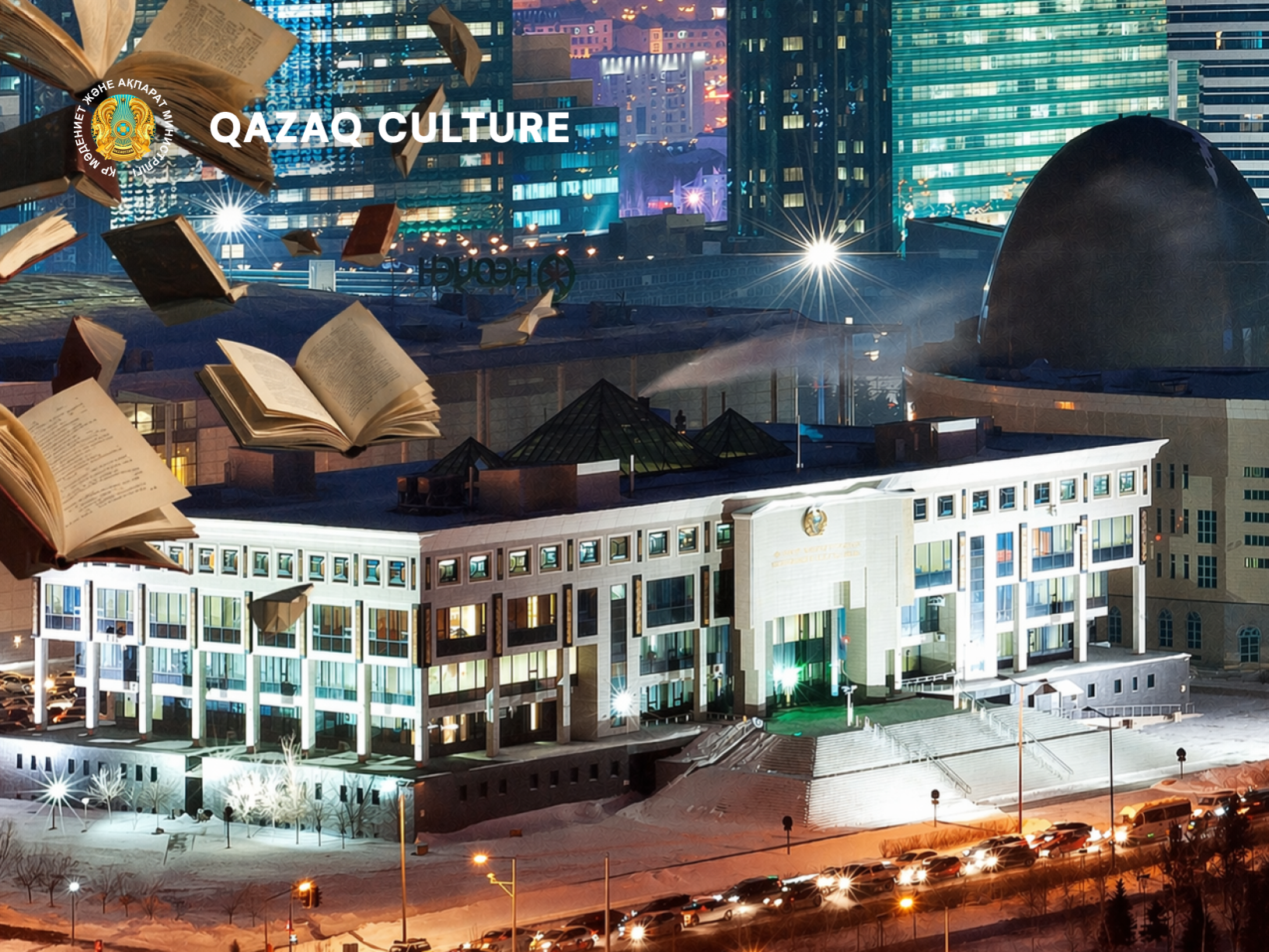
April 23rd marks National Book Day and Librarian's Day in Kazakhstan. This year, the dates take on special significance: for the first time, the two events are combined at the state level, highlighting not only the symbolic role of books but also the practical importance of libraries in the country's contemporary cultural and educational life.
Today, libraries are no longer perceived simply as a place where books are stored. They are becoming an open public space where different generations meet, digital services are available, lectures, clubs, creative activities, reading marathons, and educational projects are held. Amidst the rapid development of technology, libraries help maintain an interest in reading, make knowledge more accessible, and connect traditional book culture with new formats.
Qazaq Culture spoke with Kumis Seitova, Director of the National Academic Library of the Republic of Kazakhstan, about how Kazakhstan's library system is changing, who is visiting libraries today, what conditions are being created for librarians, and what the future holds for this field.
– April 23rd marks National Book Day and Librarian's Day in Kazakhstan. Why is this date important for the cultural sector?
The significance of this date extends far beyond a professional holiday. Books and libraries have always been part of society's cultural memory, but today they are acquiring new practical significance. The library is becoming more than just a repository for collections, but a modern cultural and educational platform where people can read, study, work with digital resources, communicate, and develop.
In 2026, National Book Day and Librarian's Day will be combined for the first time and celebrated on April 23 at the national level. This is an important change, as it allows us to consider books, reading, librarianship, and the work of librarians as a unified system. More than 1,500 events are planned across the country as part of the celebration. These include book weeks, festivals, creative meetings, lectures, master classes, competitions, reading marathons, and the continuation of national projects, including "Bir El – Bir Kitap."
The main goal of such initiatives is to bring reading closer to people, especially children and young people, and to demonstrate that the library remains a vibrant and in-demand space. What conditions are currently being created for library and book industry staff? Are there any changes in salaries?
Kazakhstan is consistently implementing measures to modernize its library system. This includes not only renovating buildings or updating collections, but also elevating the status of the librarian profession. Today, approximately 10,000 librarians work in the country's public libraries. These specialists act as conduits between readers, books, digital resources, and the educational environment.
Particular attention is paid to salaries. From 2022 to 2025, librarian salaries were indexed, increasing by 100%. Salaries depend on education, length of service, position, library status, and additional factors, including work in rural areas, environmental disaster zones, or radiation risk zones.
It is also worth noting that the National Library of the Republic of Kazakhstan was awarded "National" status in 2025. This allowed for an additional 75% increase in salaries for its employees. Such decisions are important because library development is impossible without the support of the people who work with readers every day. How many libraries are there in Kazakhstan today, and how are their attendance rates changing? Is there a growing interest in reading?
As of January 1, 2026, there are over 12,000 libraries in Kazakhstan, representing various systems and departments. Of these, approximately 4,000 are public libraries within the cultural system. This is a large network that covers cities, districts, and rural communities.
In recent years, we have seen positive attendance trends. In 2025, the number of visits to public libraries exceeded 57 million. This is 2 million more than in 2024. At the same time, book loans also increased by over 3.2 million units. These data demonstrate that libraries are becoming more popular.
The National Academic Library is a telling example. In 2010, its readership was 20,500, and the number of visits was 288,100. By the end of 2025, 57,000 readers and 1.4 million visits, including remote users, were registered.
This indicates that interest in reading is persistent and growing. Readers are turning to classical literature, fiction, Kazakh classics, educational and scientific publications, as well as books on psychology, philosophy, IT, and other contemporary fields.
– Who are the main library users today? Is the audience profile changing?
– The reader profile is indeed changing. Young people are the most active today, accounting for up to 51 percent of all library users. These are schoolchildren, students, and young adults aged approximately 17 to 25. For them, the library often becomes not only a place for reading but also a space for study, self-development, socializing, and participating in projects.
At the same time, the number of readers over 45 is growing. These are primarily teachers, researchers, scientists, specialists in various fields, and government employees. They account for approximately 41 percent of the total number of users. This structure demonstrates that libraries remain relevant to different generations.
Today, readers increasingly choose a hybrid format. They value both paper books and access to electronic resources, databases, digital catalogs, and educational events. Therefore, libraries are adapting to these new needs. Over the past two years, more than 70 public regional libraries have undergone complete modernization and are becoming multifunctional coworking centers.
– What modern formats are being implemented in libraries to attract new audiences?
– One of the key areas has been the development of multifunctional spaces and interactive formats. Libraries strive to create a comfortable and informal environment where people want not only to borrow a book but also to stay, work, socialize, and participate in a cultural or educational program.
There are already interesting examples in the regions. In the Karaganda region, the Kids coworking format has been implemented for children and teenagers. In the Pavlodar region, the "I am an Illustrator" project is underway, where children create illustrations for their favorite books. This helps develop creative thinking and an interest in reading. Particular attention is given to theatrical and play formats. Children's shadow theaters engage young readers in the world of literature through performing arts. In the East Kazakhstan Region, the "Reading Houses" social project is being implemented, helping organize cultural and intellectual leisure activities for families in new residential areas.
Outdoor formats are also popular. The "Reading Room on the Grass" event, the "Book for the Road" campaign, and events on trains and river routes are held annually. The TAXYLIBRARY format helps promote the work of local poets and writers and introduce people to local landmarks.
Library hours are also changing. Central libraries in Almaty and Astana are open until 9:00 PM, while in some regions, libraries are open until 10:00 PM or 11:00 PM in the summer. In Almaty, the Zhambyl City Youth Library and the Alatau Creative HUB, a branch of the M. Auezov Library, are open 24 hours a day. In addition, 28 self-service terminals have been installed throughout the city, accessible 24/7.
– How rapidly is digitalization of libraries progressing? What services are already available to users?
– Digitalization of libraries is no longer just a trend, but a necessary stage of development. Moreover, 2026, at the initiative of Head of State Kassym-Jomart Tokayev, has been declared the Year of Digitalization and Artificial Intelligence. For the library sector, this means a transition to new services, process automation, and expanded access to knowledge.
Today, libraries are implementing digital catalogs, e-libraries, remote access to databases, virtual reference services, chatbots, mobile apps, and AI tools. All this creates a fully-fledged library ecosystem, where users can access services not only in the library building but also remotely.
One of the priority projects of the Ministry of Culture and Information is the Kazakhstan National Electronic Library (KAZNEB), which is being implemented within the National Academic Library. It brings together full-text resources of Kazakhstani content and provides access to approximately 85,000 digital documents from anywhere in the world.
Work is also underway to digitize rare and valuable publications. This is important for preserving documentary heritage and expanding access to it. Future development will focus on expanding digital content, integrating libraries into a single system, and improving the convenience of services for users.
– Is it possible to say that modern technologies are not replacing books, but rather helping to renew interest in them?
– Yes, exactly. Modern technologies are not opposed to books; they expand access to them. Today, people can come to the library to pick up a paper edition, use an online catalog, order a document, get an online consultation, or explore a digital copy of a rare book.
This is especially important for the younger generation. They are accustomed to fast services, mobile apps, and interactive environments. If the library speaks to them in a language they understand, uses digital tools, and still preserves the value of live reading, their interest will only grow.
Therefore, the task of a modern library is not simply to preserve its collection, but to make books part of a contemporary intellectual environment. When coworking spaces, lecture halls, clubs, creative labs, and digital services appear alongside the bookshelves, the library becomes a place where people come not out of obligation, but out of interest.
– How do you see the development of libraries in Kazakhstan in the next 5-10 years?
– I believe libraries will continue to evolve under the banner of their transformation from traditional book repositories into multifunctional intellectual centers, or Smart Libraries. These will be spaces that combine digitalization, access to global knowledge, a comfortable public environment, and vibrant cultural communication.
In the coming years, important areas will remain the modernization of infrastructure, expansion of electronic collections, integration of libraries into a unified digital system, development of artificial intelligence in library services, staff training, and the creation of new formats for children, young people, researchers, and the elderly.
But despite all the technological changes, the library's core mission will remain the same. It should help people read, think, learn, develop, and feel connected to their country's culture. In this sense, the library of the future is not an alternative to the book, but a new space for its life.