Kazakhstan expands cooperation with UNESCO in the field of cultural heritage
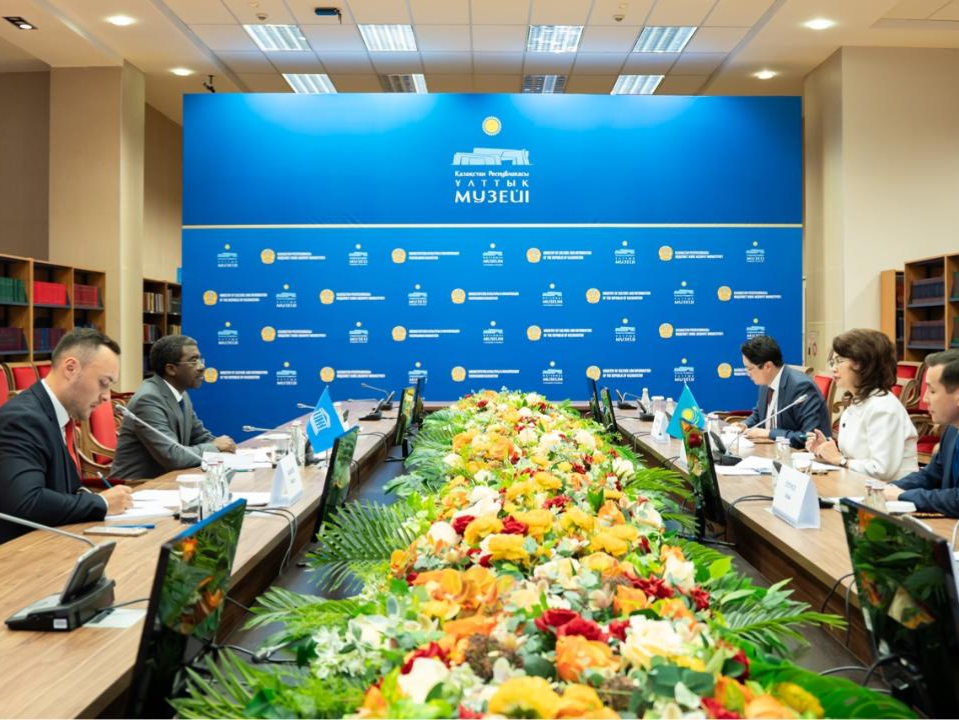
A meeting took place in Astana between Aida Balayeva, Deputy Prime Minister-Minister of Culture and Information of the Republic of Kazakhstan, and Lazare Eloundou Assomo, Acting Assistant Director-General for Culture and Director of the UNESCO World Heritage Centre.
The parties discussed pressing issues of cooperation between Kazakhstan and UNESCO in the field of preserving, studying, and promoting historical and cultural heritage.
Aida Balayeva thanked the UNESCO representative for participating in the international symposium “The Golden Horde as a Model of Steppe Civilization: History, Archaeology, Culture, and Identity,” which is taking place in Astana under the auspices of UNESCO.
During the meeting, it was noted that the Government of Kazakhstan approved a Comprehensive Plan for the preservation and promotion of cultural heritage under the auspices of UNESCO for 2026-2028, which provides for systemic measures to prepare new nominations, develop scientific research and an educational base, introduce modern monitoring technologies, and strengthen international cooperation.
Thus, this year, for the first time among post-Soviet countries, Kazakhstan presented a mixed heritage nomination, combining both cultural and natural components.
“Following the instruction of the President of the Republic of Kazakhstan, the nomination dossier ‘Ustyurt: Cultural Landscapes and Arana Hunting Traps’ was prepared and submitted. This nomination is the result of many years of research and close cooperation between Kazakhstani and international experts in the fields of archaeology, history, ecology, and natural heritage protection,” said the Deputy Prime Minister.
Furthermore, during the 48th session of the World Heritage Committee in Busan, two nominations involving Kazakhstan will be considered: “Mangystau Rock Mosques” and “Silk Roads: Fergana-Syrdarya Corridor,” prepared jointly with Kyrgyzstan, Tajikistan, and Uzbekistan. Their potential inclusion in the World Heritage List will be an important contribution to the preservation of the region’s common cultural heritage and the further development of international cultural cooperation.
In addition, the Ministry of Culture and Information of the Republic of Kazakhstan expressed its readiness to embark on a new stage of work on the development of the transnational nomination “Silk Roads: Caspian-Volga Corridor” jointly with interested states of the region and to act as an active coordinator of this process.
In turn, Lazare Eloundou Assomo noted that productive relations have developed between Kazakhstan and UNESCO on a wide range of issues. Speaking about the initiative to coordinate work on the transnational nomination “Silk Roads: Caspian-Volga Corridor,” he emphasized that Kazakhstan possesses significant potential and can become a program leader among the five participating countries, and the holding of today's symposium serves as confirmation of this.