“Sacred Place”: Where the Land Becomes Memory. An Interview with Kali Koralasbayev
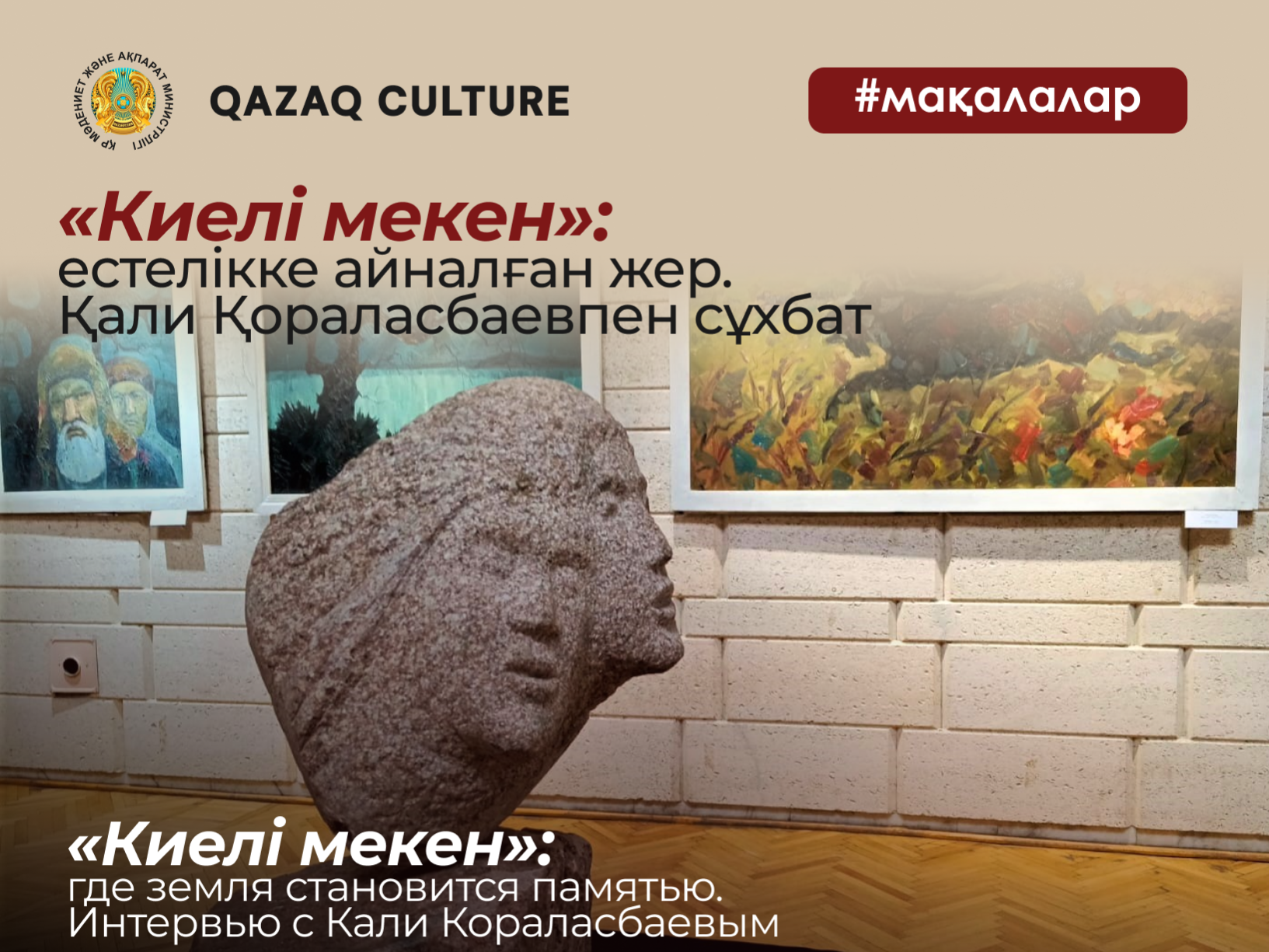
A solo exhibition by Honored Artist of Kazakhstan Kali Koralasbayev titled “Sacred Place (Kieli Meken)” has opened in Almaty. The large-scale project brings together more than thirty years of the artist’s creative exploration. The exhibition features works from different periods: from early canvases of the 1990s, imbued with memories of his native village and the spirit of change of that era, to his most recent painting series, graphic works, wooden compositions, and stone sculptures. Within a single space, viewers encounter not only the evolution of the artist’s style, but also the gradual unfolding of a theme that occupies a central place in his work—the bond between human beings and the land, memory and time, nature and the spiritual world.
Art historians note that Koralasbayev perceives the landscape not as a background or decorative setting, but as a living interlocutor—with its own character, voice, and history. In his works, the Kazakh steppe becomes a metaphor for memory, while ancient burial mounds, tree silhouettes, and river bends are transformed into signs of cultural continuity. This exhibition emphasizes that “Kieli Meken” is not merely a point on a map, but a spiritual territory where the artist’s personal biography intertwines with the collective destiny of the people.
“Kieli Meken” is perceived not only as a summative stage of a long creative journey, but also as an open question posed to society. How well do we understand our land? How carefully do we treat cultural heritage? Are we able to hear the silence in which the stories of those who came before us live?
It is from these reflections that our conversation with the artist begins. In the interview, Kali Koralasbayev shares the philosophy behind the exhibition, his personal understanding of “kieli” as a spiritual foundation, and explains why, for him, the main exhibition hall has always remained the Great Steppe itself.
— The concept of “kieli meken” occupies a central place in your exhibition. What is the source of sacredness for you: the land itself, the memory of ancestors, or an inner sense of connection with your native places?
— For me, sacredness always begins with an inner state. The land on which my ancestors lived is filled with history. Stones, shrubs, boundless horizons—all of this carries the memory of people who left us a spiritual legacy. I travel extensively across the country, and I am particularly impressed by the Turkic complexes and balbal stones in the Shu Valley. They stand under the open sky and already constitute an exhibition in themselves.
I feel a connection with the past and understand that the true exhibition takes place directly in nature. That is why everything I create is, in one way or another, connected with an inner sense of the vast land and its spiritual space.
— In your works, nature appears as an independent protagonist. How do you find an artistic language that conveys the character of the steppe while remaining respectful of its inner world?
— Nature is a part of my heart. In the composition “Kieli Meken,” I depicted an oak tree standing like a living guardian. The river behind it symbolizes the flow of time. In the distance, ancient burial structures can be seen. This shows the connection between different eras and human life.
It is important for me not to embellish nature, but to listen to it. An artist must understand that nature carries meaning. It demands respect and an attentive gaze. Our people have gone through difficult periods, yet preserved strength of spirit, like that oak. The river reminds us that time can also lead to renewal. These images arise naturally when you live within the steppe and feel its breath.
— The exhibition presents works from different periods of your life. When you look today at your canvases from the 1990s, what changes in your worldview do you notice?
— This exhibition has become a moment of summing up for me. In the 1990s, I painted about the pain experienced by small villages. The paintings Abandoned Nests and We Are Waiting convey empty houses and the anticipation of parents who believed their children would return. At that time, this was a reflection of my reality.
Today, much has changed. Auls are beginning to develop. New schools, roads, and jobs are appearing. My own perception has also changed. Where I once saw only hardship, I now feel hope. The aul remains my main source of inspiration. There I feel a living connection to the land and to my own past.
— The aul remains an important theme in your work, even as the country undergoes rapid urbanization. Why do you continue to return to rural space, and what does it reveal to you as an artist?
— I live and work in an aul, and this is a conscious choice. Many say it is easier for an artist to work in the city. Perhaps it is easier to organize exhibitions there, but my theme lives precisely in the village. The aul preserves memory, traditions, and the voice of ancestors. There I feel natural. The village has always been, and remains, the cradle of the Kazakh people. If it is preserved, then the future will also be strong.
— You work with paint, wood, stone, and graphic media. What determines the choice of material, and how does your idea change when it becomes sculpture or painting?
— Each material has its own language. Sometimes a thought requires stone, sometimes wood, sometimes color or the softness of watercolor. I work with what best conveys the inner state. The material becomes a tool that helps express the idea, but does not limit it. The inner thought itself chooses the form.
— Stone sculpture requires particular patience and concentration. How do you experience the passage of time in this work, and what meaning does it acquire for you?
— Working with stone is very demanding. It requires strength, endurance, and responsibility. But I perceive this process as part of a tradition passed down from our ancestors. Balbal stones and other stone figures were created not merely as monuments—they carried spiritual meaning. In stone, time is felt especially deeply. It becomes not an obstacle, but a natural companion. One must know how to listen to the material. If you listen carefully, the stone itself suggests the form.
— Space and artistic silence play an important role in many of your compositions. What does empty space on a canvas mean to you, and how does it work with the inner content?
— The Kazakh soul is connected with vast space. When space shrinks, a person feels pressure. That is why I leave open areas in my works. They create a sense of breathing, calm, and movement along a path. Silence in a painting is a spiritual space in which the viewer can reflect. It recalls the steppe, its tranquility, and its inner light.
— National motifs can easily slip into mere decoration. How do you find a way to speak about culture and historical memory without limiting yourself to external form?
— Ornament and decor alone do not convey the depth of culture. It is important for me to speak about the feelings of the people, their destiny, and their memory. In works devoted to difficult historical periods, I try to show a person’s inner state. In compositions about hospitality, I speak not about tradition, but about purity of soul. The true national code lives within a person.
— Themes of mutual support, nature, and humanity often appear in your works. For whom do you create your paintings, and how important is the viewer’s response to you, especially that of young people?
— I create paintings based on inner experiences. They reflect the time and space in which I live. Some people understand a work immediately; others later. That does not prevent me from continuing. I perceive my paintings as a letter to the future.
Young viewers often come to exhibitions. They ask about the land, traditions, and spiritual searches. Their sincere questions give hope. I see in them a strength that can lead us forward.
— The project “Kieli Meken” is perceived as part of a long creative journey. How do you envision its future, and what would you like viewers to see in your works in twenty or thirty years?
— I would like viewers to see the soul of the people in my works. To feel the inner light that is preserved in every person. “Kieli Meken” remains an endless theme for me. It accompanies me throughout my life. I am confident that this path will continue further.