Код, высеченный во времени – как выставка «Таңбалы: Код предков» превращается в современный культурный разговор
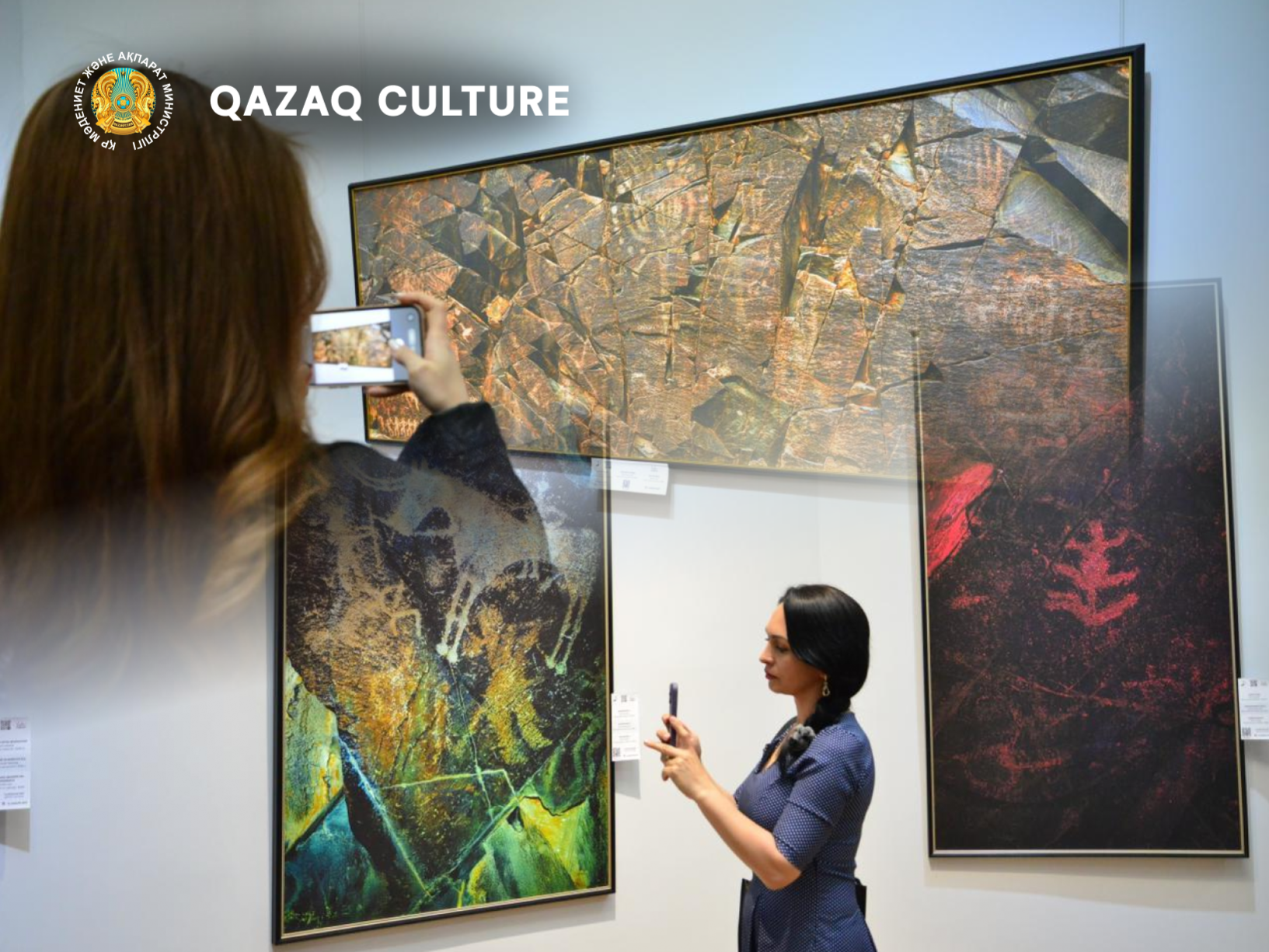
Sometimes, genuine modernity doesn't begin with a new image, but with a new perspective on the ancient. This is precisely the feeling that lingers after experiencing the exhibition "Tanbaly: Code of Ancestors," which opened at the A. Kasteyev State Museum of Arts in Almaty. This project functions not as a typical museum exposition, where the past is neatly placed under glass and accompanied by explanatory text, but as an attempt to restore the ancient images' voice – not a museum voice, not an archaeological one, but a human and living one.
The exhibition, organized by the State Historical and Cultural and Natural Museum-Reserve "Tanbaly" with the support of the Ministry of Culture and Information of the Republic of Kazakhstan, sets a broader scale for the conversation from the very beginning. It's not just about petroglyphs as a unique monument of the past, but also about how cultural heritage can exist in today's visual world without losing its authenticity and without turning into a decorative backdrop. The exhibition combines photographic works, art objects, multimedia solutions, elements of artificial intelligence, 3D holographic projection, and digital navigation, yet its main nerve is connected not with technological effect, but with the idea of a careful approach to the original source.
The very title of the exhibition provides a key to its interpretation. Tanbaly here appears not just as an archaeological landscape, but as a unique code of ancestors – a system of signs in which the ancient person's perceptions of the world, nature, ritual, memory, and cosmos have been preserved. In this sense, the exhibition invites the viewer not so much to look, but to gaze intently. Not so much to receive information, but to gradually enter a space where the image ceases to be silent.
For photo artist Vladislav Kim, the author of the project's exhibition interpretation, this work began not as a pre-calculated artistic strategy, but as an internal experience of encounter. In talking about Tanbaly, he speaks not in the language of external impression, but in the language of almost physical recognition. According to him, for a long time, petroglyphs were not perceived by him as an object of artistic work, until during one trip, what he describes as an internal breakthrough occurred. In Tanbaly, the artist recalls, the image seemed to reveal itself, just as photographic film once did. It was then that the feeling arose that the ancient sign could be seen anew – not as an archaeological detail, but as an independent visual image.
This idea proves central to the entire exhibition. The project has almost no desire to explain antiquity through modernity. On the contrary, contemporary artistic language is needed here to clear the path to the original itself. Kim emphasizes that for him, it is fundamentally important "not to violate the originality of the petroglyph by a single pixel." He does not change the form of the drawing, does not interfere with the lines, and does not complete the image, but works with light, surface, color, and texture of the stone to allow the image to manifest. This is one of the strongest qualities of the project – it does not imitate ancient art, but tries to learn to see it.
Vladislav Kim speaks about this with great precision. For him, the petroglyph is important not as a "static picture," but as an image capable of speaking to the viewer. And perhaps that is why the exhibition creates the impression not of a collection of objects, but of a space for slow dialogue. Much here is built on pause, on attention, on internal contact with the image. The stone, which is usually perceived as a silent surface, begins to function as a carrier of memory.
No less important is the environment from which these works emerge. Shooting in Tanbaly, according to the artist, requires not only technical preparation but also almost physical endurance – wind, cold, lack of water, difficult terrain, the need to wait for the right light for hours, and sometimes to return to the same spot multiple times. But the sun becomes the key co-author in this work. It is the angle of light, its precision, and the brevity of the moment that determine whether the petroglyph will reveal itself or remain hidden in the shadows. Sometimes, Kim says, only one out of a hundred shots remains. This detail is important not only as a story about the difficulties of shooting. It explains the very nature of the exhibition – before us is not a quick visual product, but the result of prolonged close observation and almost ascetic work with the material.
At the same time, the project deliberately exists on the border between ancient material and modern technologies. The exhibition uses multimedia formats and artificial intelligence tools, but an important measure is embedded here too. Kim approaches these solutions with emphasized caution. He acknowledges that digital tools can enhance interest, especially among younger audiences, but warns against the danger of substitution. If the viewer begins to perceive the petroglyph itself as a product of technological processing, the main thing disappears – authenticity. Therefore, AI here plays not the role of an author, but the role of a delicate intermediary, helping to revive the context without rewriting the object itself.
It is at this point that the artistic intonation of the exhibition connects with a broader international framework. In his opening remarks, UNESCO Regional Representative for Culture, Philippe Delanghe, referred to rock art as a "code" and a "language" that conveys ideas about daily life, the environment, shamanic traditions, and belief systems. This formulation aligns remarkably precisely with the internal logic of the exhibition itself. Tanbaly turns out to be not just a place where ancient images have been preserved, but a space where the past is fixed in signs that continue to speak to the present.
Delanghe also reminds us of the scale of the object itself. The archaeological landscape of Tanbaly was inscribed on the UNESCO World Heritage List in 2004 and includes about 5,000 petroglyphs, as well as settlements and burial grounds that collectively bear witness to the life, rituals, and social organization of nomadic communities from the Bronze Age to the early 20th century. But in his speech, historical information is not the only important aspect. Far more significant is another emphasis – World Heritage sites are not merely places of memory, but living spaces of connection, creativity, and transformation, especially meaningful for younger generations. In this sense, the exhibition in Almaty becomes not a secondary accompaniment to the monument, but an important part of its contemporary cultural biography.
The project is also given special expressiveness by its coincidence with broader state and international processes. As the UNESCO representative noted, the exhibition coincided with the approval of the Integrated Plan for the Preservation and Promotion of Cultural Heritage under the auspices of UNESCO and ICESCO for 2026-2028. Among its objectives are improving the quality of protection of World Heritage sites, expanding public participation in their preservation, developing professional training, and using modern approaches to conservation and restoration. Against this background, the exhibition "Tanbaly: Code of Ancestors" is perceived not only as an artistic event but also as part of a broader movement to rethink the role of heritage in public life.
But perhaps the main effect of the exhibition lies elsewhere. It removes the usual distance between "ancient" and "modern." Usually, heritage exists as something important but distant, almost inaccessible in everyday experience. Here, however, it returns to the relevant cultural space – not as an attraction and not as museum stylization, but as a living system of images that are still capable of evoking an internal response. Kim says that viewers often find personal meanings, experiences, and even answers to internal questions in these images. And in this, perhaps, lies the main secret of the project – it does not force one to look at petroglyphs as "obligatory heritage," but allows one to see in them an experience that can still be read.
Therefore, "Tanbaly: Code of Ancestors" is not just an exhibition about the past. It is an exhibition about how the past changes its form of presence in the present. About how authenticity does not necessarily mean immobility. About how cultural memory can be not only an object of preservation but also a form of contemporary artistic conversation. And, perhaps, this is its most important intonation – the ancient stone here is not silent. It continues to speak if a precise language is found for it.