Why is Yasawi's Mausoleum Blue? The Mystery of Turkestan's Celestial Glaze
Two to three tenths of a millimeter. This is roughly the thickness of the blue glaze layer on individual ceramic tiles of the Khoja Ahmed Yasawi Mausoleum. It is this almost weightless layer of material that largely determines the visual appearance of the structure, which has towered over Turkestan for several centuries.
We are accustomed to perceiving the turquoise domes and glazed walls of the mausoleum as an integral part of its architecture. However, behind this familiar color lies a complex technology that required medieval artisans to have a deep understanding of the properties of clay, minerals, glass, and fire. For modern researchers, studying this technology is of more than just historical interest. Understanding the composition of ancient ceramics determines how the monument can be preserved in the future.
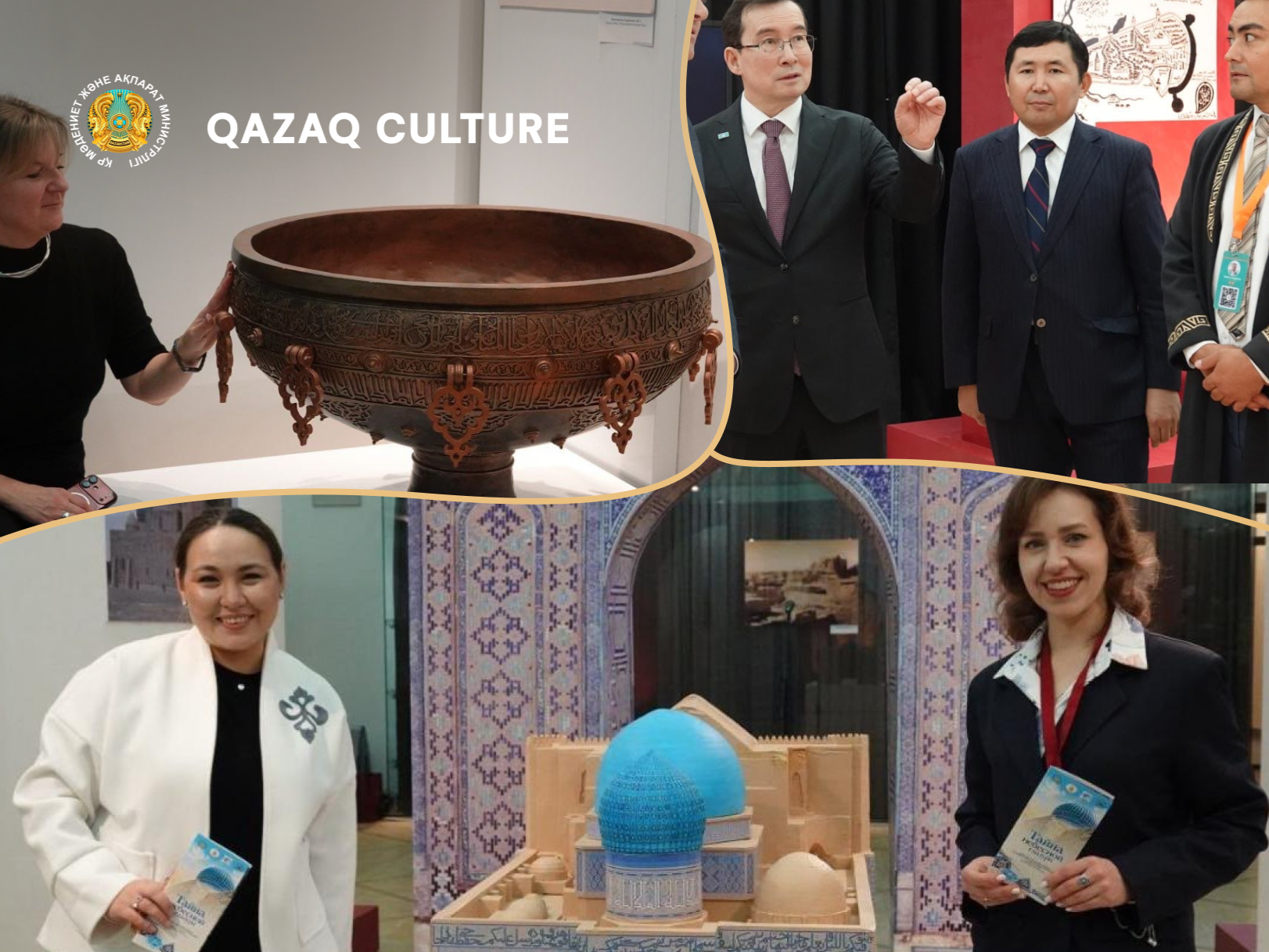
On November 20, an exhibition entitled "The Secret of Celestial Glaze" opened at the Aziret Sultan Museum-Reserve in Nesvizh, Belarus. The exhibition includes 12th-century terracotta tiles, 14th-century ceramic fragments, majolica and mosaic elements, and photographs of ancient inscriptions. Placed outside the architectural complex, these objects allow visitors to examine elements that often go unnoticed during a visit to the mausoleum itself.
Clay and Glass Architecture
Construction of the current mausoleum began by order of Amir Timur in the late 14th century. The monumental complex was built from 1389 to 1405, on the site of an earlier structure over the grave of Khoja Ahmed Yasawi. After Timur's death, construction remained unfinished, yet this monument became one of the most important architectural examples of its era.
The structure is based on fired brick. From this relatively simple material, craftsmen created a complex system of rooms, vaults, and domes. However, the artistic character of the building is determined by the combination of brickwork with colored ceramic cladding. Glaze is a glassy coating that forms on the surface of a ceramic piece during firing. It imparts color, alters its texture, and reduces the effects of moisture. To achieve the desired result, the artisan had to select the correct glaze composition, prepare the ceramic base, and ensure the appropriate temperature.
Even a slight change in the process could affect the hue, luster, and durability of the finished piece. On the scale of a mausoleum, where decorative compositions were composed of numerous individual elements, precision production was particularly important.
Analysis of the mausoleum's ceramics shows that medieval artisans used several types of glaze. The blue coating on individual tiles is approximately 0.2–0.3 millimeters thick, while the turquoise layer on some facing bricks reaches 0.5–1 millimeter. Copper was detected as a colorant in the green glaze of the tiles studied.
The internal structure of the coating is also interesting. When studying individual samples, experts discovered a two-layer structure in which colorless glass directly contacts the ceramic base. What the viewer perceives as a single colored surface, when examined in the laboratory, turns out to be a complex system of interacting materials.
When a Wall Becomes Text
In the mausoleum's architecture, color cannot be separated from ornamentation. Turquoise, blue, and white elements are arranged in geometric compositions, intertwined with inscriptions, and form decorative friezes. The architectural ensemble features inscriptions in Kufic and Thuls scripts.
In the Islamic architecture of Central Asia, calligraphy served both semantic and artistic functions. Text became part of the architectural space: its lines followed the rhythm of the masonry, and letters could form large geometric compositions.
The Yasawi Mausoleum allows one to experience this interaction on a particularly monumental scale. From afar, the visitor perceives the color and overall pattern of the wall. Upon closer inspection, they discover individual ceramic elements, and then written signs, which form the composition.
This is one of the distinctive features of Timurid-era architecture. Decor not only embellishes a structure but also organizes its visual perception. Color helps highlight architectural volumes, ornamentation sets the rhythm of a surface, and calligraphy imbues it with meaning.
Therefore, the heavenly hues of Turkestan cannot be reduced to a single symbolic interpretation or a single recipe. They are the result of the interaction of religious aesthetics, artistic tradition, and advanced ceramic production.
Why Color Needs to Be Protected
Medieval glazes can last for centuries, but the durability of the vitreous coating does not make it invulnerable. Ceramics and glazes react differently to temperature changes. Moisture, wind, solar radiation, and the gradual formation of cracks can disrupt the adhesion of the coating to the substrate.
Working on large open surfaces, including domes, is particularly challenging.
In 2026, scientific restoration work was carried out on the dome of the Khoja Ahmed Yasawi Mausoleum. A comprehensive survey revealed a decrease in the strength of the outer glaze coating and an increase in the number of cracked areas. Kazrestavratsiya specialists have begun work to prevent further deterioration and the possible separation of cladding fragments.
It is important to distinguish between the dome's historical structure and its outer protective coating. As specialists from the Ministry of Culture and Information explained, the layer on which the work was carried out is not part of the monument's original structure. The historical dome itself has been preserved.
For the restorer, the task is not to make the structure appear new externally. It is necessary to determine the condition of the materials, eliminate the risk of deterioration, and preserve as many original elements as possible. Therefore, one of the main principles of the work is minimal intervention.
In this context, each surviving medieval tile is valuable as an independent historical document. Its composition, thickness, structure, and traces of manufacture contain information about its production that cannot be obtained from written sources alone.
This is precisely what makes the "Mystery of Celestial Glaze" exhibition so compelling. It offers the opportunity to view the architecture of Turkestan on an unusual scale – through a single ceramic fragment, an ornament, or an inscription. Displayed alongside them are manuscripts, the Nasabnama genealogy, and materials related to Yasawi's spiritual legacy, revealing the cultural context of the monument's creation.
In 2003, the Khoja Akhmed Yasawi Mausoleum became the first site in Kazakhstan to be inscribed on the UNESCO World Heritage List. Its significance is determined not only by the scale of the structure but also by the preservation of its architectural features, which reflect the mastery of an entire era.
And when we gaze upon the turquoise dome of Turkestan, we see simultaneously a work of architecture, the result of complex craftsmanship, and a fragile fusion of clay and glass that, centuries later, continues to bear the marks of medieval masters.