Masterpieces of Kazakh Art in the Heart of Moscow: How the Tretyakov Gallery Opened a New Dimension of Cultural Dialogue
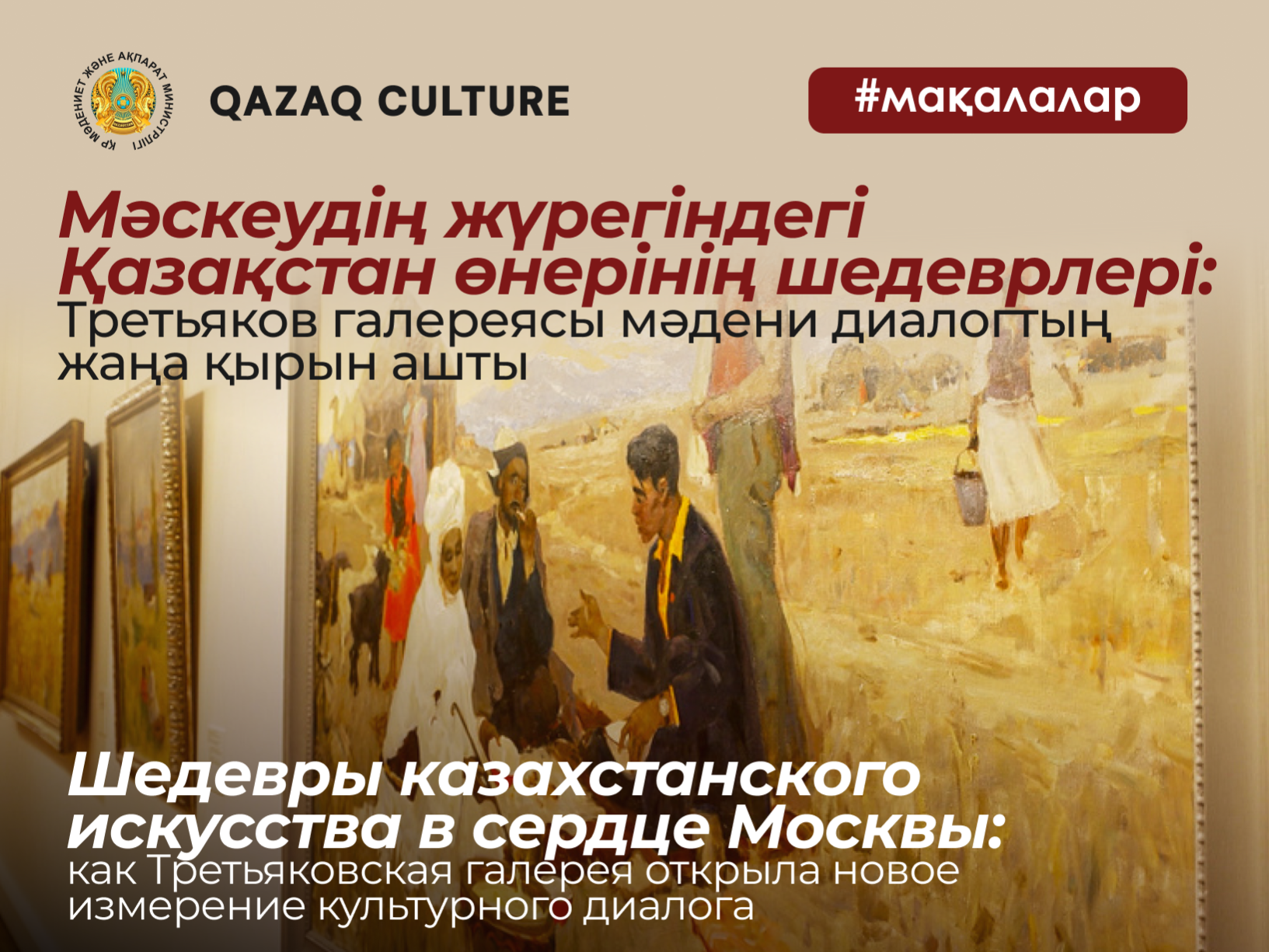
In November, the exhibition "Masterpieces of Kazakh Art" opened at the State Tretyakov Gallery in Moscow as part of the Days of Kazakh Culture. This project, dedicated to the 90th anniversary of the Abylkhan Kasteev National Museum of Arts, became an important cultural event highlighting the close ties between Kazakhstan and Russia.
The exhibition, which will remain open until November 23, introduces visitors to the works of outstanding Kazakh sculptors — Tulegen Dosmagambetov, Erkin Mergenov, Olga Prokopyeva, and Esken Sergebaev. Their works reflect a wide range of creative searches and artistic directions that shaped the development of Kazakh sculpture in the 20th century.
Tatiana Gubanova, chief specialist of the foreign exhibitions department at the Tretyakov Gallery, honored cultural worker of Russia, and laureate of the Tretyakov Prize, spoke with Qazaq Culture about how the project was created, the ideas behind it, and the visitors’ responses.
Tatiana Polikarpovna, please tell us, how did the idea to hold an exhibition of Kazakh artists specifically at the Tretyakov Gallery come about?
— The idea to hold an exhibition of Kazakh artists at the Tretyakov Gallery was not accidental. It was prompted by a meeting between the Russian Minister of Culture Olga Lyubimova and the Kazakh Minister of Culture and Information Aida Balayeva, where the program of the Days of Kazakh Culture in Moscow, scheduled for 2025, was discussed. In the same year, the 90th anniversary of the Abylkhan Kasteev National Museum of Arts was celebrated — a key institution that shaped the Kazakh artistic school.
The combination of these events was a perfect opportunity to realize a large cultural project that would not only showcase the best works of Kazakh art but also become a symbol of cultural dialogue between our countries. The Tretyakov Gallery is not only the museum of national Russian art but also a space where the artistic traditions of the peoples of the entire post-Soviet space meet.
Moreover, the Tretyakov Gallery itself houses a vast and largely unique collection of works by Kazakh artists from the Soviet period. These works became a kind of bridge between the past and the present, allowing the exhibition to include rare canvases and thus show the continuity of generations, the development of the national school of painting and sculpture in the context of world art history.
We wanted this exhibition to be not just a display of artworks but a narrative — about the path Kazakh art has traveled over the past decades, about the people who managed to express the spirit of the time, the philosophy of the steppe, and the inner harmony of Kazakh culture in their works.
What was the main task you set for yourselves when creating the exhibition?
— First and foremost, we wanted to introduce the audience to the best examples of Kazakh visual art of the 20th century — from the founders to the artists who shaped the aesthetics of the end of the century. Therefore, the exhibition opens with works by Abylkhan Kasteev — a master from whom, essentially, the history of professional art in Kazakhstan begins. His paintings laid the foundation of the national artistic school and set the direction for future generations.
Next, the exhibition is built as a living story about continuity: Aisha Galimbaeva, Gulfairus Ismailova, Sabur Mambeev, Kanafia Telzhanov, Moldakhmet Kenbaev — artists who managed to combine national traditions with a realistic manner, preserving the warmth and sincerity of the Kazakh world.
Then, the viewer gradually immerses into bolder forms of artistic expression — in the work of the "Sixtiers" Salikhitdin Aitbaev, Shaimardan Sariev, Tokbolat Togusbaev. Their canvases are filled with inner energy, vivid color dynamics, and the search for a new artistic language.
Finally, the climax is the philosophical triptych by Kamil Mullashev "Land and Time. Kazakhstan," where the past, present, and future of the country merge in a single space — as a symbol of the continuity of cultural memory and the spiritual strength of the people.
A special place in the exhibition is given to works by Kazakh sculptors. What is behind this decision, and what role does sculpture play in the overall concept of the exhibition?
— Sculpture occupies a special place in the history of Kazakh art — it is impossible to imagine a complete picture of the national artistic process without it. The exhibition features works by Tulegen Dosmagambetov, Erkin Mergenov, Olga Prokopyeva, and Esken Sergebaev — masters who managed to convey the national character and inner strength through the plasticity of form and the emotional expressiveness of the material.
Their works harmoniously coexist with Russian exhibits, creating a visual and semantic dialogue. In this proximity, the commonality of artistic traditions and, at the same time, the originality of the Kazakh school, its unique intonation, plastic energy, and philosophical depth become especially evident.
One interesting decision made during the preparation of the project was placing the exhibition not in a separate hall but in the space dedicated to 20th-century art. This immediately drew the attention of critics and visitors as it defined the context for perceiving Kazakh works in dialogue with Russian artistic tradition. Could you tell us more about why this decision was made?
— It was a conscious decision. We wanted to create a dialogue between Russian and Kazakh art, to show not only differences but also similarities in the artists' imaginative thinking.
When Kasteev’s, Ismailova’s, or Telzhanov’s paintings hang next to works by Soviet masters of Russia, the viewer inevitably draws parallels: common themes, similar intonations, love for their land, for the working person. At the same time, Kazakh canvases express a special poetic nature, a connection to nomadic culture, and a sense of space and light.
I would note that visitors and specialists received the exhibition with great interest. For many, it was a rare opportunity to see works that had not left museum storages for decades. Visitors were amazed that with a relatively small number of works, the curators managed to cover the entire evolution of Kazakh visual art — from its origins to mature forms, highlighting key names, trends, and achievements.
Many noted the resonance between Russian and Kazakh artists: a striving to find beauty in the everyday, deep respect for national traditions, and an inner poetic quality uniting both cultural worlds.
So, can it be said that the Moscow audience received the exhibition with great interest and responded positively?
— Yes, we were sincerely impressed by the level of interest in the exhibition: more than 40,000 people visited it in three weeks. Many noted that they were getting acquainted with Kazakhstan for the first time through artistic images. It was especially touching to see how children from the studio at the gallery create their own versions of the paintings they saw — the steppe, yurts, national ornaments come alive in their imagination and creativity.
Museum specialists emphasize the high quality of the selection of exhibits. Despite the relatively small size of the exhibition, it allows tracing the evolution of Kazakh visual art and understanding the main artistic directions. But perhaps the most valuable thing is that the project turned not just into an exhibition but into a true cultural dialogue, uniting two artistic worlds.
In your opinion, what is the main achievement of this exhibition and what kind of response did it evoke from the audience and professional community?
— For me, the main thing is the human response. People felt the closeness of two cultures, their common roots, and their striving for harmony. We showed that Kazakh art is an important part of the global artistic process.
Moreover, the exhibition became a prologue to further cooperation between our museums. We hope that in the future, such projects will become a permanent tradition — because cultural exchange always inspires mutual creativity.
And the last question: how do you personally define the mission of Kazakh art today?
— Kazakh art is a mirror of cultural identity. It preserves the memory of the nomadic world, respect for nature, and at the same time speaks a modern language. Through painting, sculpture, and graphics, you can declare yourself as a nation capable of seeing beauty, thinking philosophically, and communicating with the world without a translator — in the language of art.