Kazakh ornaments are a reflection of the people's cultural code
If you look closely at the Kazakh ornament, you can see not just a pattern, but a reflection of the soul of the people. Each line and each curve is a voice coming from the depths of centuries, carrying the wisdom and refined aesthetic taste of our ancestors. Patterns carved in stone, embroidered on felt or woven into the fabric of a shapan, have become a kind of spiritual code that has preserved the history, character and worldview of our people. This code contains everything: respect for nature, remembrance of the nomadic destiny, an idea of harmony, an understanding of beauty as part of everyday life. That is why the ornament is perceived not as a decorative detail, but as a cultural sign through which one can read the past.
In the Kazakh tradition, "oyu-örnek" (ornament) is not only an image and form, but also a special language of symbols. It reflects human thinking and the very process of cognition: man observed the world around him, singled out the main thing and transformed what he saw into stable artistic images. The evolution of ornament is closely connected with the ethnic and cultural development of our people. The tribes that inhabited the steppes, depicting natural phenomena, animals and plants, formed a system of patterns, filling them with deep meaning. Over time, these motifs were honed, became recognizable and universal, and then turned into the traditional art of national style. It is also important that the ornament did not exist separately from life: it accompanied a person from childhood, was present in the house, in clothing, in household items, in jewelry and ritual events, forming a holistic cultural space.
According to archaeological research, the first elements of ornament are found in the cultural heritage of the Sakas, Huns and Turkic tribes of the VII-III centuries BC. These patterns were used to decorate household items, clothing and weapons. The ornament in this context was not only a decoration, but also a sign of belonging to the world of steppe civilization, which valued strength, endurance, protection of the clan and respect for tradition. For a nomad, the objects that accompanied him on the road were a continuation of his identity, and therefore the artistic design was of particular importance.
In the Middle Ages, especially during the Karakhanids and the Golden Horde, ornaments were widely used in architecture. Geometric and floral motifs predominated in the decoration of mausoleums, mosques and ceramic products. Under the influence of Islamic culture, the content of the patterns acquired a spiritual meaning: the desire for harmony of forms, for rhythm and symmetry, for decorative "balance" intensified, where each detail supports the whole. Architectural ornament became part of the sacred space and a reflection of ideas about order, beauty and spirituality. At the same time, traditional motifs did not disappear, but were rethought and included in new artistic systems, which speaks to the vitality of ornamental culture.
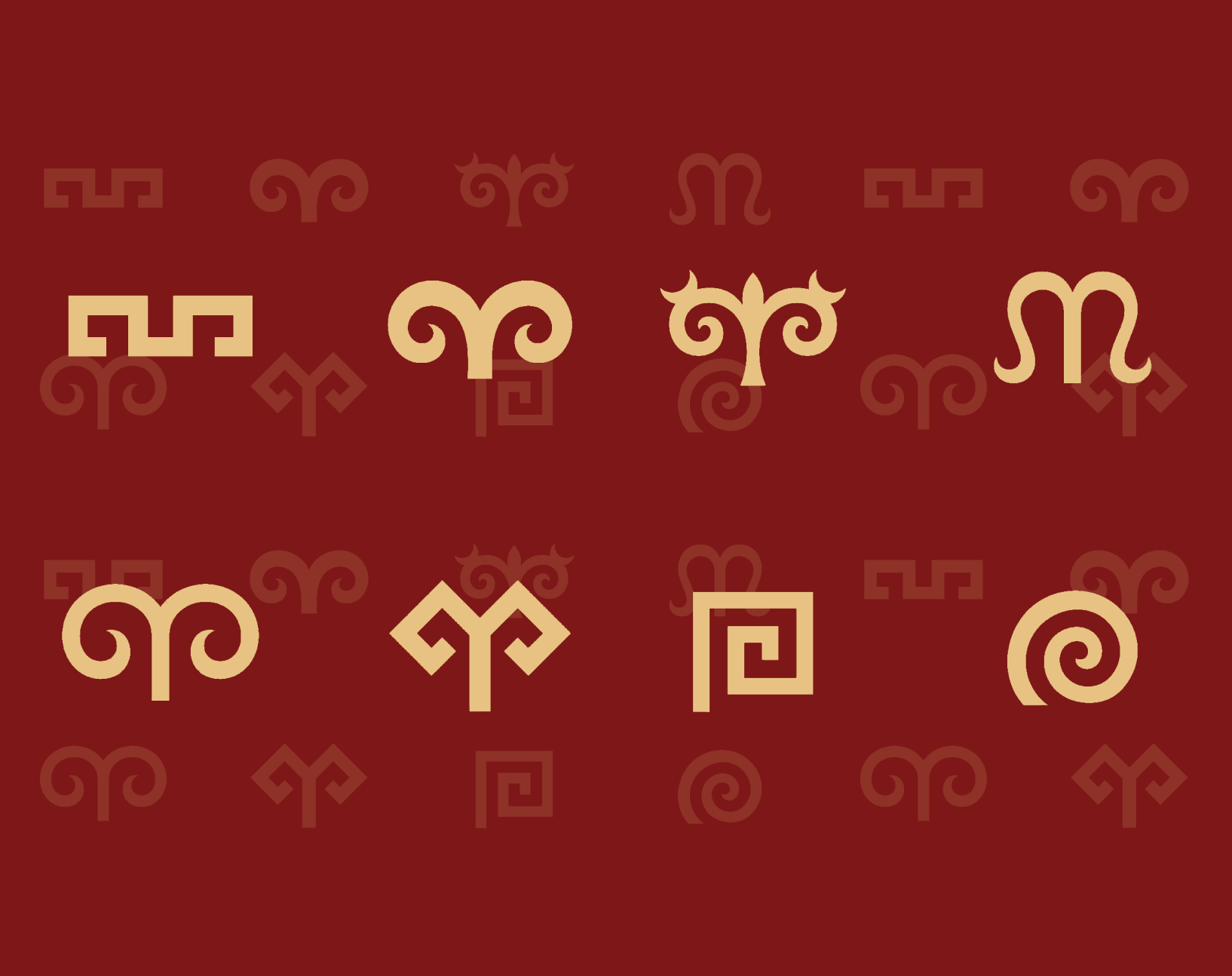
In the XIX-XX centuries, Kazakh patterns became a key element of decorative and applied art. The ornament was especially pronounced in felt products, weaving, embroidery, carving, metalworking and the manufacture of jewelry. Thus, "қошқармүйіз" (ram's horn) decorated the decoration of the yurt, "тұмарша" (amulet, talisman) was used in women's jewelry, and "сынықмүйіз" (fragment, part of the horn) was often found in carpet products. Each motif reflected the characteristics of a particular clan, region or family, and sometimes the workshop manner of a particular needlewoman. The ornamental tradition was closely connected with the transmission of skills and knowledge: patterns taught to see the world, preserved family meanings, fixed the memory of ancestors.
Currently, elements of ornament have become an important part of the national brand and decorative culture. Patterns are widely used in the fashion industry, interior design and digital graphics. Today, ornament easily transitions into modern materials and formats: it appears in prints, logos, packaging, urban environment, visual identity of projects. At the same time, its value is preserved precisely because there is a cultural meaning behind each motif, and not just decorative repeatability. In terms of content, purpose and form, ornaments can be divided into several groups. The most common types are "қошқармүйіз" (ram's horn), "өркеш" (camel hump), "тұмарша" (amulet, talisman), "құс қанаты" (bird's wing) and "қазмойын" (swan's neck).
"Қошқармүйіз" is one of the oldest and most recognizable ornaments, known since the time of the Sakas and Huns. Its origin is connected with nomadic cattle breeding, where the well-being of the family directly depended on the farm and the preservation of the herd. The motif, based on the shape of ram's horns, became a symbol of prosperity, well-being and family unity. It embodies the idea of a strong home and the continuation of the clan, so the ornament was often used in the decoration of the yurt, men's clothing and jewelry. It was perceived as a sign of stability and inner strength of the family, as a wish for abundance and harmony.
"Өркеш" is a traditional ornament inspired by the shape of a camel's hump. Its origin is closely connected with the nomadic way of life, where the camel was a symbol of the path, patience and the ability to endure hardships. Since ancient times, this sign has expressed endurance, strength and well-being. "Өркеш" was used on products made of camel wool, in the decoration of the yurt (handmade carpets - tekemet, syrmak, alasha), as well as in men's clothing. It seemed to remind: stability is born in a long movement and the ability to withstand trials, remaining true to its path.
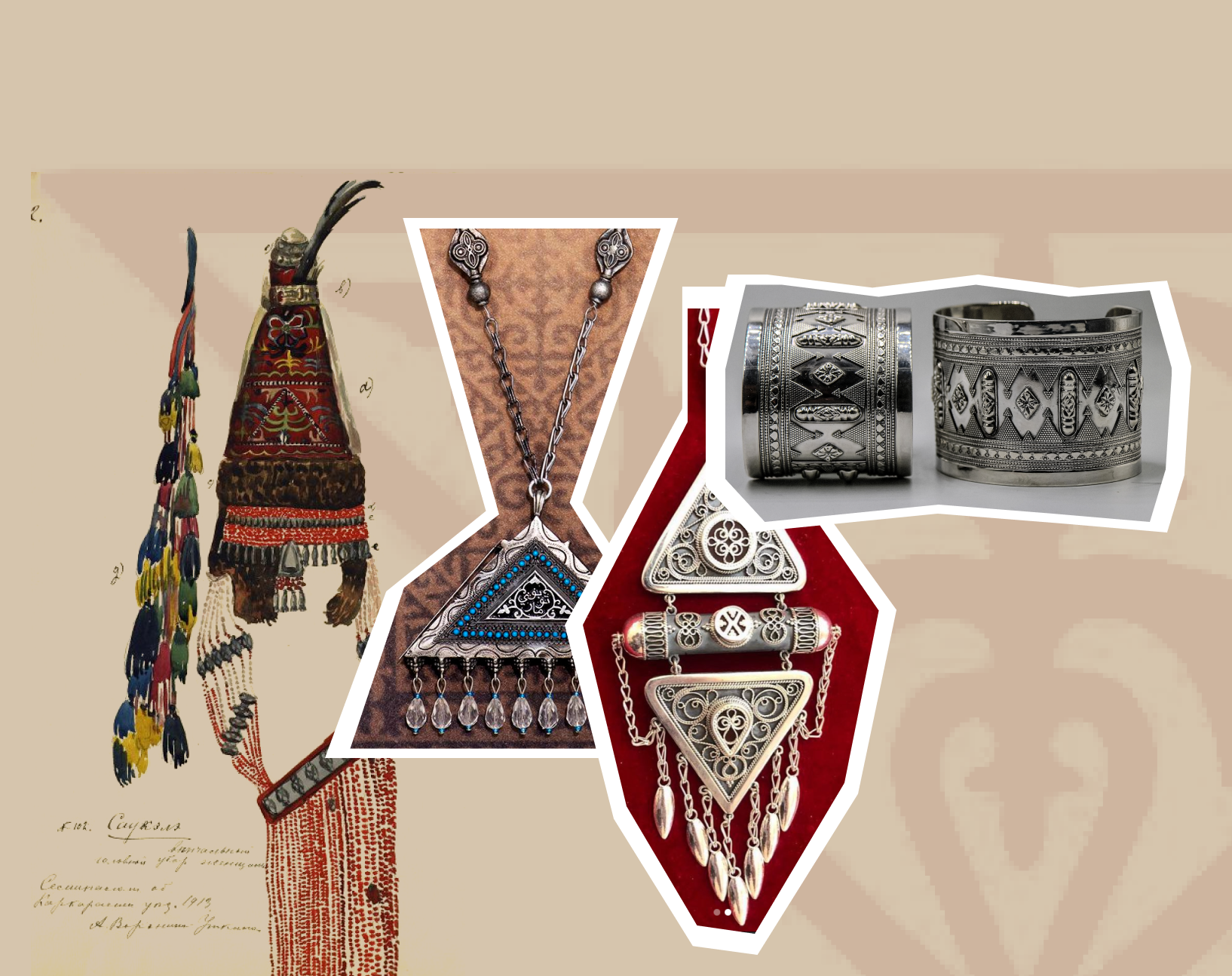
"Тұмарша" originates in the era of ancient Turks and Sakas. Triangular amulets and ornaments of this type are often found in archaeological finds and jewelry. The motif was mainly used in women's clothing and jewelry - on wedding headdresses (saukele), women's scarves (kimeshek), bracelets, amulets, as well as in felt products. It symbolized spiritual protection and well-being, as well as the idea of an invisible support that protects a person. However, since "тұмарша" was considered a sacred motif, it could not be used on objects intended for flooring, such as felt carpets (syrmak, tekemet). This rule emphasizes respect for symbolism: ornament here is not just beautiful, it has meaning and requires careful handling.
"Құс қанаты" is a symbol of freedom and an elevated spirit. For the Sakas and Turks, the bird represented the connection between heaven and earth and embodied spiritual freedom. This motif embodies the desire for height, for lightness, for bright hope. This ornament was widely used in clothing and jewelry, especially in headdresses, camisoles and elements of festive attire for girls. The motif expresses the boundlessness of human dreams, kindness and hope, retaining the idea that a person is able to rise above circumstances and maintain inner dignity.
"Қазмойын" symbolizes beauty and elegance. Etymologically, the word means "swan's neck", and the motif itself repeats the smooth line of the bird's neck, conveying the grace and softness of the form. Its origin dates back to the ancient Turkic era and the period of the "animal style". The people who lived in harmony with nature turned the image of the swan's neck into an artistic symbol and included it in everyday life and decorative art. "Қазмойын" is most often used in women's clothing, jewelry, embroidery and decorative products, emphasizing the aesthetics of subtlety and noble restraint.
Thus, each type of ornament, formed over the centuries, has its own content and meaning, reflecting the worldview, aesthetic taste and lifestyle of our people. Kazakh ornaments are rightfully considered an invaluable artistic heritage, revealing the depth and richness of our cultural identity. And the more carefully we look at these patterns today, the clearer we understand: they contain not only the past, but also the ability of culture to live on - to be updated, preserving its foundation and recognizable language.