A Century-Long Journey: The Role and Mission of the Kazakh National Drama Theatre named after Mukhtar Auezov
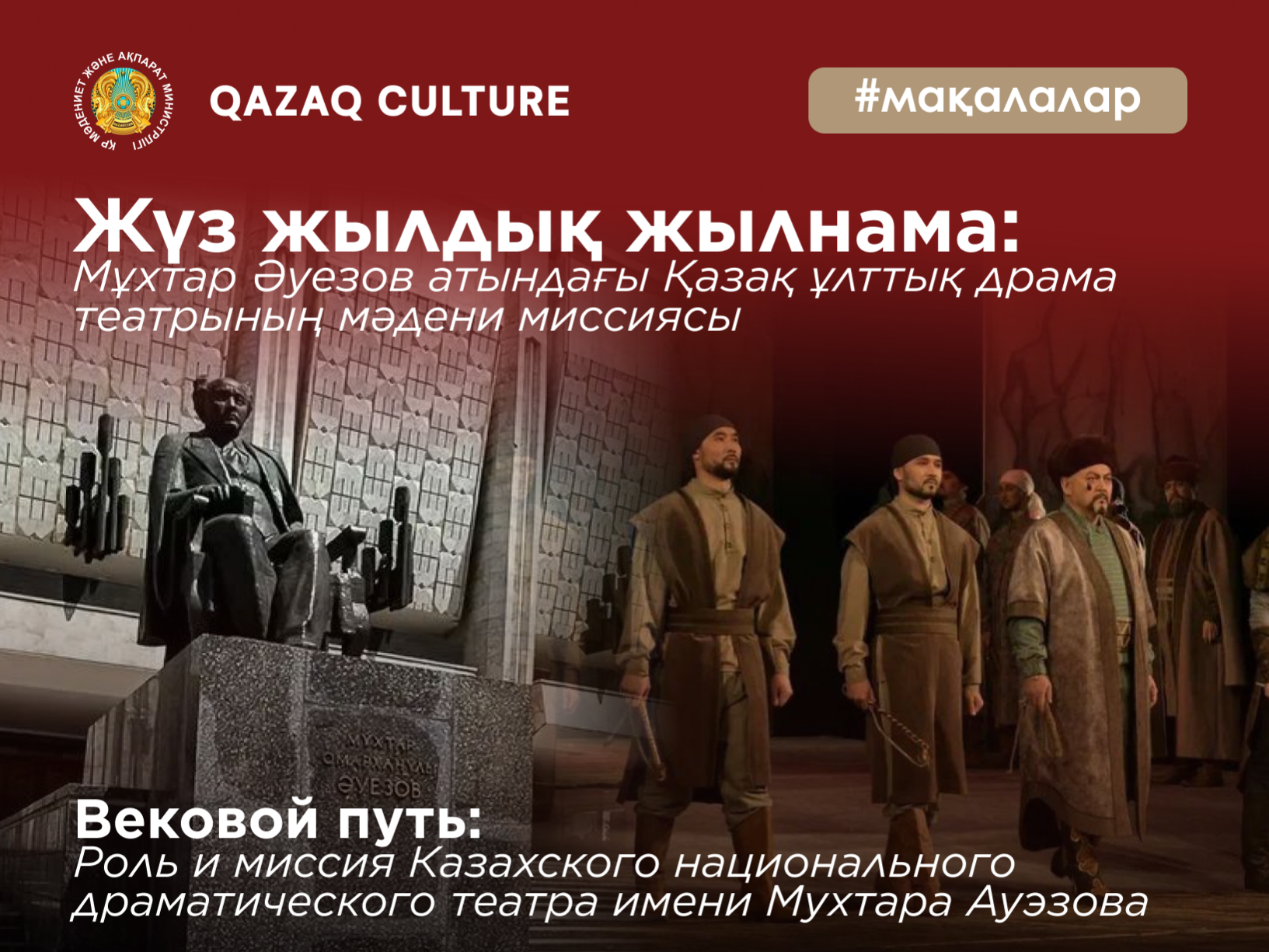
The 100th anniversary of the Mukhtar Auezov Kazakh National Drama Theater is a significant milestone, testifying to its influence on the cultural heritage and development of Kazakh theater. Time, however, is not the only criterion of significance: a key role is played by the spiritual heritage, passed down from generation to generation and reflecting Kazakh traditions and culture. The theater opened its doors in 1926 in Kyzylorda. Over this century, it has nurtured many outstanding personalities, becoming a prominent representative of Kazakh art on the world stage.
The anniversary celebration is not only a retrospective of achievements but also a look into the future, responses to modern challenges, and the presentation of new creative ideas. In honor of this occasion, we spoke with the theater's director, Honored Worker of Kazakhstan Nurlan Zhanmukhambetov, to discuss the theater's future, its mission, and creative direction. In honor of the theater's 100th anniversary, what is the main message you would like to convey to audiences?
100 years is not just a time marker, but an entire era, engraved in the cultural memory of the people. It represents the development of the dramatic explorations and acting schools of Kazakhstan's first professional theater, the formation of its stage language and artistic vision. Therefore, we perceive this anniversary not as a celebration celebrating the past, but as an important stage in which the theater consciously rethinks its aesthetic orientation, creative responsibility, and social mission. Given the technological advances of the 21st century and changes in cultural consciousness, our main goal today is to maintain a balance between tradition and innovation.
The theater's curtain opened with the production of "Enlik-Kebek." How has this beginning continued to shape the spirit and direction of the theater to this day?
The theater's foundations were laid in Kyzylorda, and its first curtain rose with the production of "Englik-Kebek." This event became a significant historical moment, defining the spiritual and aesthetic direction of the national theater. Although the first production was Q. Kemengeruly's "Altyn Saqina," theater scholars have come to believe that the curtain of Kazakh professional theater opened with M. Auezov's tragedy "Englik-Kebek."
The tragedy "Englik-Kebek," with its artistic integrity and dramatic structure, defined the aesthetic guidelines of Kazakh theater. This work allowed for a deeper understanding of issues of social consciousness, tribal relations, individual freedom, and moral responsibility, and also defined the artistic mission of Kazakh theater at a high level. Mukhtar Auezov, who was directly involved with the theater during its early years, worked in the literary and dramatic department and significantly contributed to its development. His contribution elevated the artistic level of the national repertoire and influenced the formation of drama policy. Auezov's creative experience helped systematize the ideological and aesthetic orientation of Kazakh theater. Thus, he is not only a historical figure but also an important cultural phenomenon, having laid the professional, artistic, and intellectual foundations of Kazakh theater. Thus, the production of "Englik-Kebek" became the theater's aesthetic manifesto.
– Looking back over the theater's century-long history, in what areas have its most significant achievements been manifested?
– The theater's achievements over its century-long history can be divided into several key stages. First and foremost, the most important achievement is the formation of national drama and its transformation into a professional theatrical system. The theater laid the institutional foundation for Kazakh drama and developed expertise in adapting literary texts for the stage. This process was strengthened through acting and directorial interpretation.
Furthermore, the acting school is a second important pillar of the theater. Performance traditions rooted in a national worldview, as well as a system of stage design, were formed here.
Repertoire policy is also a key aspect defining the theater's historical significance. While preserving its classical heritage, the theater also actively engages with contemporary drama. This balance in the repertoire has demonstrated the theater's aesthetic stability, artistic boldness, and commitment to continuous development.
The theater's cultural influence is a natural result of these three trends. The theater has given impetus to the process of national self-discovery and influenced public consciousness. It has shaped cultural taste and artistic norms, becoming a benchmark for other creative groups.
– How did you manage to maintain the continuity of traditions while simultaneously incorporating modern trends when preparing the program for the 100th anniversary? The centenary of the M. Auezov Kazakh National Drama Theater is a shining example of the development of national art. The theater, while preserving its spiritual mission passed down from the last century, offers modern audiences new perspectives and creative directions.
The path begun by such outstanding figures as Serke Kozhamkulov, Kalibek Kuanyshbayev, Yelubay Omirzakov, Kapan Badyrov, Kurmanbek Zhandarbekov, Isa Baizakov, Amre Kashaubayev, and Kazhymukan Munaitpasov became the foundation of Kazakh theater. Therefore, we are organizing events worthy of this important occasion to celebrate the centenary of the Kazakh theater.
This season, the theater's classic works were presented in new performances, and international tours allowed a wider audience to become acquainted with the creative potential of the national theater. A major cultural event was the gala performance of "Khasyrga Basqan Qadam," which took place in November 2025 and became a shining symbol of the theater and its centenary history.
On January 13, the theater's founding anniversary, an international scientific and theoretical conference, "The 100th Anniversary of the National Theater: Dәstүr, zhңaшылдық және көркемдік переформация," was held. This event became an important scientific platform for analyzing the spiritual and aesthetic evolution of the national theater over the course of its century of existence and discussing its future development. Scholars from Uzbekistan, Azerbaijan, Kyrgyzstan, and leading Russian specialists participated in the conference. A total of 15 papers were presented. A special collection based on these scientific papers is currently being prepared and will be published soon. Additionally, to further explore and popularize the theater's history, its prominent figures, and the stages of its development, three major book projects are being prepared and have already been submitted to publishers.
— After the theater's reconstruction, how will the updated stage and modern technical capabilities influence creative development?
— We don't view the reconstruction as simply a renovation of the building. It is an opportunity to create a new internal creative logic for the theater. First and foremost, it opens up more freedom in working with the stage space. The theater is transformed from a venue for presenting finished productions into a vibrant creative environment where ideas and forms develop simultaneously.
Furthermore, interaction with the audience is reaching a new level. Public spaces become an extension of the theater's life, opening up opportunities for cultural dialogue.
Our position is to preserve the theater's genetic code, finding ways for it to naturally engage with contemporary society through literary and theatrical language. We do not reject traditions, but rather strive to adapt them to contemporary forms of perception. In future productions, we will pay special attention to ensuring that the rhythm and flow of classical texts resonate with modern audiences.
Working with interdisciplinary creative teams, nurturing young directors and actors, and supporting contemporary Kazakh drama are key areas for us in the future.
– What are the theater's key areas in the coming years?
– Today, the theater's main goal is to give people time for reflection and a space for meaning in a rapidly changing society. In the future, the theater's repertoire will focus on the most relevant themes, such as loneliness, choice, responsibility, historical memory, and personal relationships, but without hype or sensationalism. We strive not to surprise audiences, but to offer productions that provoke deep reflection.
The second important area is strengthening discipline and professional ethics within the theater. The theater should become not a temporary project for each actor and director, but a stable creative environment. Therefore, we are returning to long-term planning, the ensemble principle, and repertory continuity.
The theater's doors must also always be open. Connection with the community should not be limited to tickets alone; we want to make the theater a vibrant part of city life through open rehearsals, creative meetings, and behind-the-scenes conversations.
In addition to raising social and historical issues on stage, the theater plans to become an important platform for the exchange of opinions through forums, roundtables, and open discussions. In terms of international relations, we strive to maintain an equal dialogue with other cultures while preserving our uniqueness. The theater's second century will be a time of trust and solid development.