Living culture of the Great Steppe: values encoded in games
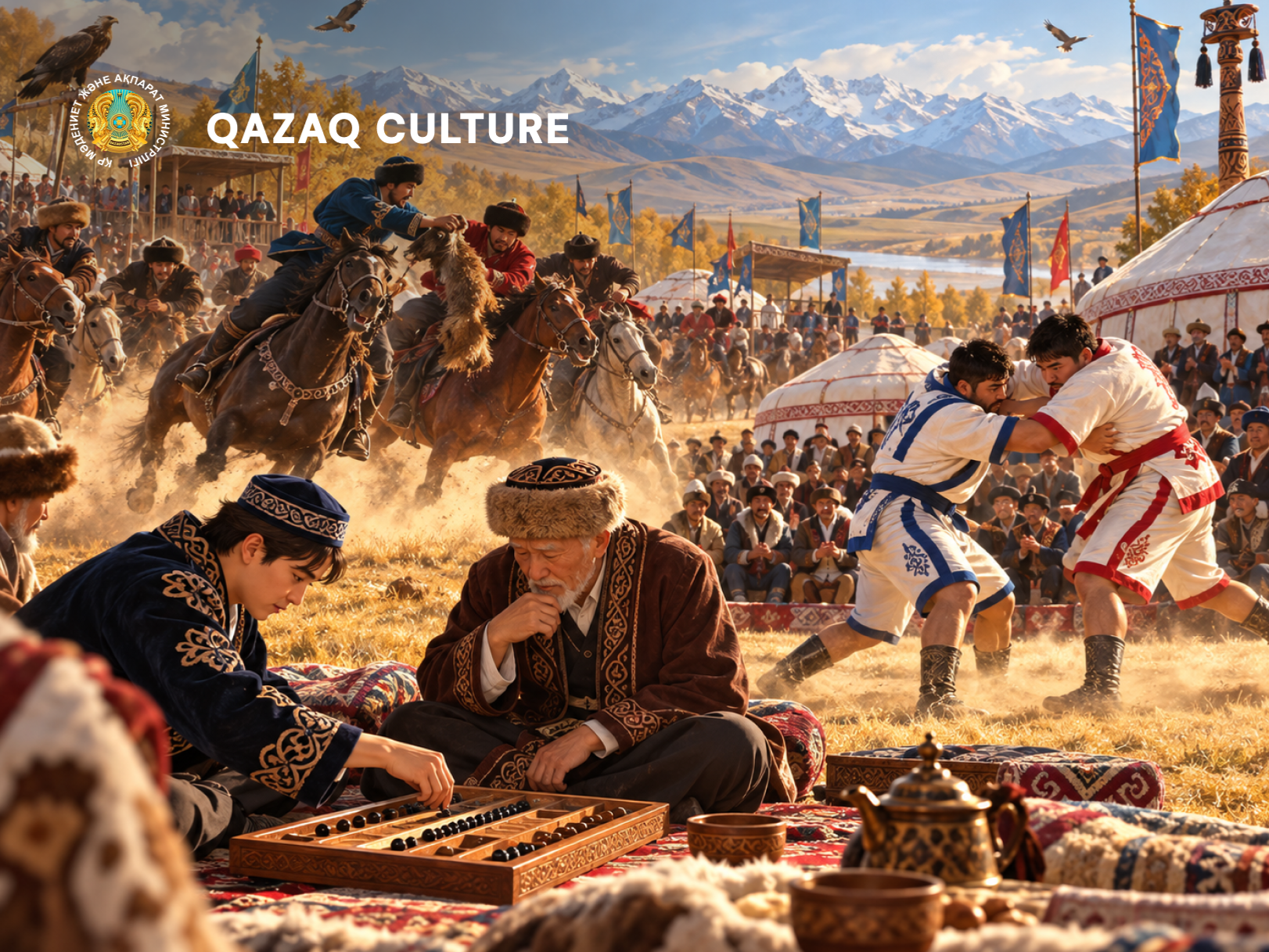
Traditional games of the Kazakh people are much more than mere entertainment or a way to spend leisure time. In the harsh conditions of the Great Steppe, they served for centuries as a school of life that cultivated courage, endurance, strategic thinking, unity, and a deep respect for strength and intellect, while preserving traditions and values. Every competition reflected the nomadic lifestyle, philosophy, and spirit of the nation.
In this article, we will talk about three jewels of Kazakh national sports: the ancient wrestling style qazaqsha kures, the spectacular and dynamic kokpar, and the deep intellectual game togyzqumalaq.
Qazaqsha Kures: The Art of the Strong and Fair
Qazaqsha kures is one of the oldest forms of martial arts, with roots stretching back centuries. Among nomads, physical strength and the ability to defend oneself and one's clan were valued above all else. Wrestling was an essential element of popular celebrations (toy, as, Nauryz). Large-scale tournaments known as tuye paluandar sayysy were organized in the auls, where the winners (paluans) were awarded main prizes. Originally, the wrestling had no strict age or weight limits—the winner was the one who possessed true mastery and an unbreakable will.
The main objective of a paluan is to throw the opponent onto their back. A clean victory is recorded the moment the opponent ends up flat on their shoulder blades. Points are awarded for throws onto the side or into a kneeling-hand position.
Kokpar: A Test for Courageous Dzhigits
Kokpar (derived from the Persian word for "grey wolf") is an equestrian team game that embodies military valor, flawless horsemanship, and team spirit. According to legend, in ancient times, hunters who snatched prey from predators would throw it to each other at a gallop to deliver it to the aul faster. Over time, this turned into a national pastime that prepared warriors for cavalry combat.
In the game, two teams of horsemen compete for the carcass. The players' objective is to lift the carcass from the ground, hold onto it despite the attacks of opponents, and throw it into the so-called kazan (the opponent's goal).
Today, official sports kokpar strictly regulates timeout periods, and hitting opponents with a whip or intentionally harming the horses is prohibited. Nevertheless, the game demands phenomenal physical preparation, coordination, and fearlessness from participants.
Togyzqumalaq: The "Algebra of the Steppe" and the Logic of Reason
The game is played on a special wooden board featuring 18 small pits (otau), 9 for each player, and two large storage pits (kazan). At the beginning of the match, exactly 9 marble-like balls (kumalaks) are placed in each of the 18 pits (162 in total).
Players take turns taking stones from a pit on their side and distributing them counterclockwise (one into each subsequent pit). If the last stone lands in the opponent's pit and the total number of stones in it becomes even, the player captures all those stones into their kazan.
If the final stone brings the number of balls in the opponent's pit to exactly three, that pit is declared the player's tuzdyk (a sacred place). All stones that land there during the rest of the game automatically migrate to the owner's kazan.
The game continues until one of the participants collects more than 81 stones in their kazan (the majority of the total pool).
The national games of the Kazakhs are a living bridge between the past and the present. Preserving rules passed down from generation to generation, qazaqsha kures, kokpar, and togyzqumalaq are experiencing a renaissance today, entering the programs of the World Nomad Games and international competitions. They teach the most important lesson: victory belongs not only to those who are strong in body or mind, but to those who respect the traditions of their ancestors.
Ultimately, qazaqsha kures, kokpar, and togyzqumalaq are not just sports disciplines, but a living code of spiritual values of the Kazakh people. They crystallize the centuries-old wisdom of the nomads, where physical power is harmoniously combined with nobility, and the thrill of competition with deep respect for the opponent.
Passed down through generations, these national games serve as an unshakeable foundation of national identity, nurturing an unbreakable spirit, patriotism, and continuity of the great culture of the Great Steppe in the hearts of the youth. For centuries, Kazakh games have served to unite ethnicities, strengthen friendship, and introduce others to our culture.