When silence says: "Silence..." by Saltanat Tashimova
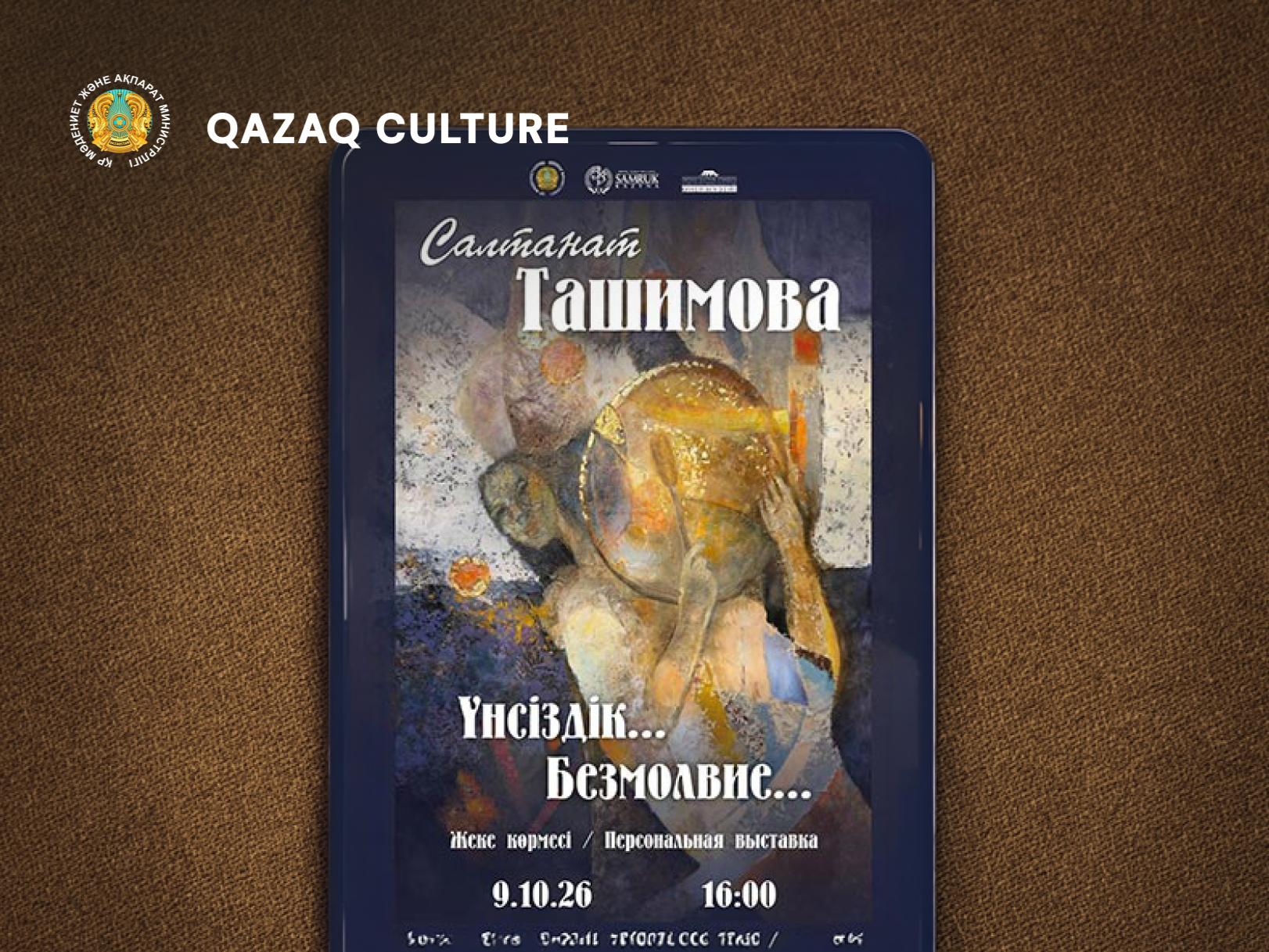
Silence in Saltanat Tashimova's paintings does not at all imply the absence of a voice. On the contrary, in her paintings, silence is filled with movement: the wind blows over the steppe, color seems to gain an inner strength, familiar natural images disintegrate into lines and spots, and another, almost mythological world emerges behind visible reality.
The artist dedicated her exhibition "Silence...," which opened at the Abylkhan Kasteyev National Museum of Arts of the Republic of Kazakhstan, to this state of mind. The exhibition brings together nature and humanity, ancient memory and contemporary anxieties, recognizable landscapes and almost abstract spaces.
This conversation is nothing new for Tashimova. For over three decades, she has been developing her own artistic language on the border between the real and the imaginary. After graduating from the Alma-Ata State Theatre and Art Institute, the artist began exhibiting in 1991. Her works are currently held in private collections in Kazakhstan, the United States, Germany, Russia, and New Zealand.
However, painting is only one facet of her biography. Saltanat Tashimova is also known as a model and actress, but the canvas has become a space where diverse life experiences coalesce into a unified statement.
The artist once admitted that spontaneity remains one of her most important principles. This explains much of her painting. Tashimova seems to deliberately avoid ready-made formulas: once an artistic solution is found, it does not become a repetitive technique.
In "Silence...," this freedom is especially clear.
In her paintings, the steppe rarely exists simply as a landscape. Sky, wind, earth, and the elements become part of a more complex conversation—about freedom, memory, the human soul, and the human place in the world around us.
The artist draws on ancient myths, legends, and Tengrian beliefs, but does not attempt to illustrate the past. Archaic images flow through her own pictorial system and return to the viewer as contemporary metaphors.
In the compositions "Dervish Dances," "Saz Cheese Melody," and "Asian Motifs," the steppe space merges with cultural memory. In "Wind Spirits," "Intersections of Worlds," "The Other Side of the World," and "Birth of Worlds," familiar reference points become even more unstable. Here, the important thing is not so much the plot as the very sense of transition—between the visible and the invisible, the material and the spiritual.
Broad color planes, intense combinations of shades, expressive texture, and the musical rhythm of lines create a painting that is more meant to be felt than deciphered.
This artistic system has been developing for years. In her project "Dreams of Umai," Tashimova combined steppe motifs, mythological images, semi-abstract painting, and reflections on nature. In the new exhibition, these themes are continued, but with a different tone—more focused and unsettling.
This is especially evident in the project "Umai and Kok-Zhailau." Here, the ancient patroness of life finds herself amidst nature, which itself requires protection. The image of Umai ceases to be merely a mythological symbol and acquires a contemporary meaning: caring for trees, the land, and natural space becomes a gesture of preservation and resistance to destruction.
For Tashimova, this theme has more than just an artistic dimension. For many years, she has been engaged in environmental activism, participating in public initiatives related to the protection of Kok-Zhailau and the preservation of Almaty's green space. Therefore, the discussion of nature in her paintings is perceived not as abstract philosophy, but as an extension of her personal position.
Another important image in the exhibition is the Sievers apple tree.
In the "Pra Yablochnaya" project, the wild ancestor of many modern apple varieties is transformed into an Ancestor Tree. Its roots are associated with memory, its branches with the continuation of life, and the tree itself becomes a meeting point between natural and human history.
This image is particularly recognizable for Almaty. The apple has long been part of the city's cultural memory, and Tashimova has previously addressed this theme in her artistic and environmental projects. In "About the Apple Tree," this motif expands significantly beyond local history—it's about origins, continuity, and responsibility to what existed long before us.
But "Silence..." speaks not only of nature.
The "Silent Scream" project translates the motif of silence into a human dimension. A medical mask depicting an open mouth becomes an almost paradoxical image: a voice exists, a scream is present, but it cannot be heard.
After the steppe expanses, mythological images, and almost cosmogonic themes, this work resonates especially poignantly.
And the very title of the exhibition begins to take on a different meaning.
Silence can be a state of contemplation—a moment when external noise recedes and a person is left alone with themselves. But it can also signify the inability to speak or be heard.
Between these two states—inner silence and the unspoken scream—exists a significant part of Saltanat Tashimova's artistic world. She paints nature, but her paintings can hardly be called landscapes in the conventional sense. The steppe becomes a memory. The wind, the movement of time. An apple tree, the image of an ancestor. Umai, a reminder of the need to protect life.
Even color here exists not only for beauty. It becomes a carrier of state.
Therefore, "Silence..." can be perceived not so much as a collection of individual works, but as a unified space for conversation, in which familiar words are almost absent.
Instead, lines, texture, color, and images emerge, simultaneously drawn from ancient memory and contemporary reality.
And perhaps the main paradox of this exhibition lies precisely in this: to hear her, the viewer is first invited to find herself in silence.
Saltanat Tashimova's exhibition "Silence..." is open at the Abylkhan Kasteyev National Museum of Arts of the Republic of Kazakhstan until October 30.