The Face of the House's Master: How a Family Album Brought Fyodor Stepanov Back to His Mansion
Museum staff knew the name of the man who built this house. They knew the documents related to the mansion, collected information from archives, and reconstructed the building's history. What they didn't know was, seemingly, the simplest thing—what its owner looked like.
This continued for many years.
Today, the former home of merchant Fyodor Stepanov in Semey houses the Nevzorov Family Museum of Fine Arts. The building's history has long been part of the museum's narrative, but Stepanov himself remained a nearly abstract figure: his name was known, but his face was not.
A phone call changed everything.
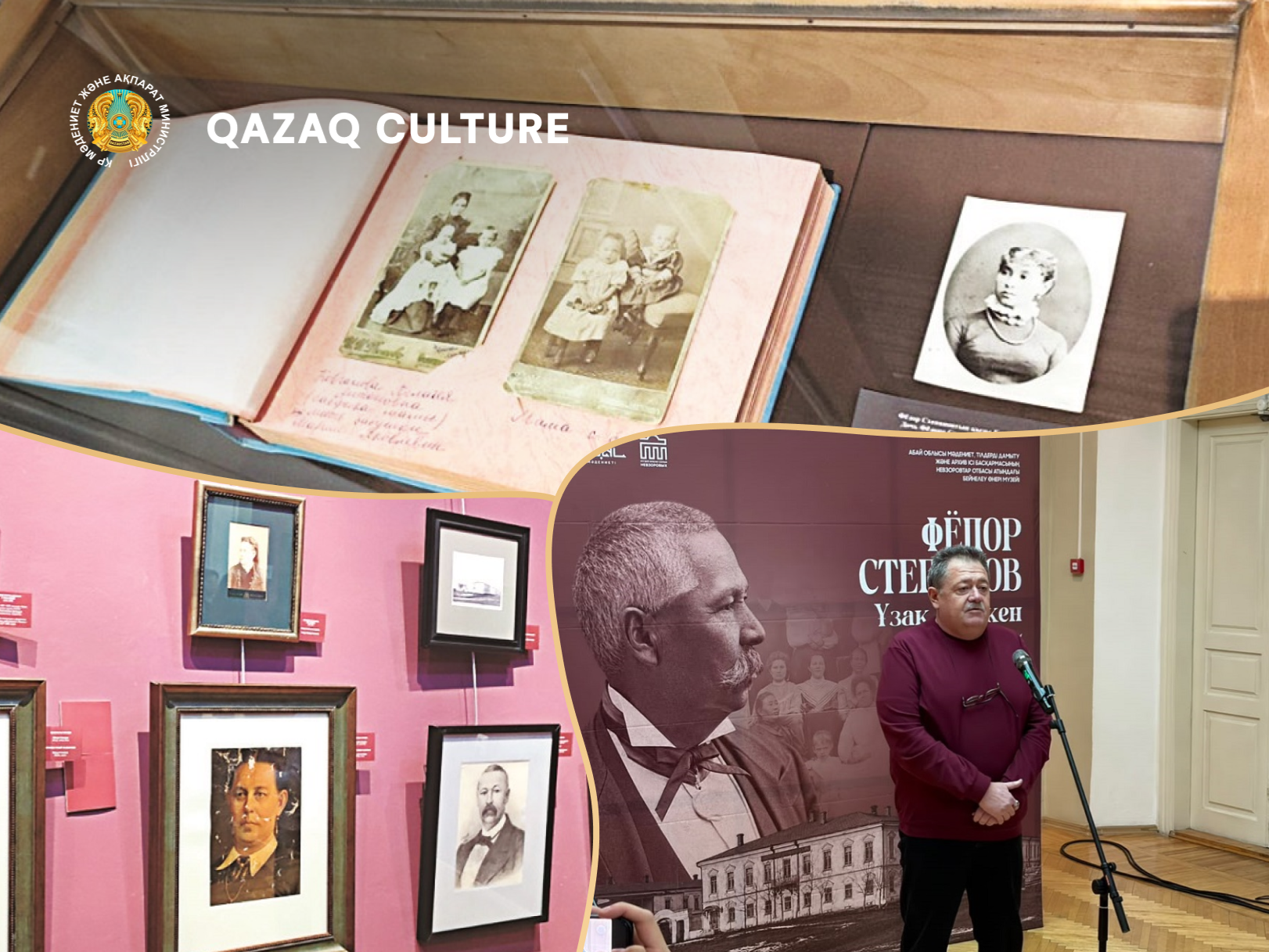
About twenty years ago, a young man approached the museum and introduced himself as a descendant of Stepanov. A correspondence ensued, sharing documents and family information. Gradually, this work helped flesh out the mansion's history and formed the basis for a separate publication about the building. But the real turning point came much later—in the summer of 2026, when the merchant's great-great-grandson, Alexander Yanenko, came to Semey and brought a family album.
Museum staff expected to see photographs of his descendants. Instead, they saw Fyodor Stepanov himself for the first time.
The family archive contains not only photographs but also painted and graphic portraits of the owner of the house, his wife, and their child. Some works are by the Moscow artist Alexey Kolesov. Objects that had remained part of private family memories for decades now reside in the very rooms where the people depicted in them once lived.
This encounter gave rise to the exhibition "Fyodor Stepanov. A Meeting Through the Ages."
Its uniqueness lies in the rare coincidence of place and material. Typically, a museum removes a person from their historical environment: a portrait moves to an exhibition hall, a document to a display case, a household object to a collection. Here, the opposite occurs. Stepanov's image returns to his own home, and the walls become not a neutral background, but part of the exhibition.
The family preserved these relics from generation to generation. According to Alexander Yanenko, the portraits were never hidden—they were shown to guests, accompanied by stories about their ancestor. It turns out that for nearly a century and a half, two parallel memories of one man existed. The house in Semey remained, but the appearance of its owner gradually disappeared. Descendants retained the face, but the images themselves were far from the place for which they were once created.
Now these two lines have converged.
But the story of the return doesn't end there.
The exhibition features reproductions of three European paintings from the 17th–19th centuries that once belonged to Stepanov himself. The merchant acquired them during a trip to Italy, after which the canvases adorned the walls of the mansion. After the revolution, their history took a different path: the paintings ended up in the hands of the Beloslyudov brothers, and later became part of the collection of the Abylkhan Kasteyev State Museum of Arts.
The originals are now in another museum, but their reproductions have once again hung in Stepanov's former home.
And this is no longer simply an attempt to restore the old interior. Today's visitors have the opportunity to see the mansion not only as an architectural monument and a repository for someone else's art collection, but also as a former private cultural space.
The Stepanov House was connected to art long before it became a museum. Guests gathered here, music played, and the owners acquired European paintings. Decades later, the building's purpose changed, but strangely, it remained close to its former life: today, the same rooms once again house paintings and host art-centered gatherings.
This is precisely why the history of a family album is more than a family genealogy.
Museum buildings are often perceived as beautiful shells for collections. We look at paintings and hardly consider who once walked these corridors, why the rooms were built, or what hung on the walls before museum labels appeared. In the case of the Stepanov mansion, the building itself gradually becomes an exhibit.
The archive provides its biography.
Portraits are faces.
Family memories are human relationships. And three recovered images of European paintings allow us to at least roughly imagine what the house's owners gazed upon more than a century ago.
For museum staff, this process took decades. First, archival inquiries and the work of local historians, then an unexpected call from a descendant, twenty years of communication, and finally, a family album opened inside the mansion itself.
In museum work, such stories are rare. The missing fragment of the past may not be in a state archive or underground, but may have lain for decades in a family closet in another city.
And then one day, it returns home.