How ancient history comes to life in the theatre workshops of the Astana Opera
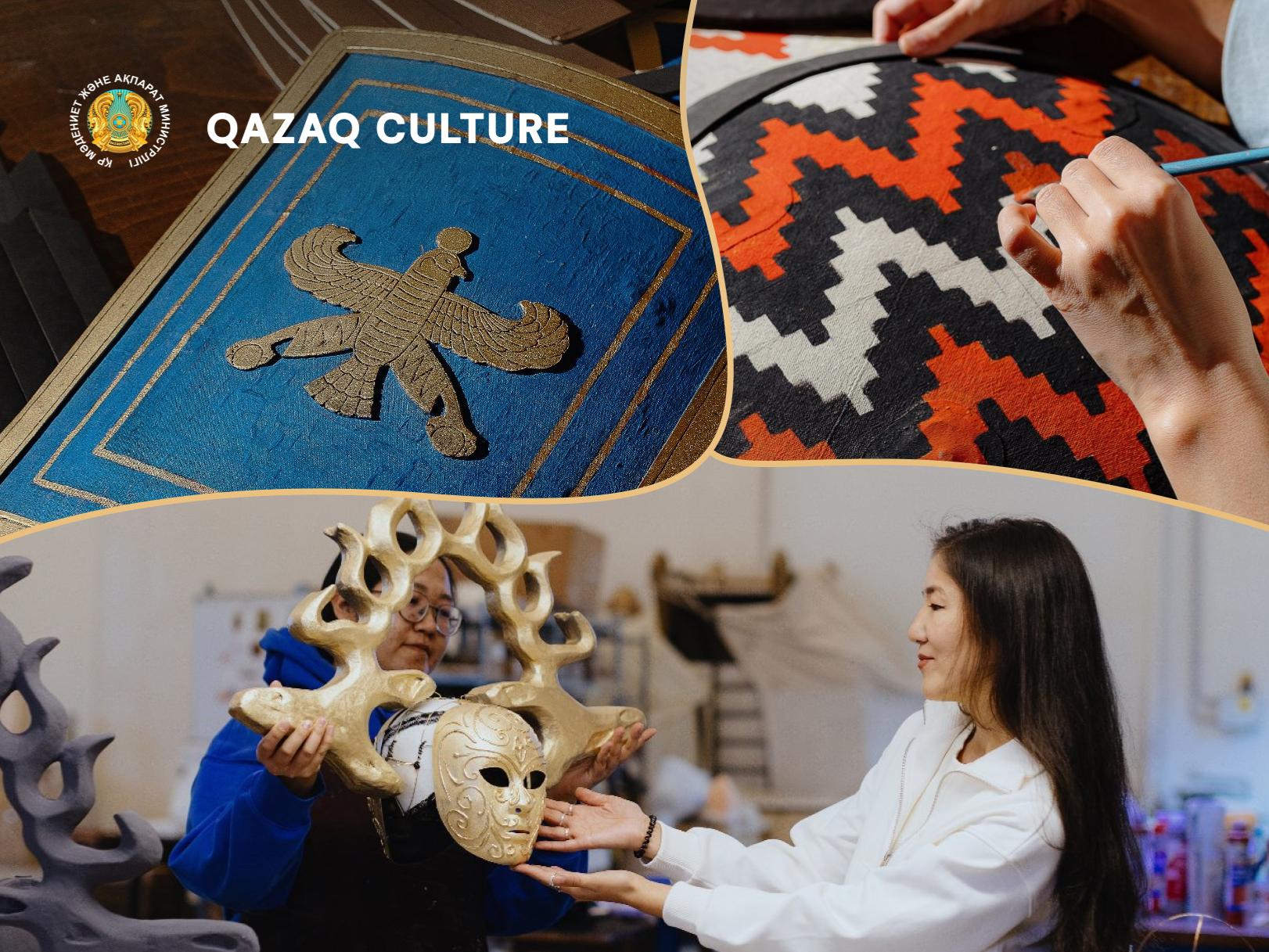
The premiere of the ballet "Tomiris" is just days away, and now this ancient story is being born not only in rehearsal halls. It's being assembled piece by piece in the theater workshops—from fabric, wood, metal, lighting, and dozens of details that the audience will perhaps only notice for a few seconds.
Hundreds of costumes and nearly a thousand props are being prepared for the premiere, which will take place on November 26–27 at the Astana Opera with the support of the Ministry of Culture and Information of the Republic of Kazakhstan. In the sewing workshops, they are creating the images of the Saka queen, warriors, and the Persian army, while in the prop shop, they are creating objects that will evoke the atmosphere of the sixth century BC on stage.
Today, the prop shop truly resembles a workshop from the distant past. Here you'll find bags of kurt and colorful spices, jugs, chests, and boxes of dried apricots. Each item looks as if it already has its own story. "Our craftsmen strive to create props that won't last just one performance, but will last for many years and retain their original appearance," explains theater prop designer Inkar Akhmetova, holding up a box of dried apricots. "Some of the apricots are attached to the lid with hot glue. Even if the lid is turned upside down, they'll stay in place. This technique was developed by our workshop's own craftsmen."
They also create armor for Saka and Persian warriors, decorative lamps, and shamans' headdresses. The latter went through several stages of processing: the base was made of foam, then covered with papier-mâché, the surface was smoothed, painted gold, and patterns were applied.
"After that, we added gold leaf. When the light hits the stage, the surface begins to shimmer, creating the effect of real gold," says Inkar Akhmetova.
The scale of the work is best conveyed by numbers. About a thousand small items were made: 30 jugs, about 60 swords, more than 50 shields, about 60 spears, and numerous other details.
In the sewing workshop, the rhythm is different, but the tension is no less. Here, history literally comes together at the tip of a needle. 256 costumes are being created for the premiere, and each artist undergoes at least three fittings. The main goal is to preserve the visual monumentality of the image without depriving the dancers of freedom of movement.
"We try to use the lightest, yet highest-quality fabrics possible. The finishing can make them appear heavy and massive. For example, one of the gray costumes resembles metal armor, although it is actually very light," explains workshop manager Aizhan Shaukenova.
One of the new challenges was the stage costumes with LED backlighting.
"This is our first experience of this kind. Overall, the performance promises to be very large-scale and interesting from a technical standpoint," she adds.
Particular attention was paid to the image of Tomiris herself. Her inner journey is conveyed through five different costumes.
"At the beginning of the ballet, she appears before the crowd in a white dress. After the death of her son and husband, an image of grief emerges. This is followed by costumes conveying loneliness and vulnerability, and later, the moment when the heroine regains her strength. In the finale, after her victory, Tomiris emerges in national dress," explains theater technologist Aigul Ryspaeva.
This logic continues in the set design. Japanese artist Yoko Seyama does not seek to literally reconstruct the ancient world. Her goal is to create a space that feels authentic while remaining a contemporary theater.
"I am convinced that modern theatrical techniques help us approach the ancient world without losing its essence. For me, it is important not simply to reproduce historical details, but to create a space that feels authentic to this story. My goal is a poetic environment where the past becomes present not as a historical illustration, but as a living experience," notes Yoko Seyama. The musical language of the production was created according to the same principle – not as an attempt to literally recreate the sounds of the Saka era, but as a search for a unique intonation between historical imagery and contemporary perception.
Composer Khamit Shangaliev admits that this task proved one of the most challenging.
"If you use only symphony orchestra instruments, the music takes on a European sound. If you switch entirely to national instruments, the music becomes too folkloric. So we had to experiment a lot. You can hear the intonations of the Kazakh steppe in the score, but there are also modern musical elements," he explains.
The music was developed in close collaboration with choreographer Sultanbek Gumar.
"Sultanbek would come once or twice a week and share his thoughts. I would play the music, he would demonstrate the movements, and we would immediately understand how well one corresponded to the other." Working alongside us was music editor and arranger Alibek Alpiyev, who helped refine the material and constantly shared his comments.
The performance features soloists and corps de ballet dancers from the Astana Opera. Sofia Adilkhanova and Torgyn Leben will perform the role of Tomiris. Doskhan Zaydin and Islam Kaypbay will perform Spargapises, while Aidan Kalzhan and Zhaksylyk Saukymbek will perform Kira. The latter will also perform the role of Tomiris's husband, Rustam Bahadur, on the first day, and Amir Khvan will perform this role on the second day. Alina Zyryanova and Limara Aidarova are preparing for the role of Arnava, Limara Aidarova and Amina Kisembayeva will perform Marta, and the shamans will be performed by Ersultan Toigulov, Nurlytan Ruslan, and Abay Yusupov. For Sofia Adilkhanova, the role of Tomiris is primarily connected to the heroine's inner drama.
"It's crucial to understand everything that's happening in the performance, to feel its history and scale. Emotionally, this role is complex. Tomiris's scenes with her son remain particularly powerful for me. Here, her anxiety, strength, resilience, and courage must be truly conveyed. For me, Tomiris is a strong woman not only as a warrior, but also as a person. Having lost loved ones and endured the harsh blows of fate, finding the strength to continue living and leading her people requires tremendous inner strength."
For Torgyn Leben, this role will be an important milestone in her stage career.
"Tomiris, for me, is not only a historical figure, but also a symbol of freedom and resilience. Through this role, I want to reveal a new side of myself and convey her spirit to the audience. It requires great physical strength and endurance, but emotional depth and inner preparation are equally important." "I try to convey her courage and strength of character, while simultaneously preserving her femininity, maternal tenderness, and vulnerability," says the artist.
Currently, all the elements of the future production exist separately: costumes hang in the sewing room, props fill the workshops, music plays during rehearsals, and the artists are exploring the personalities of their characters.
In a few days, all of this will come together on stage.
And the ancient story of Tomiris will begin to live on, no longer in a museum reconstruction, but in the space of contemporary ballet.