61st Venice Biennale: “Qoñyr” as Kazakhstan’s New Artistic Statement
The 61st Venice Biennale, one of the oldest and most prestigious events in contemporary art, has opened in Italy. Founded in 1895, the Biennale brings together artists, curators, researchers, and cultural institutions from around the world, remaining a key platform for the presentation of new artistic ideas and international cultural dialogue.
The theme of the 2026 Biennale is "In Minor Keys." According to the organizers, it invites artists and viewers to immerse themselves in a meditative, dreamy, and slightly melancholic state, evoking inner experience, memory, and subtle emotional intonations. One of the inspirations for the concept was jazz—the art of improvisation, rhythm, and sensual expression.
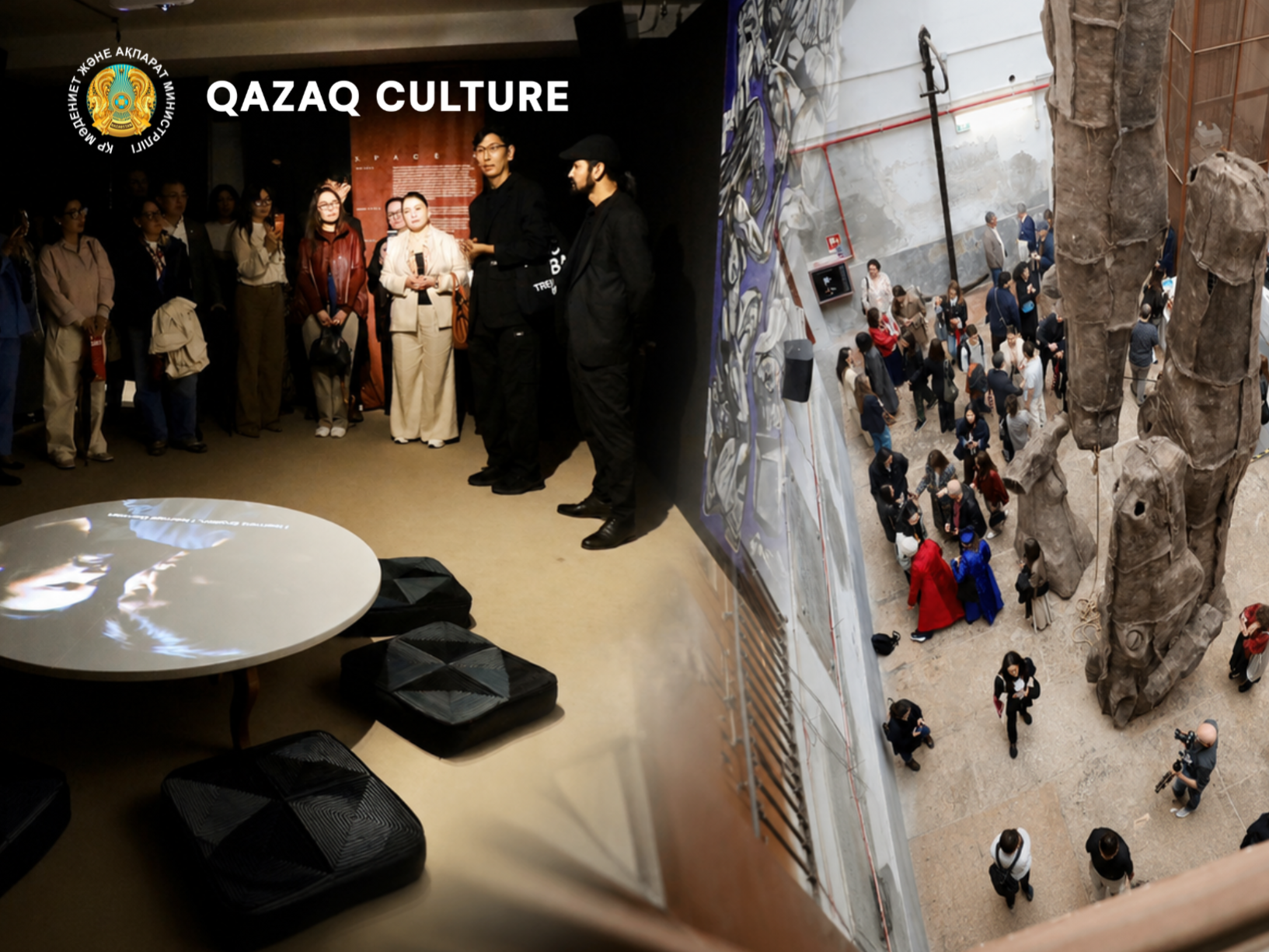
This year, Kazakhstan is participating in the Venice Biennale for the third time, presenting the National Pavilion with the project "Qoñyr: Archive of Silence." The exhibition was organized with the support of the Ministry of Culture and Information of the Republic of Kazakhstan and the project's general partner, Samruk-Kazyna JSC.
The Kazakhstan pavilion is located in the Museo Storico Navale, next to the entrance to the Arsenale, one of the Biennale's key venues. The opening ceremony was attended by Aibek Sydykov, Vice Minister of Culture and Information of the Republic of Kazakhstan; Yerbolat Sembayev, Ambassador Extraordinary and Plenipotentiary of the Republic of Kazakhstan to the Italian Republic, the Republic of Malta, and the Republic of San Marino; Pietrangelo Buttafuoco, President of the Venice Biennale; and representatives of the creative intelligentsia of Kazakhstan and Italy.
Speaking at the opening, Aibek Sydykov noted that Kazakhstan's participation in the Venice Biennale is an important part of the international cultural dialogue.
"For Kazakhstan, participation in the Biennale is an opportunity to contribute its own voice to the multi-faceted dialogue of cultures. "Contemporary Kazakh art is developing at the intersection of tradition and innovation, where the historical heritage and the code of steppe culture acquire a new resonance through contemporary artistic practices," the Vice Minister emphasized.
The curator of the "Qoñyr: Archive of Silence" project is Syrlybek Bekbota. The pavilion's concept is inspired by the traditional Kazakh kyui Qoñyr by composer Abiken Khasenov and reveals the concept of "qoãyr" as a special aesthetic category of Kazakh culture associated with inner silence, memory, and soft sound.
In the Kazakh tradition, "qoãyr" is more than just a nuance or intonation. It is a state of inner concentration, philosophical reflection, and emotional depth. In the expressions "qoãyr daauys," "qoãyr әn," and "qoãyr үn," the word conveys a calm, velvety, and profound sound.
According to the curator, the theme of "In Minor Keys" resonated with the very essence of the Kazakh worldview.
"Minor key in contemporary art is a form of expression through subtle sensations, subtexts, and inner states. There are no grand gestures here—the viewer becomes a participant and experiences the meaning of the work themselves," said Syrlybek Bekbota.
The project was developed through an interdisciplinary dialogue with musicians, philosophers, directors, writers, and cultural researchers. It was in this process that the concept of "Qoñyr: Archive of Silence" was formed.
The exhibition is structured as an immersive sensory journey and comprises five interconnected halls. The space begins outside the pavilion—with an acoustic image of the steppe—and gradually unfolds through sound, video art, light, and material installations. One of the central works was "Steppe Architectonics" by Smail Bayaliev, Akmaral Mergen, Gulmaral Tatibaeva, and Natalia Ligay. Monumental figures of horses, the sound of hooves, and steppe grass transform the pavilion space into a tangible landscape of memory.
Works by Mansur Smagambetov, Oralbek Kaboke, and Nurbol Nurakhmet continue the theme of collective memory through sound, object, and installation, demonstrating how the past is preserved in human experience and everyday life.
A special place is occupied by Anar Aubakir's work "Matrix of a New Subject," where the inner layer of an old camel wool blanket is reimagined as an art object and a silent archive of generational memory. The exhibition tour concludes with Ardak Mukanova's digital work, "Qoñyr Äulie: Immersion into the Quiet Depths" – an immersion into a sacred space where light, myth, and sound are perceived more at the level of inner sensation.
Biennale President Pietrangelo Buttafuoco noted the Kazakhstani project's special connection with the themes of memory and spiritual experience.
"Kazakhstani art, like Kazakhstan itself, drawing on its history and cultural image, is forward-looking and organically reflects contemporary artistic trends. I found art's ability to become a kind of archive of memory while preserving its own artistic expression particularly intriguing," he said.
It's worth noting that this year, for the first time, Kazakhstan determined the curatorial concept for the National Pavilion through an open competition. The selection process took place in two stages and included an expert evaluation of applications and online interviews with the finalists. The 61st Venice Biennale will run from May 9 to November 22, 2026, and will feature over 100 national pavilions from around the world.