How ancient manuscripts preserved the legacy of Yasawi
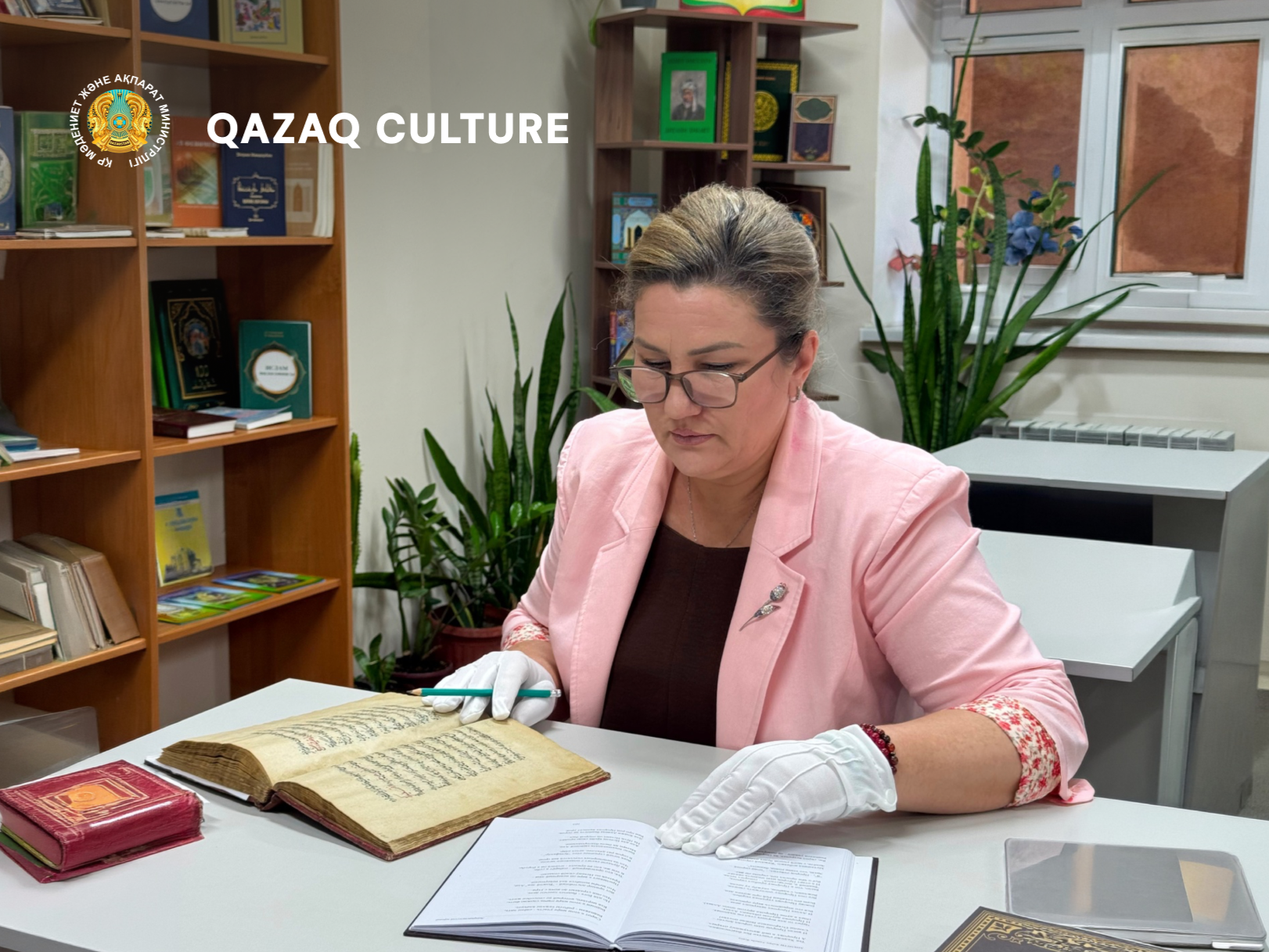
An ancient manuscript rarely comes to a museum directly from the depths of time. Between the person who once copied the text by hand and a modern researcher, there can be dozens of owners, several generations of a single family, and hundreds of years of history. Some books were carefully preserved as family heirlooms, others passed from hand to hand, and still others are discovered today by scholars in museum and library collections around the world.
The collection of the National Historical and Cultural Museum-Reserve "Aziret Sultan" contains 158 manuscripts. Among them are the Quran and religious treatises, Sufi literature, hikmats, shezhire, qissa-dastans, and works on Arabic grammar. But the written legacy associated with Khoja Akhmed Yasawi and the Yasawi tradition occupies a special place. How do scholars determine the age of a manuscript, what new information can different copies of the "Diwani Hikmet" reveal, and why are important texts sometimes discovered not in archives but in family collections? Qazaq Culture discussed these topics with Alena Baltabaeva, PhD in Philosophy and Associate Professor, Head of the Manuscript and Rare Book Research Department at the Yasawitanu Research Center.
– If we imagine the collection not as a collection of old books, but as a kind of map of Turkestan's intellectual life, what do we see there?
– Very diverse layers of written culture. The collection currently contains 158 manuscripts: Qurans and individual suras, tafsirs, works on fiqh, aqida, and sharia, stories of the prophets, prayers, amulet texts, Sufi literature, hikmets, qissa-dastans, works on saints, genealogies, and works on Arabic grammar.
The language is also diverse. There are Arabic and Persian texts, Turkic manuscripts, works from the Chagatai literary tradition, and Kazakh texts written in Arabic script.
Most of the precisely dated manuscripts date from the 18th to 20th centuries, but recent acquisitions include some from the 16th century.
Therefore, we view this collection as much more than just a collection of religious literature. It allows us to study the book culture, education, language, and spiritual and intellectual history of Turkestan and Kazakhstan over several centuries.
– When it comes to manuscripts, age seems to be the primary criterion for value. Is this true?
– Not quite. Of course, age matters, but the rarity of the text, its content, its history, and its scholarly potential are equally important.
For example, among the recently acquired collection of 17 manuscripts and rare books, there is a work dated 1544. Another valuable work is a 1724 collection of the Persian works "Musibatname" and "Iskandarname," the description of which notes a connection with the legacy of Khoja Ahmed Yasawi.
There is a 1735 manuscript of "Maslakul Muttaqin"—a work on faith, religious and ethical principles, and the earthly and eternal life of man. It helps us understand the texts that were part of the intellectual circulation of 18th-century Central Asia.
The three-volume "Magarij un-Nubuat," dedicated to the life of the Prophet Muhammad and the history of prophecy, deserves special attention. According to our data, this is a rare work for Southern Kazakhstan that has not yet received comprehensive scholarly study.
—Is it possible to discover unknown pages of Yasawi's legacy today? It would seem that the main texts have long been studied.
—This is precisely where a very interesting field of research is now opening up. Manuscript versions of works related to Yasawi and the history of the Sufi tradition, previously not specifically examined in our research, have been discovered in St. Petersburg, Moscow, and Tashkent.
A special focus is the manuscript tradition of the "Diwani Hikmet." The St. Petersburg manuscript contains hikmets and other materials related to Yasawi. Comparing it with the Tashkent and other versions, we can see differences in the composition of the texts, their sequence, and understand how they were disseminated.
Therefore, the most important discovery for us is not just one sensational find. Much more interesting is that texts, currently located in different cities and countries, can be collected into a single research space. In this way, the path by which Yasawi's legacy was transmitted over the centuries is gradually being reconstructed.
– So, the "Diwani Hikmet" is only part of a much larger written tradition?
– Exactly. We have several manuscripts of the "Diwani Hikmet" in our collection. One of the older versions dates back to approximately 1845 and contains 326 pages. Recently, a manuscript of "Hikmets" from 1834, containing 120 hikmets, was discovered among materials transferred from the Sauran region.
But Yasawi's legacy is not limited to these. The "Pakırnama," "Risala dar adabi tariqa," "Mirat ul-Qulub," and other works are associated with this tradition. They allow us to explore ideas about spiritual perfection, dhikr, the rules of the Sufi path, and the relationship between mentor and disciple.
Also very important are the nasabnama—genealogical texts—and the shezhire of the sheikhs. These allow us to study not only genealogies but also spiritual succession, the circle of sheikhs, the silsila, and the formation of the authority of saints. When considering all these sources together, it becomes clear: we are dealing not with a single work, but with a written tradition that has lived and developed over several centuries.
– How do manuscripts even end up in a museum after hundreds of years?
– Each has its own path. A significant portion was kept in families for a long time and passed down from generation to generation. Some then donate their ancestral heritage to the museum, while other items are acquired for the collection in accordance with established procedures.
Moreover, sometimes the history of the owners is no less interesting than the manuscript itself. It is important to know which family it belonged to, what region it came from, and to whom it was passed. All this helps reconstruct the history of the text's dissemination.
A good example is related to "Bustan ul-Mukhibbin." When textual scholar Ulykbek Zhunisbaev was studying the known copies of this work in 2009, an elderly man came to the museum and brought another handwritten version, which, according to him, was brought from Uzbekistan. This proved a valuable addition to the comparative study. Another example is 17 manuscripts and rare books, long held in a private family collection in the Sauran region and recently donated to the museum.
Such stories suggest that many unknown manuscripts are still preserved in family archives.
– Let's say an old book with no clear date or author's name is brought to the museum. How do scholars make it "speak"?
– A kind of detective work begins. We study the paper, ink, handwriting, binding, page size, number of lines, design, seals, ownership records, and marginalia.
If there's no title, we examine the beginning and end of the text, its structure, any mentions of the author, and compare the work with other manuscripts, catalogs, and publications.
The colophon – the scribe's final inscription – is very valuable. It may contain their name, year, month, and sometimes even the day and place where the work was completed. If there is no colophon, the manuscript must be dated based on its handwriting, spelling, paper, watermarks, ink, and comparison with known texts.
Language is a particular challenge. A single Turkic text can simultaneously contain Chagatai, Kipchak, Oghuz, and local linguistic elements, as well as Arabic and Persian vocabulary.
Therefore, a single detail rarely provides a definitive answer. A manuscript reveals its biography gradually—when textual criticism, paleography, codicology, linguistics, and source studies begin to work together.
And, perhaps, this is one of the most astonishing features of manuscript heritage. A book, treasured for centuries in a single family chest, may today prove to be a missing piece of a larger story—and help us understand how Yasawi's ideas traveled through the centuries and reached our time.