Nomad Code: How Zheti qazyna explains the true values of the Kazakh people
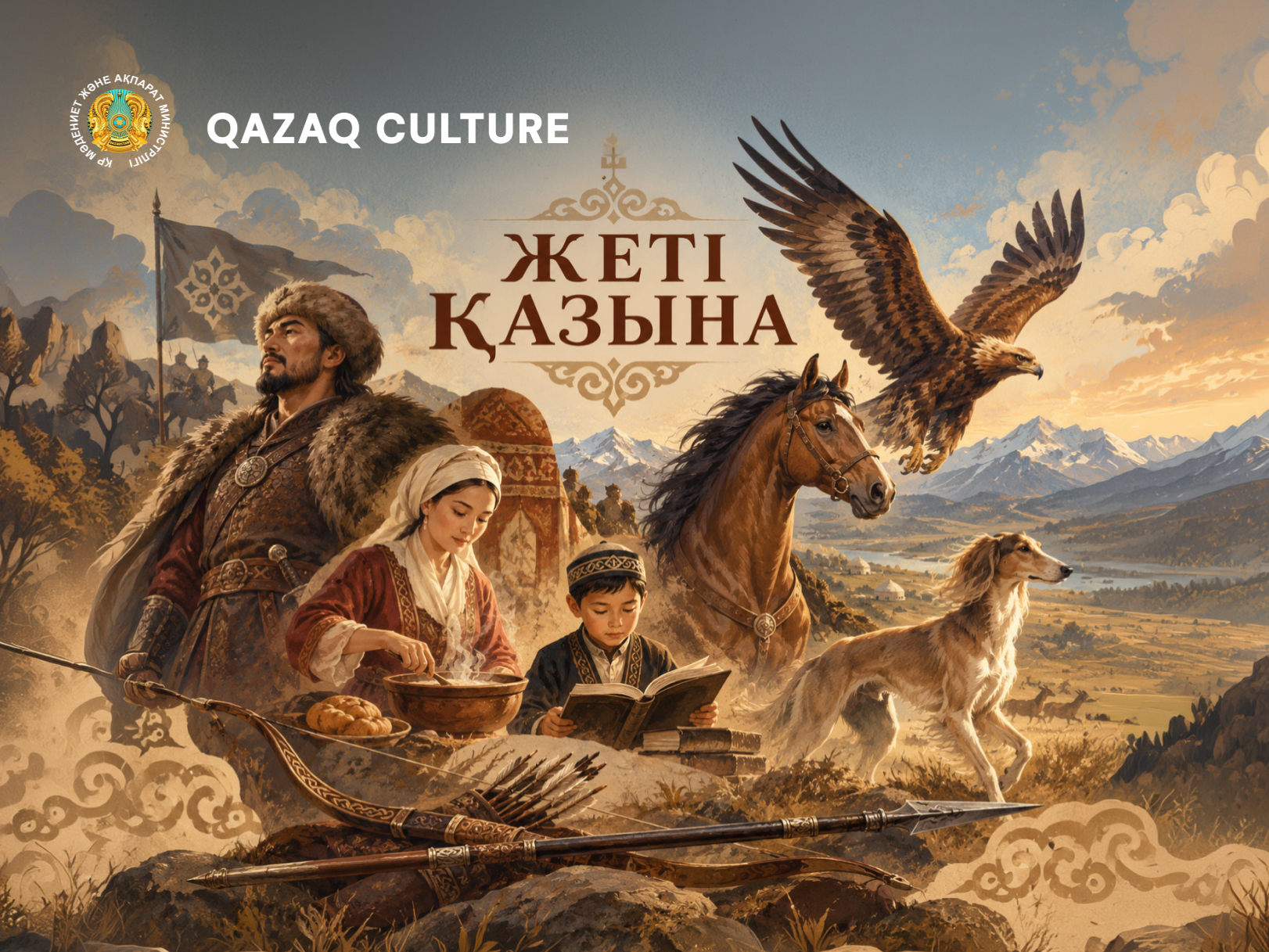
The Great Kazakh Steppe holds countless secrets. For thousands of years, it was a cradle of civilizations where technologies, state alliances, and unique philosophical systems that were ahead of their time emerged. The wisdom of the steppe is encoded in the traditions and cultural codes of ancient nomadic civilization.
For modern people, wealth is often measured by the numbers in bank accounts, car brands, and square meters of real estate. For Kazakh nomads, however, true abundance was measured quite differently. The concept of “Zheti Qazyna” (Seven Treasures) represents a unique system of values in which spiritual strength, the continuation of the family line, loyal companions, and the tools necessary for survival in a harsh yet beautiful world are harmoniously intertwined.
Let us look back through the centuries and discover what lies behind this sacred number.
The jewel of nomadic civilization — the tradition of “Zheti Qazyna” (Seven Treasures) — is not simply a list of material possessions or living beings. It represents a profound philosophical system, a code of honor, and a set of life principles of the Kazakh people. In the worldview of their ancestors, this concept brought together everything that made a person strong, independent, and spiritually rich in the harsh conditions of the Great Steppe.
Here is the sacred meaning of each of these seven elements.
Er Zhigit (The Warrior Man)
The head of the household and its principal protector. In nomadic society, men carried a heavy responsibility: guarding the borders of their homeland, ensuring the safety of their people, taking part in military campaigns, and making the most important decisions concerning the tribe.
Er Zhigit embodies courage, justice, loyalty to the homeland, and the willingness to sacrifice himself at any moment for the future of his people.
Sulu Aiel (The Beautiful Wife)
The guardian of the family hearth, the continuer of the family line, and the embodiment of harmony. Kazakhs believed that a man’s well-being and success outside the home depended directly on the wisdom and support of his life partner.
In the traditional understanding, a woman’s beauty was not limited to physical attractiveness. It included intelligence, compassion, the ability to create comfort, preserve the family hearth, welcome guests, and raise worthy children.
Bildek (The Wise Child / Knowledge)
In some interpretations, this element is described as “ilim-bilim” (knowledge) or “aqyldy urpaq” (wise offspring). For nomads, whose lives depended on their ability to read the signs of nature, navigate by the stars, and negotiate with neighboring peoples, intelligence and the continuity of generations were matters of survival.
A child who has absorbed the wisdom of their ancestors and strives for knowledge is a guarantee that the family line will not die out and that its culture will not disappear with the passage of time.
Zhuyrik At (The Swift Steed)
The importance of the horse in the culture of the Great Steppe cannot be overstated. This is reflected in the traditional saying: “Qanattyga qaqtyrmagan, tuyaktyga baqtyrmagan” — referring to a horse and rider who know no equal.
For a nomad, a swift steed was not merely a means of transportation or a loyal companion in barymtau or battle; it was a source of pride and freedom. A fast and enduring horse could save a person’s life in the steppe and allow them to cover enormous distances.
Qyran Burkit (The Golden Eagle)
The golden eagle is a symbol of pride, nobility, freedom, and unparalleled mastery of hunting.
Traditional eagle hunting, known as qusbegilik, was elevated in Kazakhstan to the level of a highly respected art. A trained bird of prey provided a family with meat and valuable furs during harsh winters. For batyrs, the golden eagle was also a loyal companion that emphasized the status and prestige of its owner.
Algyr It (The Loyal Dog — Tazy)
The Tazy, a traditional Kazakh hunting sighthound, is a source of national pride for the Kazakh people. Its exceptional endurance, incredible speed, and keen intelligence made this breed an indispensable hunting companion.
Tazy dogs were valued so highly that, according to traditional accounts, a good dog could be exchanged for a herd of horses. In steppe legends, the Tazy is said to have the ability to sense danger and protect its owner at the cost of its own life.
Qaru-Zharag (Weapons)
The weapons of a true zhigit — bow and arrows (sadaq), saber (qylysh), spear (naiza), and battle axe (aibalта) — complete the list of the Seven Treasures.
In conditions of constant internal conflicts and external threats, weapons were the principal guarantee of independence and freedom. They were treated with great reverence and passed down from father to son, with people believing that the spirit of their ancestors lived within the steel of the blade.
The Seven Treasures of the Kazakh people form a complete circle of existence: there is someone to protect — the warrior; someone to love and care for — the wife; someone to teach — the children; means of transportation and hunting — the horse, dog, and bird; and something with which to defend one’s freedom — weapons.
Understanding “Zheti Qazyna” allows us to gain a deeper insight into the philosophy of the nomads, for whom the material world was always inseparably connected with spirituality and respect for the world around them.
Looking back across the centuries, “Zheti Qazyna” reveals itself not simply as a museum artifact or a tribute to history, but as a timeless guide for life.
There is no gold or precious stones on this remarkable list, because the true treasures of a Kazakh person have always been living values: devotion to duty, love for one’s loved ones, the wisdom of children, loyalty of four-legged companions, and the readiness to protect one’s home.
By understanding the philosophy of “Zheti Qazyna,” we can better appreciate the unbreakable connection between generations and the profound harmony with the world that our ancestors carried through the centuries.