In the Footsteps of Ancestors: How Akylbek Tampiev Transforms Memory into Art
Some artists seek their subject matter in travel, urban environments, or abstract images. Akylbek Tampiev often turns to what seems familiar down to the smallest detail: the steppe, a horseman, a home table, family memory, familiar gestures and objects. But it is precisely this familiarity that conceals for him the space for a larger conversation – about time, heritage, and the human connection to the past.
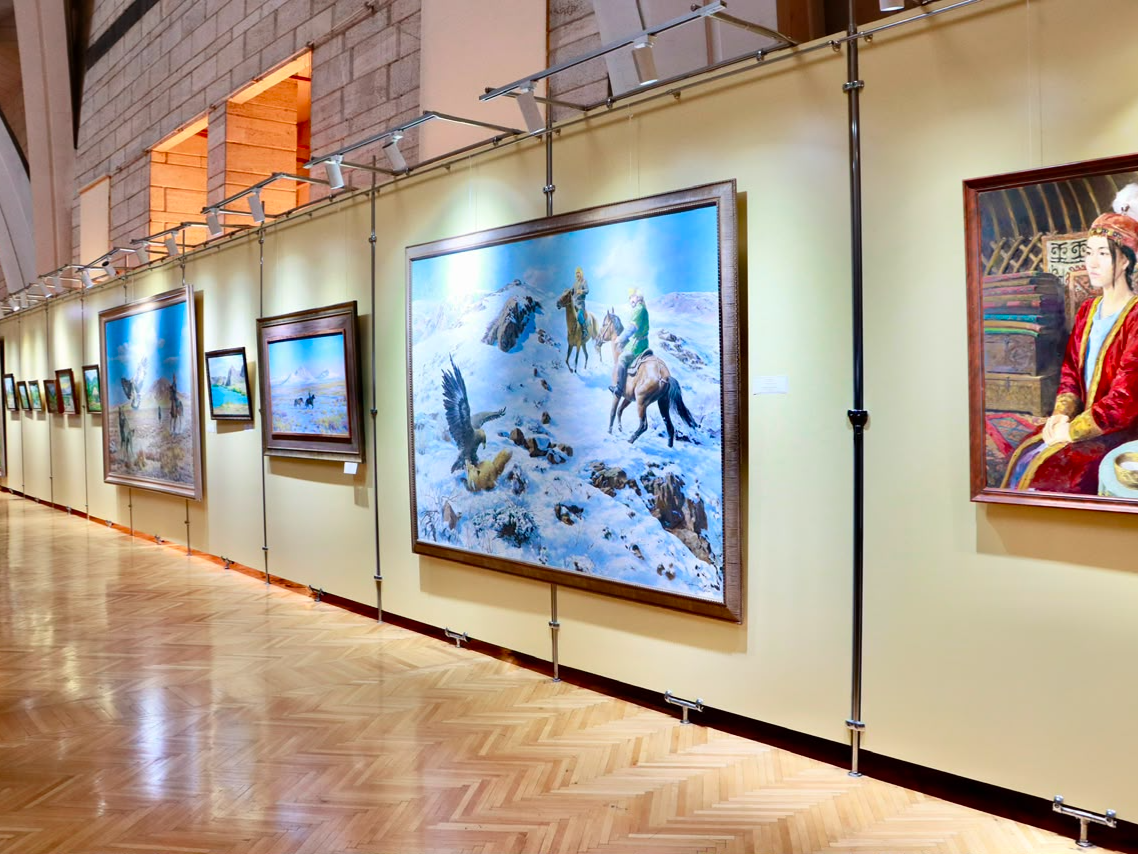
The artist's solo exhibition, "In the Footsteps of Ancestors," which opened at the National Central Museum of the Republic of Kazakhstan, brings together approximately 55 works. Formally, these are landscapes, still lifes, and genre compositions. But if you look at the exhibition as a single narrative, it becomes clear: the protagonist here is not an individual or even nature, but cultural memory.
Akylbek Tampiev came to art through academic school. After graduating, he entered the art and graphic arts department of the Abai Kazakh Pedagogical Institute, and then worked for many years in design, continuing his artistic practice. Today, he continues to pursue creative endeavors and teaches drawing at the Aizere Art School in Almaty.
Over the years, Tampiev has participated in national and international exhibitions and art projects, but his own artistic language is particularly marked by something else—a desire to combine professional painting with a direct sense of nature and everyday life.
In his paintings, there is no desire to turn national themes into decorative symbols. The steppe here is not simply a backdrop, but a space in which a person's character was formed. Traditional objects are not mere museum attributes, but continue to live within family history. Even a familiar, everyday subject becomes a way to speak about much deeper things.
One of the exhibition's central works is "Lord of the Expanses." At the center of the canvas is a steppe horseman, an image that has long been one of the most recognizable symbols of Kazakh culture. But Tampiev does not limit himself to a striking figure against a backdrop of endless space. His horseman seems to exist within the steppe itself, becoming an extension of it. This composition conveys freedom, inner dignity, strength, and the human habit of living in constant dialogue with nature. The space around the subject does not overwhelm him with its scale, but rather emphasizes the connection between man and the earth.
The artist uses a completely different language in his work "Tea at Mom's."
There is no broad horizon or epic scope here. Instead of a horseman, there are household objects, and instead of the steppe, there is the intimate space of a family table. But this does not diminish the painting's emotional power.
Ordinary tea becomes a memory of home, care, and intimacy. Objects cease to be mere elements of a still life and begin to hold a human presence. For the artist, it is precisely these seemingly insignificant moments that often prove to be the most enduring images of memory.
The contrast between "Lord of the Open Spaces" and "Tea at Mom's" largely explains the very logic of the exhibition. For Tampiev, heritage exists in several dimensions at once. It is both a grand historical and cultural image of the steppe and an almost intimate memory of the family home. One cannot be separated from the other.
Therefore, the title "In the Footsteps of Ancestors" here does not sound like a literal reference to the past. The artist does not attempt to reconstruct a bygone era. Rather, he seeks what from it continues to live in modern man—in his sense of space, his attitude toward family, his habits, his visual memory, his concept of beauty.
This is how the distinctive character of his landscapes emerges. Tampiev works within the realistic tradition, but nature in his works rarely remains simply nature. It sets the mood, becomes a participant in the plot, and helps reveal a person's inner state.
This reflects the artist's plein air experience: attention to light, air, space, and the variability of color. The academic school provides compositional precision, while direct observation of nature provides a vivid sense of the moment.
Despite the diverse subject matter, the works in the exhibition are united by a single thought. History, nature, traditions, and family memories do not exist separately here. Together, they form a conception of what shapes human identity. That's why "In the Footsteps of Ancestors" is not so much an exhibition about the past as a reflection on the present.
We inherit more than just objects, customs, or images. We inherit ways of seeing the world, feeling a connection to the land, remembering loved ones, and understanding our place within a larger history.
Akylbek Tampiev translates this memory into the language of painting—sometimes through the figure of a horseman in the steppe, sometimes through a cup of tea on the table.
And perhaps this is precisely the exhibition's main message: traces of ancestors don't always have to be sought far away. Sometimes they are found in the most ordinary things, things we simply stopped looking at closely long ago.