Five things that hold the memory of the steppe: the secrets of Kazakh ethnographic objects
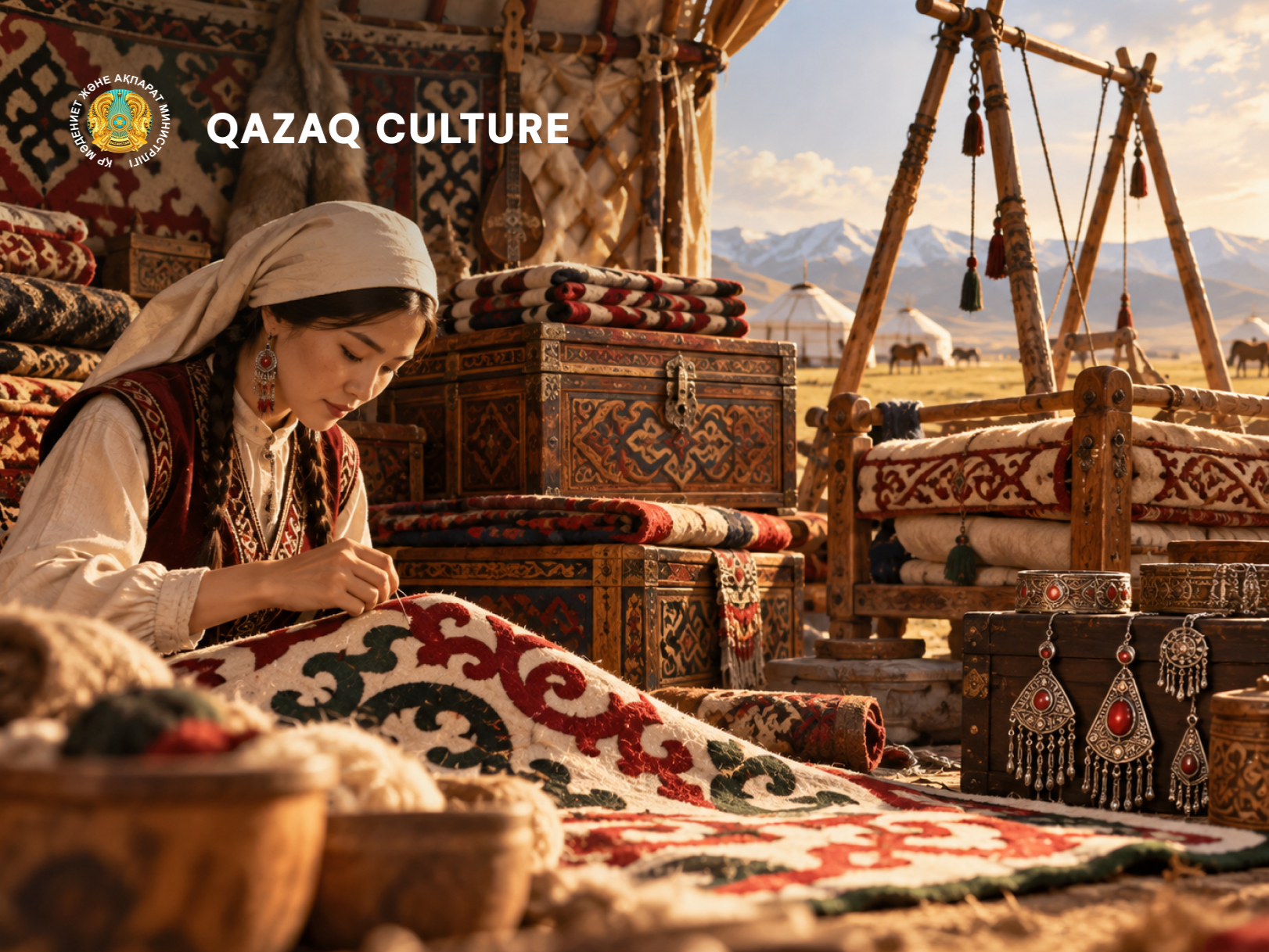
Sometimes, it's not chronicles, but objects, that tell the story of the past. The pattern on an old tukkiyaz, the carved surface of a kebezhe, a silver earring, or a wooden adalbaqan can preserve much more than meets the eye. They contain ideas about beauty, the structure of a home, family traditions, craftsmanship, and the daily life of several generations.
The collections of the Otyrar State Archaeological Museum-Reserve contain objects that were once part of everyday Kazakh life and have now become valuable ethnographic evidence. Together with specialists from the Ethnography Department, we explore the stories hidden behind five familiar objects – tukkiyaz, kebezhe, tösek aqash, adalbaqan, and traditional earrings.
Tukkiyaz: a pattern that set the mood of a home
Tukkiyaz was never just a wall decoration. It was placed in the interior of the home in place of a carpet, and it largely determined the visual character of the space.
According to Zhadyra Uskenbaeva, a researcher in the Ethnography Department, traditional tuskiiz were made from velvet, silk, cloth, cotton, and other materials. The base was most often white or black felt, over which patterns cut from colored fabric were placed. In other cases, the pattern was created with embroidery.
But the main expressiveness of such a piece lay not so much in the material as in the composition. On the surface of the tuzkiyz, one can find "koshkaar mүyіz," "syңar mүyіz," "arқar mүyіz," "tarmaқty mүyіz," "syңar өkshe," "tөrt құlaқ," "irek su," and other traditional motifs. The central part, for example, could be occupied by a "koshkaar mүyіz," around which a more complex composition of horn-shaped ornaments unfolded. Along the edges, an "irek su" often ran, connecting the individual elements into a single rhythm.
Tuzkiyz also had regional characteristics. In southern Kazakhstan, it was traditional to create it on a base of white or black felt, decorating the surface with colored fabric appliqués. The edges could be trimmed with chintz or a solid-colored fabric, which both strengthened the piece and gave it a finished look.
Strict repetition of a single pattern was not required.
"The craftswoman's creative exploration was of great importance. She personally selected the color and texture of the fabric, as well as the combination of patterns. Rich red, blue, green, yellow, black, and white shades allowed for completely different solutions. Therefore, even tushkiiz, made using the same principle, rarely turned out identical," notes Zhadyra Uskenbaeva.
Thus, a common household item simultaneously became a space for individual creativity.
Kebezhe: When a Chest Becomes a Work of Art
Today, we often see kebezhe in museums. But once, they were primarily an essential everyday item.
Wooden chests were used to store food, dishes, clothing, and other items. For nomadic life, their durability, compactness, and ease of transport were especially important. Department employee Gulhan Mayabasova notes that traditional kebezhes had a generally similar design, but the manufacturing methods and appearance could vary depending on the region.
The most common form consisted of four walls, a bottom, and a lid. The parts were joined together to withstand long-term use and frequent travel. There were also special versions adapted specifically to nomadic life, including models with four ledges and two internal compartments.
However, practicality did not necessarily mean simplicity.
The wood surface was decorated with carvings and ornaments. Common motifs included the "tört kulah" and "koshqar müyÖz." Several such kebezhes are currently housed in the collections of the Otyrar State Archaeological Museum-Reserve. On the front of some pieces, a large "tört kulah" (a symbol of the heart) forms the compositional center, while the surrounding "koshqar müyÖz" (a symbol of the heart) elements create rhythm and fill the space. Thus, an ordinary chest is transformed into a work of decorative art.
A special place is occupied by süyektelgen kebezhe (pieces decorated with bone).
Department Head Aklima Zhumasheva explains that the surface of such kebezhe (pieces decorated with bone) was decorated with geometric bone plates. One of the museum pieces features six diamond-shaped elements, with wave-like patterns running between them. Circles are carved into the centers of the small bone pieces, and the edges are decorated with the "irek su" (a symbol of the heart).
Specially prepared horse and camel bones, as well as goat, argali, saiga, and ibex horns, were used for this decoration.
The master faced a challenging task: to create an object that was simultaneously durable, comfortable, and beautiful. It is this combination of functionality and artistic design that makes the kebezhe so special.
Tösek ağaş: a bed as part of an artistic space
Another item that is difficult to imagine in a traditional interior is the tösek ağaş, a wooden bed.
Mira Akhmet, a senior researcher at the Ethnography Department, notes that such items were widely used in the 19th and 20th centuries.
Depending on the design, there were various varieties, including syrly tösek, oyuly tösek, süyektelgen tösek, kümіstelgen tösek, and other varieties. Interestingly, craftsmen usually meticulously decorated the part of the furniture that was visible.
One of the museum pieces is built on four legs, and its headboards are slightly curved backward. Almost the entire surface is covered with ornamentation. Horn-shaped motifs, particularly the "kos muyiz" motif, as well as cosmogonic elements, play a central role in the composition.
For the master, ornamentation was not an addition applied after the object was made. It became part of the very structure and visual image of the piece.
"Each pattern not only decorated the furniture but also reflected the people's traditional beliefs about nature and the surrounding world. Therefore, such an object allows us to see the connection between furniture making and the culture of national ornamentation," says Mira Akhmet.
Adalbaqan: a household object transformed into a sculpture
The adalbaqan's function was extremely practical – it was used to hang clothes and various other objects. It was placed near the entrance to a yurt or attached to a kerege.
But the museum specimens demonstrate how far the master could go from simple utilitarianism.
Tour guide Gulmira Arystanbaeva draws attention to one of the adalbaqans kept in the museum. The tall wooden trunk is completely covered with carved floral designs. As they ascend, the decorative elements become more elongated, and the composition is completed by an image of a crescent moon.
The lunar element is made of light-colored metal and mounted on a wooden base.
Metal appears in other parts of the piece as well. Three large sections hold eight hooks, and the trunk itself is further decorated with metal arches in several places. The upper part is painted red and green, complementing the natural tone of the wood.
As a result, an object created for the simplest everyday task acquires an almost sculptural expressiveness.
The adalbaqan demonstrates a characteristic feature of traditional craftsmanship: the boundary between useful and beautiful practically disappears.
Earring: A piece of jewelry that could tell a story about a person
Kazakh jewelry art particularly clearly demonstrates the richness of meaning that a small object can convey.
The collection of the Otyrar State Archaeological Museum-Reserve contains silver earrings from the 19th and 20th centuries, collected from various settlements. Sabira Aitbay, a researcher in the Ethnography Department, explains that artisans used a variety of techniques—molding, engraving, metal twisting, and embossing. The earrings themselves varied in both shape and decoration.
Museum specimens include semicircular "ai syrga," elongated "sabaqty syrga," earrings with pendants and tassels, as well as triangular and diamond-shaped varieties.
Silver was decorated with niello, granulation, and fine patterns. Some earrings were inlaid with carnelian and coral. Coral decoration was especially common in jewelry typical of the southern regions.
But an earring could have more than just aesthetic value.
According to Sabira Aitbay, some families had a custom of placing an earring on a long-awaited or late-born boy, hoping to protect him from the evil eye. When the child grew older, the earring was removed, turning this moment into a family event.
The earring also played a role in wedding rituals. During matchmaking, placing an earring on a girl signified the agreement between two families and her new status as a future bride.
A small silver ornament could thus simultaneously be a work of jewelry, part of a ritual, and a sign of a certain stage in a person's life.
Objects that continue to speak
Tusks, kebezhe, tösek ağaş, adalbağan, earrings – all these objects were once found inside an ordinary home and served very specific functions.
Today, in a museum collection, they offer a much closer look at traditional culture.
They reveal how artisans worked with wood, felt, fabric, bone, and metal, what ornaments they favored, and how they combined practicality with artistic taste.
But perhaps the most interesting part lies elsewhere. These objects weren't created as future museum exhibits. They were used every day: kebezhes were used to store essentials, adalbaqan was used to hang clothes, a silver earring occupied its place in the home, a silver earring adorned the wall, and silver earrings accompanied a person through important moments in life.
That's why ethnographic objects allow us to see history not only through major events and dates, but also through everyday life—through what people surrounded themselves with, what they considered beautiful, and what traditions they wanted to pass on to the next generation.