When Circus Becomes Theater: How Cirque du Soleil's OVO Changed the Stage
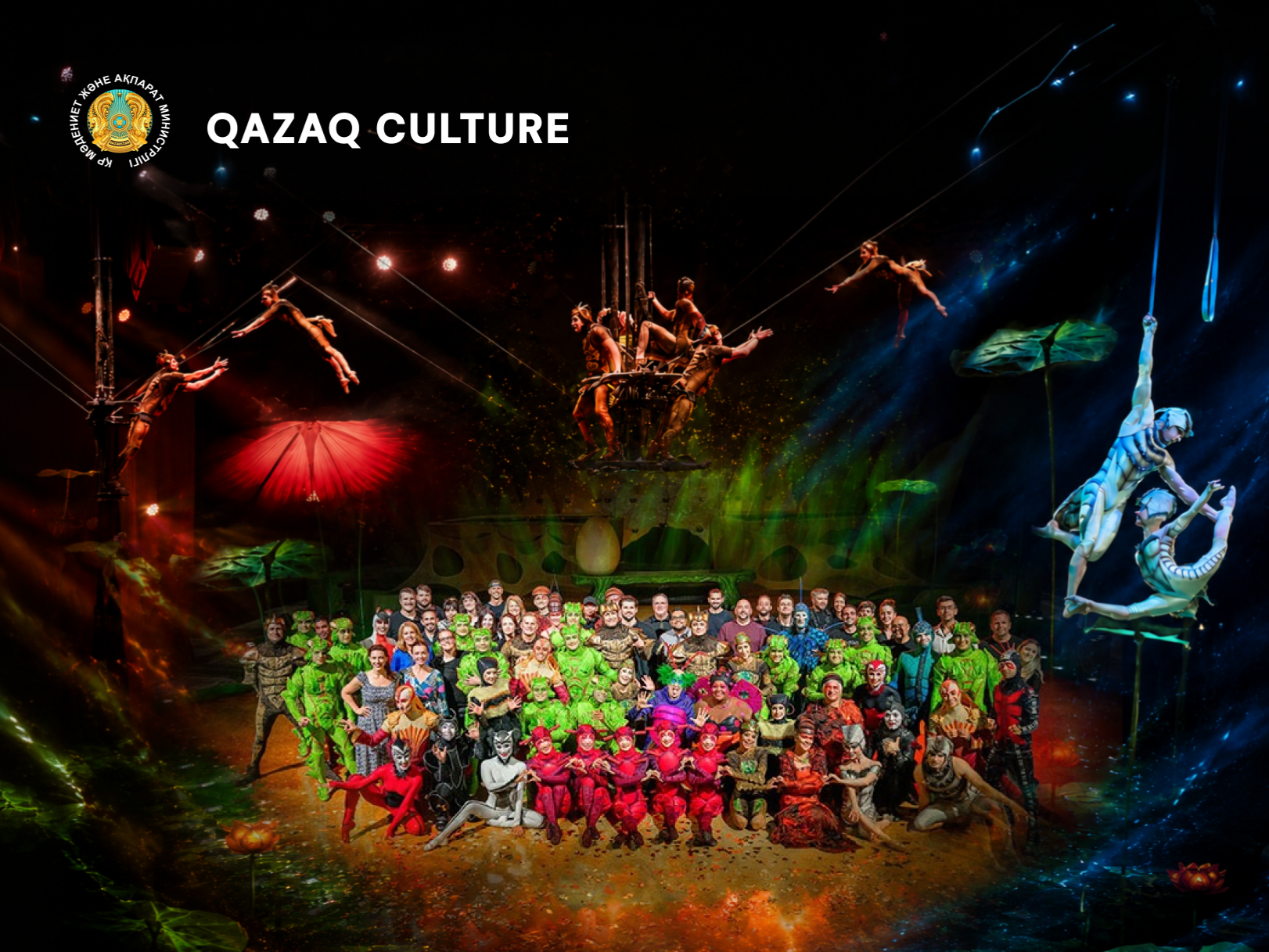
There are performances that the audience watches. And there are those into which they seem to step. OVO by Cirque du Soleil belongs to the latter. For several days, Almaty Arena transformed not just into a venue for the world-renowned troupe's tour, but into a distinct, living universe – vibrant, strange, fluid, and almost hypnotic.
For Almaty, the arrival of Cirque du Soleil was not an ordinary cultural event, but an encounter with a type of stage art where the circus has long ceased to be just a collection of complex acts. In OVO, acrobatics, theater, music, choreography, costume, and light exist as a unified system. What matters here is not only how complex a trick is, but also what emotion it evokes, how it works within the story, and why the audience, holding its breath, watches not the technique, but the life of a fictional world.
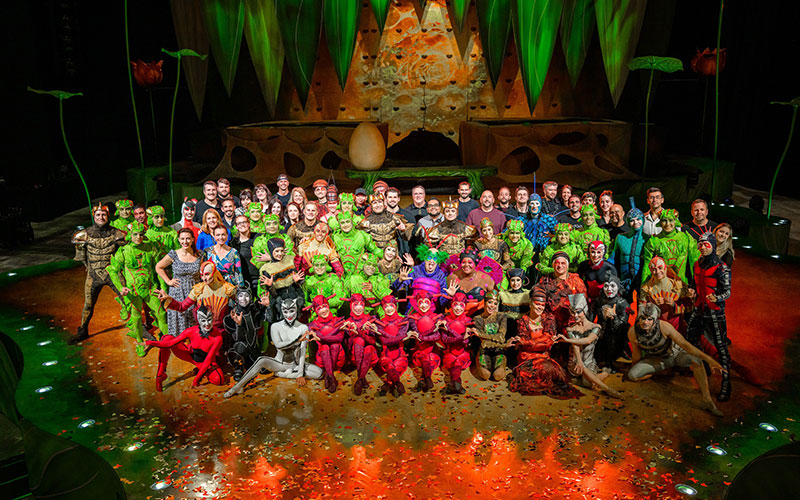
The name OVO translates from Portuguese as "egg." This mysterious object becomes the starting point of the performance. It appears in the insect world and disrupts the usual order. Around it arises curiosity, anxiety, play, movement, and attraction. Butterflies, ants, beetles, spiders, and other inhabitants of a fantastic microworld come alive on stage. But the power of the production lies not in showing a colorful "insect encyclopedia." Something else is much more interesting: through this microworld, Cirque du Soleil speaks about living nature as a space of constant movement, clash of characters, search, and renewal.
OVO doesn't explain itself directly. It operates through rhythm, fluidity, and visual images. The viewer doesn't need to follow a complex plot – it's enough to enter its atmosphere. In this performance, the world is built from movement: someone crawls, someone flies, someone balances on the verge of falling, someone appears suddenly and disappears just as quickly. All this resembles life seen under a magnifying glass, where even the smallest gesture becomes an event.
It's particularly interesting that behind the apparent ease of the show lies an almost engineering precision. Before the premiere, journalists were shown behind the scenes of OVO – the part of the performance that the audience usually doesn't see. And it is there that one understands how the magical effect is created. While the hall is still empty, the artists are already warming up, rehearsing sequences, checking interactions with partners, practicing elements on aerial straps, trampolines, and stage structures. Nearby, the technical team fine-tunes lighting, sound, and mechanisms. Costume designers prepare details of the looks that will later appear as a natural part of the characters on stage.
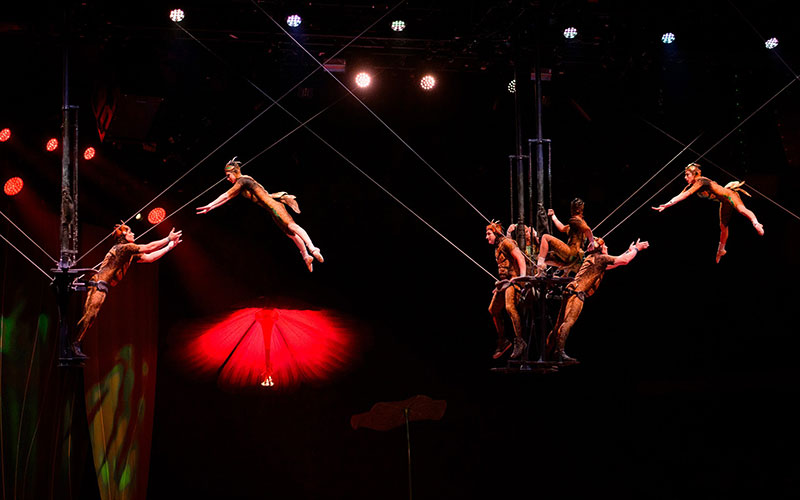
This backstage work shatters the romantic myth of magic as something sudden. Magic here is born from discipline. From hours of training, repetitions, body control, trust, and the ability of dozens of people to work in one rhythm. Perhaps this is why Cirque du Soleil makes such a strong impression: the audience sees the lightness, but intuitively feels the scale of the effort behind each act.
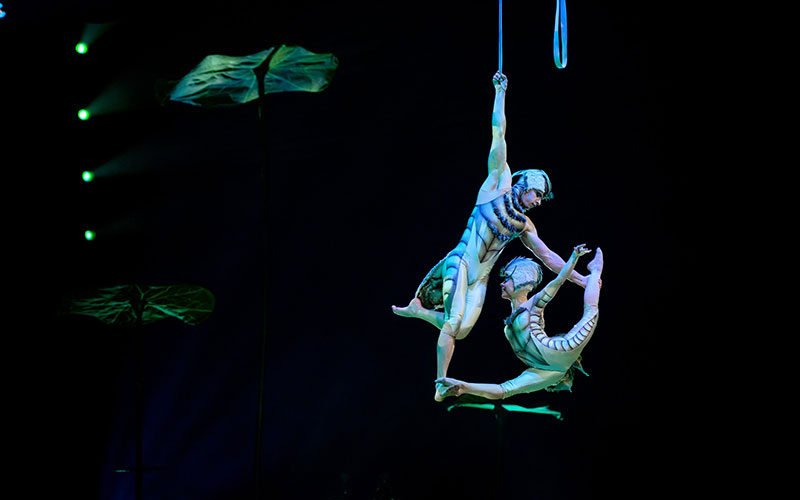
OVO features many scenes built on this delicate balance between danger and beauty. One of the most impressive episodes is the slackwire act performed on a huge swaying leaf. It creates a tension that literally silences the hall. Each step of the artist seems simultaneously precise and impossible. In another scene, diabolo juggling transforms into a play of light and darkness: ultraviolet flashes make the movement almost graphic, as if a light drawing appears in the air.
But OVO does not turn into a demonstration of records. Its main strength lies in its ability to combine the most complex technique with emotional accessibility. There is humor, naivety, a romantic storyline, elements of play, and a constant feeling of celebration. The clown characters do not appear as a pause between acrobatic acts. They lead the audience through the story, set the tone of the performance, and help maintain the connection between the stage and the audience. Ladybug, The Traveler, and Master Flipo become not just heroes, but guides into this strange, vibrant, and somewhat childish world.
Music holds a special significance. In OVO, it sounds not as a background, but as the living nerve of the performance. A vocalist and seven musicians create the atmosphere in real-time, setting the temperament and breath of the action. Thanks to this, the stage doesn't feel like a pre-assembled mechanism. It lives in the here and now, changing with the artists and the audience's reaction.
The costumes in OVO also work not just for beauty. Approximately 800 elements of the stage images were handcrafted in Montreal and adapted for each artist. Everything is important in them: form, texture, color, the ability not to hinder movement, and at the same time, to reveal the character's personality. Therefore, the costume here becomes part of the choreography. It doesn't just show who is in front of us, but helps to understand how this character moves, how they exist, and what place they occupy in the overall world of the performance.
The production was created by director and choreographer Deborah Colker. She managed to do a rare thing: build a vibrant circus universe completely dedicated to the world of insects, yet not confine it to mere decorativeness. OVO remains a human story. It contains wonder before the unknown, fear of change, a desire to approach others, the joy of discovery, and the energy of life, which is stronger than any chaos.
The scale of the project is impressive in itself. The show has been on world stages for 17 years, seen by over 10 million spectators in 47 countries. The Kazakhstan tour involved a team of more than 100 people representing 25 countries. 53 artists took to the stage – acrobats, gymnasts, and high-level athletes, including world champions. But all these numbers are not important as a reason to admire statistics. They show how complex the nature of modern circus has become. Today, it is a global industry where art requires no less organization than a large technological production.
For Kazakhstan, the arrival of Cirque du Soleil is also important as a professional exchange. The tour included not only shows for a wide audience. Over 200 tickets were freely given to children from orphanages, social institutions, and children with special needs. In addition, a private meeting between Cirque du Soleil artists and students from Kazakh circus schools was planned. For young artists, this is an opportunity to see not only the brilliance of a global brand, but also the internal culture of the profession – discipline, training systems, attitude towards the body, the stage, and the audience.
OVO in Almaty served as a reminder that modern circus has long transcended the boundaries of its usual genre. It can be theater, a musical performance, a plastic poem, and a visual exploration all at once. There is no usual division into "act" and "plot," "trick" and "image," "technique" and "emotion." Everything works together, creating an effect of complete immersion.
And, perhaps, that is why the audience left the hall with a feeling not just of having seen a show, but of having experienced a celebration. Cirque du Soleil knows how to restore an adult's childlike capacity for wonder. But it does so not through simple spectacle, but through mastery, precision, and artistic imagination. Behind the lightness of OVO lies immense effort. Behind its vibrancy – a well-thought-out dramaturgy. Behind the fairy-tale world of insects – a universal conversation about life, movement, and constant renewal.
Almaty saw not just a touring performance. For several evenings, the city became part of a large world stage, where the circus speaks the language of theater, music – the language of movement, and the human body once again proves that its capabilities are far wider than they seem.