When the Archive Becomes a Playlist: Akhmet Zhubanov's Music Returns to the Listener
It all started with a blank Spotify page. Returning to Kazakhstan after twelve years in Austria, violinist Zhangir Zhubanov decided to search streaming sites for the music of his great-grandfather, Akhmet Zhubanov. A name without which it's impossible to imagine the history of professional music in Kazakhstan, it was almost invisible in the digital space. For someone accustomed to Bach, Bartók, or Shostakovich just a few taps away, this absence seemed especially paradoxical.
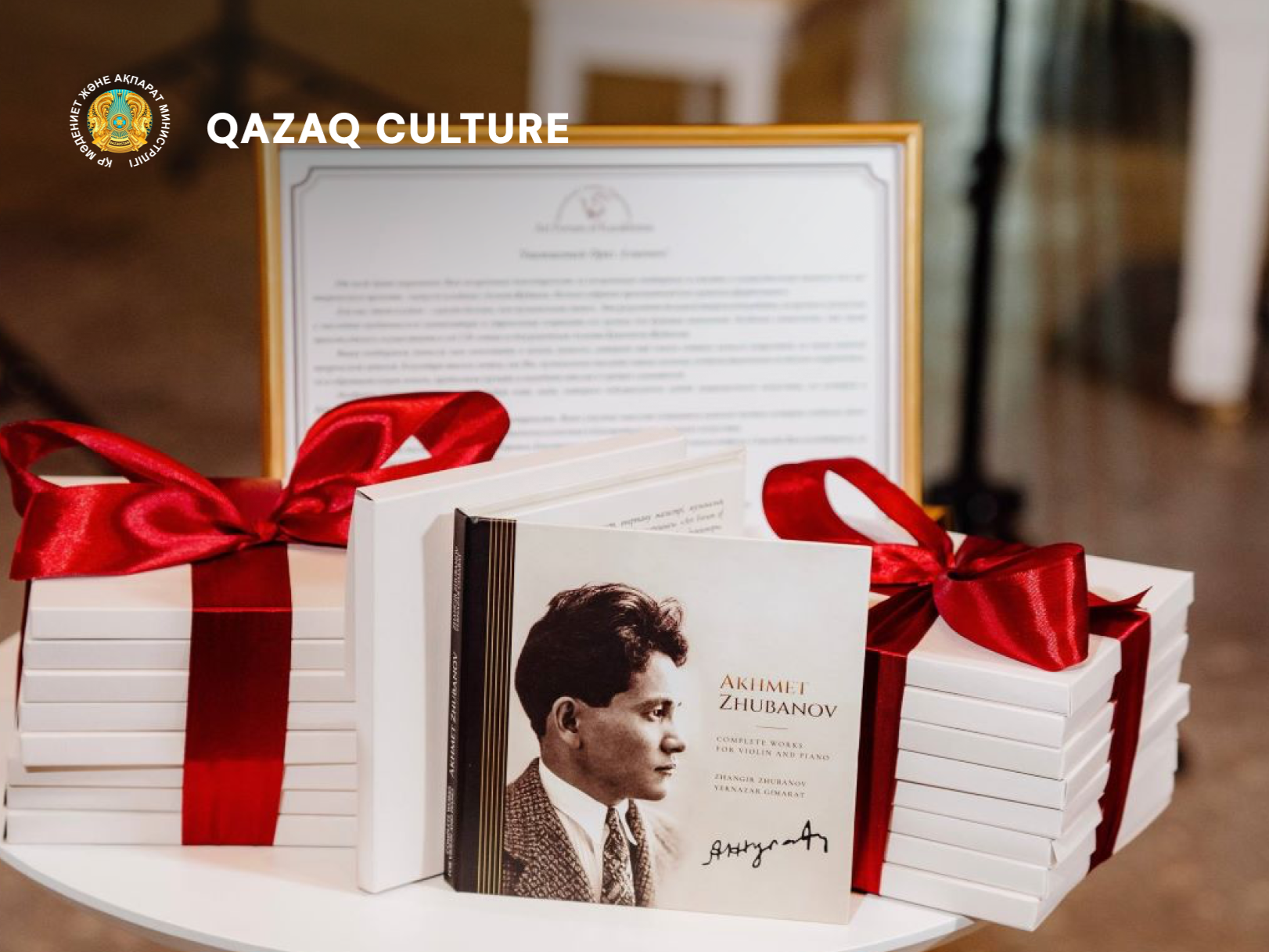
Thus arose the idea for the album "Akhmet Zhubanov. Complete Works for Violin and Piano," which Zhangir Zhubanov recorded with pianist Yernazar Gimarat. The project was presented in Almaty on the composer's 120th birthday, but its meaning extends far beyond the anniversary. It explores how 20th-century music integrates into the infrastructure of the 21st—and what happens to cultural heritage when it doesn't. Access to such works was once determined by sheet music libraries, records, radio, and concert halls. Today, the first encounter with a composer increasingly begins with a search engine. If a recording is unavailable on a familiar platform, for a significant portion of the audience, the work effectively falls outside the everyday musical experience. In the case of Akhmet Zhubanov, this gap is particularly noticeable. The composer, musicologist, folk music scholar, and one of the architects of Kazakhstan's professional musical culture left a legacy long embedded in the national canon. However, canon and accessibility are not the same thing. Music can have historical status and still remain difficult to access for new listeners.
The work of Zhangir Zhubanov and Yernazar Gimarat therefore began with more than just performance. The musicians had to return to surviving sheet music, search for existing versions of the works, and in some cases, rework the arrangements. The recording took place in the Great Hall of the Kurmangazy Kazakh National Conservatory. Thus, gradually, the complete works of Akhmet Zhubanov for violin and piano came to fruition in a modern professional recording.
There's a curious contradiction in this process. The digital release seems almost weightless: the music appears on a platform without a physical medium, the cover art appears on a screen, and a few seconds pass between the selection of a piece and the first sound. But behind this simplicity lies a work with the archive, the score, the performance tradition, and the question of how far a contemporary musician can go in their own interpretation of a past work.
For Zhangir, the project also became a conversation with family history. The album cover features a young Akhmet Zhubanov—not a monumental figure from a textbook, but a man at the beginning of his journey. This choice resonated with the performer's own position. After many years abroad, Zhangir connects this new stage of his life with Kazakhstan, and the recording of his great-grandfather's works became one of his first major projects after his return.
Here, family inheritance takes on a rather unusual meaning. Musical dynasties often talk about passing on a profession: a child sees an instrument at home, grows up among rehearsals, and then takes to the stage. But after several generations, another challenge arises – not simply continuing to make music, but redefining the relationship with the family's already established legacy.
Performing a great-grandfather's work simultaneously means establishing a very personal connection with him and maintaining a professional distance. A recording cannot be reduced to a purely family gesture of remembrance. The music must exist independently of the performer's name and withstand an encounter with a listener who knows nothing of the family ties. Therefore, pianist Ernazar Gimarat became an important partner in the project. The album is built not around the idea of a solo statement by a composer's descendant, but around an intimate dialogue between two young musicians and scores created several decades ago.
This idea was further developed at the presentation concert at the Almaty Museum of Arts. Zhangir Zhubanov and Yernazar Gimarat were joined by violists Adil Karimov and Ilkhan Tokhtakhunov, and the Giovani Talenti chamber orchestra under the direction of Arshat Sharip. Music prepared for digital recording returned to the medium for which it was originally created – live performance in front of an audience.
And herein lies, perhaps, one of the most interesting effects of the digitalization of classical music. Streaming doesn't necessarily replace a concert. Rather, it changes the route to it. A person can hear a piece for the first time on headphones, then find information about the composer, discover other recordings, and one day return to the concert hall as more than just a casual spectator.
For young musicians, digital accessibility has another significance. If a piece exists only in sheet music or an old archival recording, studying the performance tradition becomes significantly more difficult. A modern professional version becomes both an independent interpretation and a starting point for those who wish to return to the music later. Therefore, the release of Akhmet Zhubanov's album on international streaming services can be seen not so much as a technological innovation as a change in the status of his legacy. The archive preserves the work, the performer returns it to the stage, and the digital environment gives it the opportunity to reenter everyday musical circulation—discovered by chance, added to a playlist, heard outside of Kazakhstan, or discovered by a student picking up the score for the first time.
The project team is already talking about continuing the work—new recordings, arrangements, and a return to the work of the Akhmet Zhubanov Foundation. If these plans are realized, the current album will not be a final collection for the anniversary, but the first part of a larger process.
For cultural heritage, this is perhaps more important than the date itself. One hundred and twenty years since the composer's birth pass but once. But the opportunity to press the Play button and hear his music for the first time remains.