One coin – an entire epoch: what the finds of ancient Taraz tell
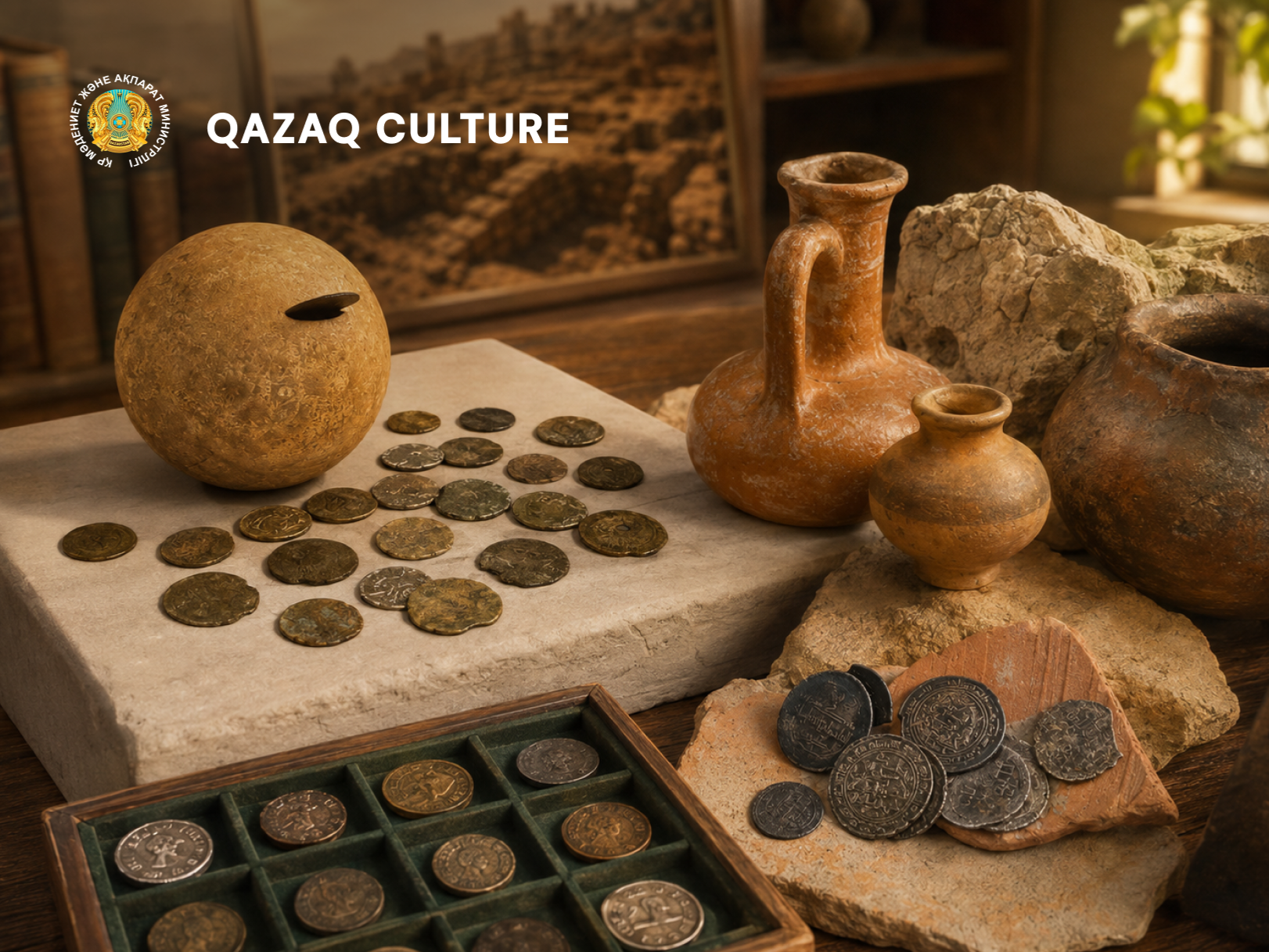
A coin, only a few centimeters in size, can preserve more than it seems. The ruler's name, the language of the inscription, the metal, the minting technique, traces of circulation – all this transforms a small object into a historical document. From it, one can understand who ruled the city, with whom it traded, and what cultural influences intersected on its streets.
This is especially evident in the example of Taraz – one of the key cities of the Great Silk Road. The numismatic collection of the "Monuments of Ancient Taraz" State Historical and Cultural Museum-Reserve currently holds 1902 items. Among them are coins from the Türgesh and Karakhanid periods, banknotes from the Kokand Khanate, Russia, and China, as well as rare specimens connected with a much broader cultural space.
Qazaq Culture spoke with Aidana Zhanbosynova, the chief curator of the museum-reserve's collections, about what ancient coins can tell us about Taraz.
– The museum's collections house a large numismatic collection. Why are coins so important for understanding the history of Taraz?
– Because a coin is a very precise historical source. Among more than four thousand archaeological finds from the territory of ancient Taraz, coins occupy a special place precisely due to the volume of information they preserve.
They can be used to trace monetary circulation, trade, political power, and connections with neighboring states. Therefore, our collection is not just a collection of ancient banknotes. It is a unique chronicle of the economic and cultural life of the city over centuries.
– What eras are represented in this collection?
– The range is very wide. There are coins from the Türgesh and Karakhanid periods, banknotes from the Kokand Khanate, Russia, and China. This alone shows how actively Taraz was connected with various political and trade centers.
One of the earliest exhibits is particularly interesting – the so-called pseudosolid, made by Sogdian craftsmen based on a Byzantine gold coin.
Researchers have several theories regarding its prototype. According to one, the image resembles the Byzantine emperor Phocas, who ruled in the early 7th century. According to another, the coin could have been created under the influence of solidi from the era of Emperor Heraclius.
The word "pseudosolid" itself is important here. Real Byzantine solidi were minted from high-purity gold and were not common currency for daily circulation far beyond the empire's borders. Sogdian craftsmen created their own versions of well-known designs.
For us, the value of such a find is not only in its age. It shows that there were connections between Byzantium, Sogd, and Central Asia, and Taraz was part of this large system of exchange.
– Does the diversity of coins mean that Taraz was indeed a major center of the Great Silk Road?
– Yes, and the coins provide very clear confirmation of this.
If banknotes from different states and eras are found in one territory, it indicates a developed and stable circulation of money. Taraz was connected with near and far regions, and along with goods, people, ideas, and cultural influences passed through the city.
It is especially important that mints operated in Taraz itself. Money was minted here on behalf of rulers. This means that the city was not just a stop for caravans, but an independent economic center with its own monetary system.
Sometimes I say that coins can be seen as traces of ancient merchants' routes. They show where people came from and with what economic spaces the city was connected.
– What place do Karakhanid period coins occupy in the collection?
– This is one of the most significant parts of the collection. We currently hold 835 units belonging to the Karakhanid era.
Their value lies in the fact that many have preserved the names and titles of rulers, as well as various inscriptions. Texts executed in Arabic script allow us to determine the time of minting and understand under which ruler the coin was issued.
The metal and manufacturing technology also provide important information. From them, researchers reconstruct the features of the monetary system and the traditions of coin production.
The coin is small in size, but sometimes an entire era is truly encapsulated within it. For the history of medieval Taraz, Karakhanid money is one of the most concrete material sources.
– How are ancient coins preserved after entering the museum?
– Work begins not with cleaning, but with research. First, specialists determine the material, surface condition, degree of damage, and only then decide whether conservation or restoration is required.
Copper and bronze are susceptible to corrosion, so stable temperature and humidity are especially important for them. If signs of oxidation appear, the restorer determines their nature and carries out the necessary work to stabilize the metal.
The approach with silver is different. Here, it is important to preserve the natural surface. Excessive cleaning can destroy historical traces and even damage signs of authenticity.
Generally, the restorer's task is not to make an ancient coin "like new". On the contrary, it is necessary to preserve what time has left on it. Wear, patina, traces of circulation – these are also part of its history.
It is thanks to this approach that an object that once changed hands in the markets of ancient Taraz continues to perform its main function through centuries – to tell the story of the city.
Today these coins can no longer buy anything. But their value has become much higher than their face value: each of them holds information about people, trade, power, and the routes that once connected Taraz with the vast world of the Great Silk Road.