From school clubs to world tournaments: what the new generation is learning
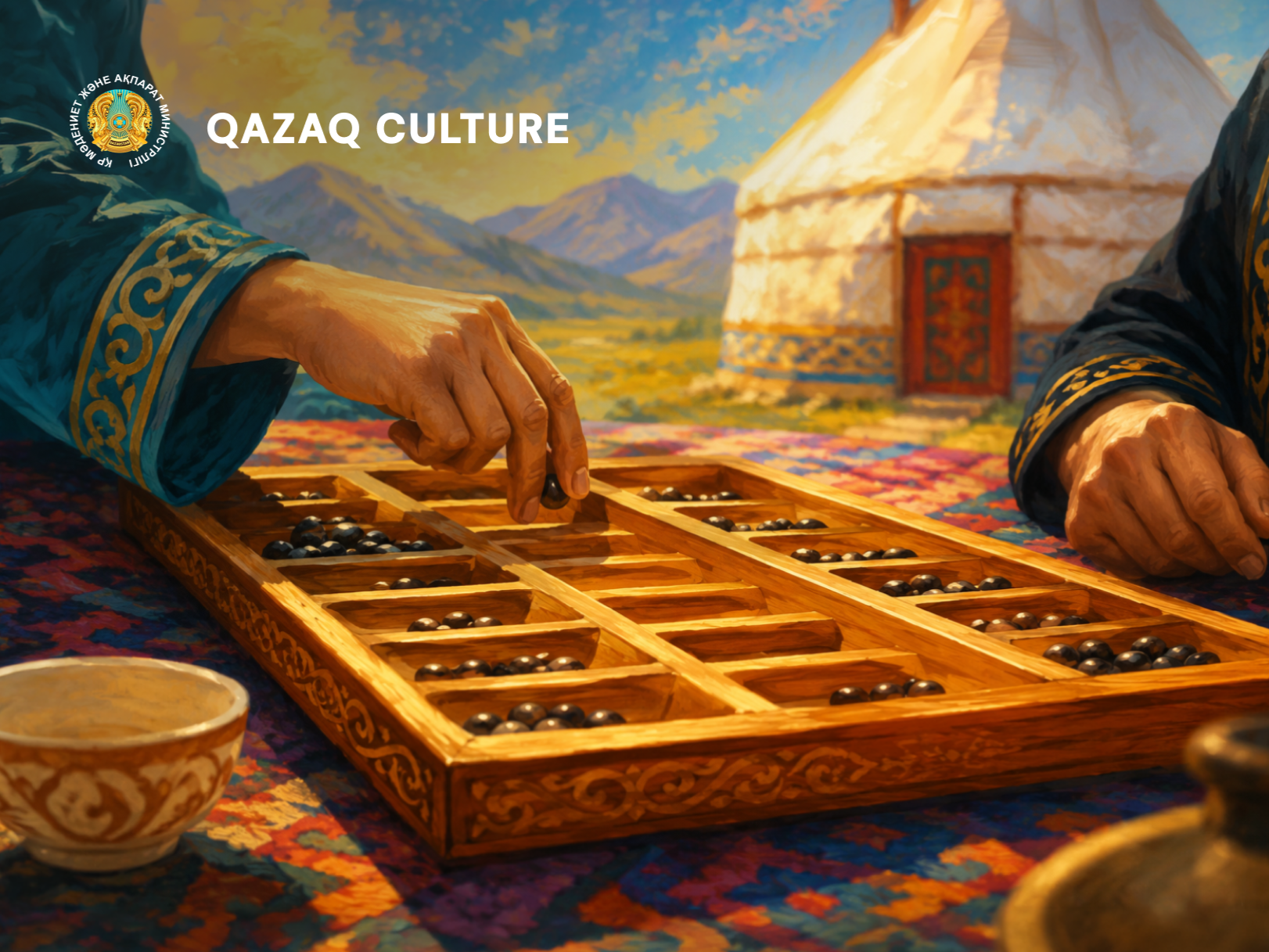
When fifth-grader Aizhan Kartaeva first sat down at a togyzkumalak board in 1985, it was difficult to imagine the scale of this game today. Ust-Kamenogorsk had only two Kazakh boarding schools at the time, and Shaker Zhakypov, a lead and zinc plant worker, came to introduce the children to this national intellectual game.
A year later, Aizhan won the first regional competition, and the year after that, she traveled to Almaty for the first togyzkumalak festival among the Central Asian republics and Kazakhstan, where she was the youngest participant. Her photo with the board even appeared in the newspaper "Leninshіl zhas."
Almost four decades have passed. Today, togyzkumalak is known in more than 30 countries, championships and international tournaments are held, and the game itself is included on the UNESCO Representative List of the Intangible Cultural Heritage of Humanity. What began for Aizhan Kartaeva in a school club has become part of a larger movement to restore and popularize national intellectual traditions.
Qazaq Culture spoke with Aizhan Kartaeva about why togyzkumalak is called "steppe chess," what this game can teach a modern child, and how national heritage has found its place in the digital age.
– You were introduced to togyzkumalak as a child. What do you remember about that time?
– I started playing in 1985, when I was in fifth grade at the Zhambyl boarding school in Ust-Kamenogorsk. Those years are especially dear to me because not only did my own story with togyzkumalak begin then, but the game itself was just beginning to spread rapidly in our region.
There were only two Kazakh boarding schools in the city. Shaker Zhakypov, who worked at a lead and zinc plant, came to visit us and taught a togyzkumalak club. This was a completely new and very interesting activity for us. He didn't just explain the rules; he explained that it was a traditional intellectual game of the Kazakh people. I think it was thanks to him that we truly became interested in it.
In 1986, the first regional competition was held in Ust-Kamenogorsk, and I took first place.
And in March 1987, we went to Almaty for the first togyzkumalak festival among the Central Asian republics and Kazakhstan. I was the youngest participant. For a schoolchild from Ust-Kamenogorsk, the very opportunity to participate in such a competition was a huge event.
After the festival, our photos were published in the newspaper "Leninshil Zhas." On April 2nd, the newspaper published a photo of me holding a togyzkumalak board. Seeing myself on the page was incredible.
Today, I understand that this isn't just my personal story. It's part of the story of the children who were among the first to master and popularize togyzkumalak in the Kazakh boarding schools of Ust-Kamenogorsk.
"Today, togyzkumalak is often called 'steppe chess.' What does it really require of a player?"
"Togyzkumalak is based on counting, logic, and strategy. But counting the number of togyzkumalaks isn't enough. You need to see the situation several moves ahead, understand your opponent's intentions, and anticipate various options.
Therefore, the game simultaneously develops mathematical skills, memory, concentration, and strategic thinking.
Character is equally important." Sometimes your opponent gains an advantage, and that's when you can't give in to emotion. You need to stop, calmly assess the situation, and seek a solution. One mistake or lapse of concentration can change the entire game.
In this regard, togyzkumalak truly becomes a school of thought and patience.
– What if you explain the rules to someone seeing the board for the first time?
– Two people are playing. There are 18 otau on the board – nine for each player – and two kazans. At the beginning of the game, each player has 81 kumalaks, for a total of 162.
The main goal seems simple: to collect more than half – at least 82 kumalaks – in your kazan.
But the path to this is much more complex.
During a player's turn, they distribute the kumalaks among the otau. If the last kumalak lands in the opponent's otau and makes the total number of kumalaks there even, they can be taken into your kazan. Therefore, practically every move requires calculation: it's important to understand not only what will happen next, but also what situation will arise after the opponent's response.
It is from such decisions that the strategy of the entire game gradually develops.
— There is also the famous rule of "tuzdyk." Why is it so important?
— It's one of the features of togyzkumalak. Under certain conditions, you can take a "tuzdyk" into your opponent's otau. After this, the kumalaks that land there go to the kazan of the tuzdyk owner.
But you can only take it once per game, and there are other restrictions. Therefore, sometimes the opportunity to take a "tuzdyk" presents itself, but a strong player deliberately declines it, calculating a more advantageous continuation.
There is also the concept of "atsyrau." This is the name for a situation in which a player in otau has no further options to make a move. The word itself, in the traditional sense, is associated with the state of a knight exhausted after a long journey or race. I think even the terminology clearly demonstrates how deeply this game is connected to traditional culture.
– After all, there was a time when togyzkumalak didn't even require a special board?
– Yes. In ancient times, people could carve otau and kazans in stone or simply make depressions in the ground, using small pebbles instead of kumalaks. Later, wooden boards appeared, including folding ones, which were convenient to carry around.
Therefore, togyzkumalak didn't arise as an artificially created intellectual discipline. It grew directly from the people's way of life, their ability to count, observe, compare, and strategize.
That's why I perceive it as a reflection of our culture of thought.
– How did a game so closely connected to Kazakh tradition manage to become understandable to people in other countries?
– I think precisely because the national form here combines with universal content. You don't need to know the Kazakh language or the history of Kazakhstan to play. Logic, calculation, strategy, and the desire to anticipate an opponent's moves are understandable to people of all cultures.
Today, toghizkumalak is played in more than 30 countries. World championships and international tournaments are held, federations are being created, and the game is featured at the World Nomad Games.
Digital technology has also played a major role. Now you can be in Kazakhstan and play online against an opponent on the other side of the world. This is especially important for young people.
And in 2020, toghizkumalak was inscribed on the UNESCO Representative List of the Intangible Cultural Heritage of Humanity as part of a joint nomination by Kazakhstan, Kyrgyzstan, and Turkey.
It's an interesting combination: a game that once emerged in the steppe now feels completely at home in the digital environment.
– Kazakhstan is currently devoting significant attention to the development of national sports. How does this directly impact toghizkumalak?
– Support for national sports at the state level not only preserves traditions, but also creates the conditions for their systematic development. Since 2025, national sports have been included among the priority areas, alongside Olympic and Paralympic sports. For Toghyzkumalak, this means new opportunities in training athletes, hosting competitions, developing children's sections, and coaching.
The World Nomad Games, held in Kazakhstan in 2024, were also of great significance. Such venues allow national sports to be showcased to an international audience.
President Kassym-Jomart Tokayev places particular emphasis on developing national sports and promoting historical and cultural heritage. In my view, today offers an opportunity to take the next step – to perceive Toghyzkumalak not only as a national game, but also as a recognizable intellectual brand of Kazakhstan.
Moreover, its potential extends far beyond sports. Toghyzkumalak can be developed at the intersection of education, science, digital technology, and international competitions.
You've personally witnessed the journey of togyzkumalak from a small school club to international tournaments. What would you say to children today who are just learning this game?
"We shouldn't view our national heritage as something of the past. The most important thing is to learn to carry it on in the present."
Togyzkumalak teaches us to think first and then act. It teaches patience, calculation, concentration, the ability to accept defeat and achieve victory through hard work. All these qualities are essential far beyond the playing field.
I'm especially pleased to see how much the scope of the game has changed since those years when we first sat down at the board in Ust-Kamenogorsk. Today, young people can play online, participate in international tournaments, and introduce togyzkumalak to their peers from other countries.
We were once children just learning this game. And today's generation can be the one to make it known throughout the world.