Al-Farabi: Architect of Thought in the Medieval East
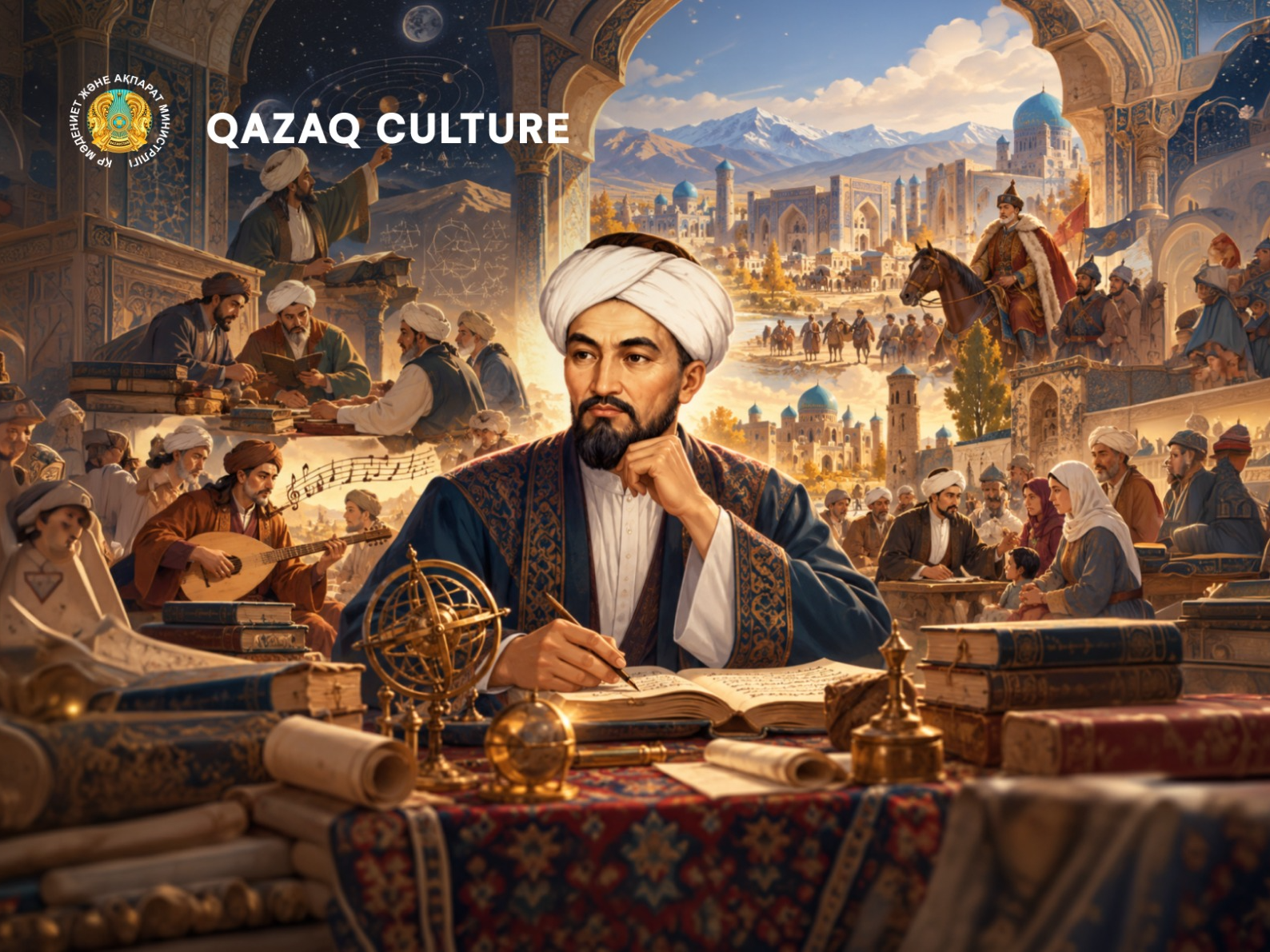
There are many examples of great minds emerging at the crossroads of eras, civilizations, and great cultures—minds whose vision was centuries ahead of their time. Among the constellation of brilliant thinkers of the medieval East, Abu Nasr al-Farabi holds a special place. He was a man whose intellect united the wisdom of ancient Greece with the spirit of the Islamic Renaissance, and scientific precision with the finest harmony of music and poetry.
Abu Nasr Muhammad ibn Muhammad al-Farabi (c. 870–950) was born, according to the most widely accepted account, in Farab, traditionally associated with the region of Otrar. Reliable information about his origins is scarce, while accounts of his noble Turkic ancestry and his father’s military status belong to a later biographical tradition.
The philosopher’s intellectual development took place in the major centers of learning of his time—Baghdad, Damascus, and Aleppo. Al-Farabi worked primarily within the Arabic-speaking intellectual world and studied the Greek philosophical tradition in depth through the translations and commentaries available to him.
For his profound understanding of logic and his unprecedented commentaries on the works of Aristotle, al-Farabi was given the honorary title of “the Second Teacher,” while Aristotle was known as “the First Teacher.” Before al-Farabi’s time, Aristotle’s works had already been translated and commented upon in the East, but al-Farabi made a significant contribution to their systematic study and to the development of the Aristotelian logical tradition. He wrote a series of profound commentaries and paraphrases (interpretations) on Aristotle’s classical body of logical works, known as the Organon.
Fundamental Achievements in Science and the Arts
The breadth of al-Farabi’s intellectual gifts is remarkable: he is credited with around 150 scientific and philosophical treatises covering many of the disciplines known at the time.
In his work The Enumeration of the Sciences, he developed a clear and logical structure of knowledge, dividing it into grammar, logic, mathematics, physics, and metaphysics, as well as civic disciplines.
He wrote detailed commentaries on Euclid’s geometry and the works of Ptolemy, developing ideas related to spatial analysis.
The philosopher reflected on the nature of the vacuum, the human soul and intellect, optics, and astronomy.
Al-Farabi entered the history of music as the author of the fundamental Great Book of Music. In this work, he provided a mathematical foundation for acoustic intervals and musical scales and described the structure of musical instruments, including string and wind instruments. He also studied the effects of music on human beings and the relationship between music, speech, and poetry.
He examined the nature of beauty and the relationship between poetry, rhetoric, and other forms of art. He argued that art and culture ennoble human beings, shape their moral character, and lead them toward spiritual perfection.
The Philosophy of a Just Society
In his political, philosophical, and ethical treatises, including the famous Treatise on the Opinions of the Inhabitants of the Virtuous City, al-Farabi laid the foundations of Eastern political philosophy.
He regarded the highest good and ultimate purpose of human life as the attainment of true happiness through knowledge and virtue.
In his view, the ruler of a virtuous city should combine the wisdom of a philosopher, high moral principles, and a commitment to serving the common good. Al-Farabi contrasted the virtuous city with societies whose inhabitants pursue false or illusory goods instead of true happiness.
Al-Farabi’s ideas built a lasting bridge between ancient culture and medieval European philosophy. Latin translations of his works influenced the intellectual life of medieval Europe, including the reception of the Aristotelian tradition and the classification of the sciences.
At the heart of al-Farabi’s philosophy was the idea that human beings attain true happiness through reason, knowledge, and a virtuous life.