Not the Pinnacle, but the Beginning: Shugyla Yeshen and Her Path to International Recognition
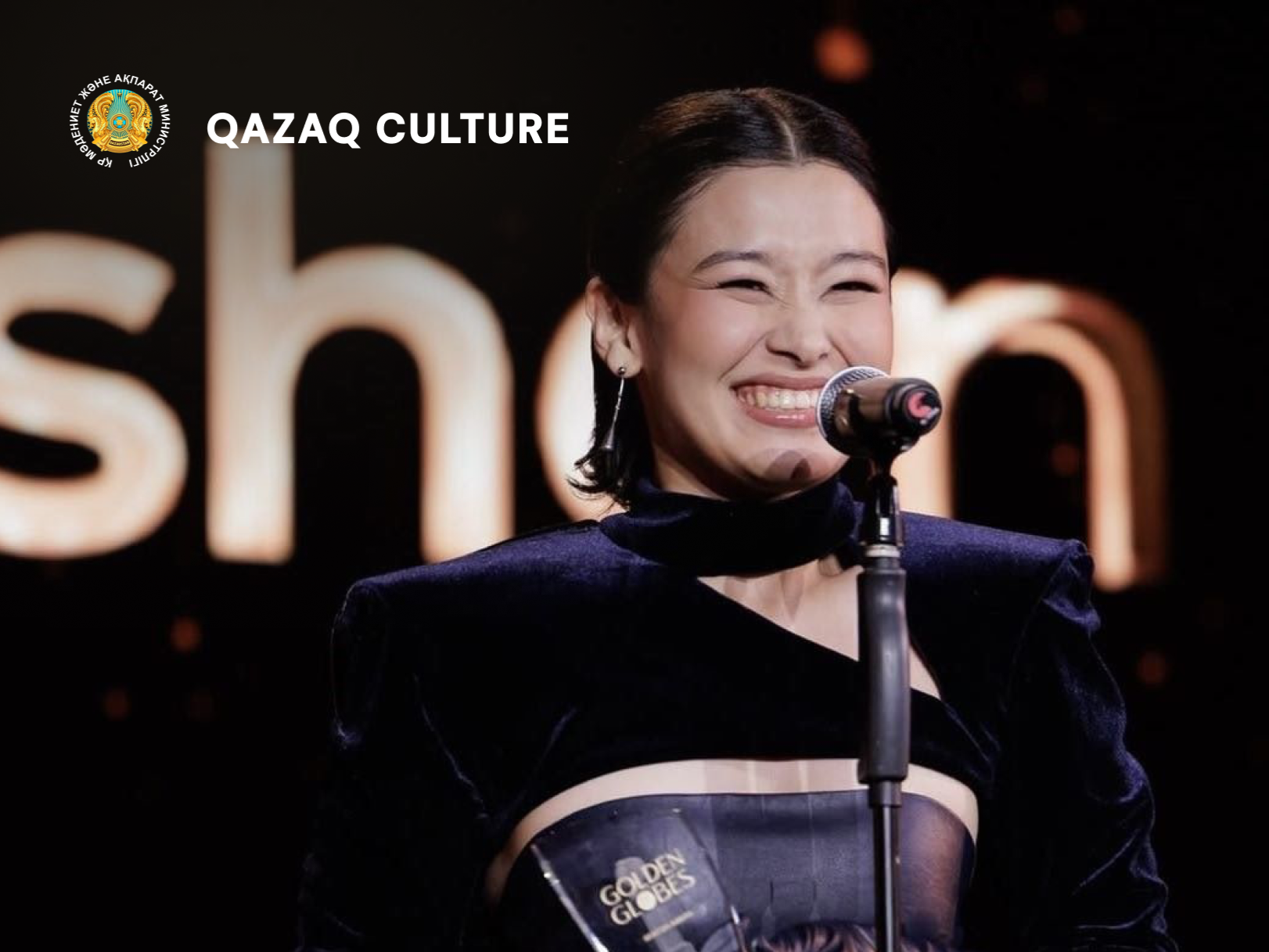
At 24, Shugyla Yeshen already knows what it's like to be recognized on the street, to have one film project follow another, and to have a Golden Globe award appear alongside her. But the actress herself is much more relaxed about it all than one might expect.
"I still feel like I'm just starting out," she says.
And perhaps it's with this phrase that we should begin discussing the award Shugyla received in Tashkent.
At the first Golden Globes Silk Road Tribute Gala, which brought together film and television representatives from Central Asia and the Caucasus, the Kazakhstani actress was awarded the Beacon Award, a special prize for young performers representing the new generation of regional cinema. She became the first representative of Kazakhstan to receive this award. Armenian actor Samvel Tadevosyan was also awarded the Beacon Award.
For Shugyla herself, the organizers' decision came as a surprise. She learned about her selection from among the region's young talents about a month before the ceremony. Today, her name increasingly appears alongside the most notable projects in new Kazakh cinema. "Sheker. The Last Chance," "Kaytadan," "Kashykpyn Sagan," "Zheti Karakshy," and the upcoming "Zheti Ata"—the list is growing rapidly. But behind the apparent rapidity of this career lies a rather traditional acting path: years of study, theater school, auditions, small roles, and constant work on her craft.
Shugyla was born in Astana and raised in Almaty. She didn't come to acting through her family dynasty: her father was a journalist, her mother an economist. First, she attended the theater college at the Temirbek Zhurgenov Academy of Arts, then the academy itself. In total, she studied acting for seven years, in the workshops of Kuanysh Kerimkulov, Tungyshbay Zhamankulov, and Dariya Zhusup.
The actress recalls that her father was cautious about his daughter's choice. He understood how dependent this profession could be on circumstances. His mother, on the contrary, advised him to follow his inner instincts.
Shugyla would later say that it was her family that taught her not to be afraid of mistakes.
This quality quickly came in handy.
She began trying out for films while still a college student. At 17, she auditioned for the lead role in Olzhas Nurbay's television series "Soqqy." The project turned out to be one of the young actress's notable first works and gave her experience on a film set even before completing her professional education.
But another part of her acting life—the theater—was also developing in parallel.
Today, Shugyla Yeshen works at the Gabit Musrepov Kazakh State Academic Theater for Children and Youth. One of her first stage roles was the role of the boy Olezhka in the play "Bolmaqan Balalyq Shaq" based on the work of Akbergen Elgezek.
She doesn't try to contrast cinema and theater. The screen offers a close-up, the opportunity to work with minimal gestures, glances, and pauses. The stage demands a different scale of existence and the repetition of a role over and over again – each evening a little differently. For the young actress, these two schools coexist, and judging by her current schedule, she has no plans to part with either.
Her first major professional recognition didn't come from an international award.
For her role as Diana in "Sheker: The Last Chance," Shugyla received the Kazakhstan Association of Film Critics Award for Best Supporting Actress. Her theater work also earned her awards at the ALTYN SAQA festival: in 2025, she was recognized in the "Umit" category, and a year later, for her role in a national classic.
And only after that did the Beacon Award appear.
It's significant that the official Golden Globes, when introducing Shugyla among the Silk Road Tribute Gala winners, specifically listed these works – theater, the national film critics' award, and her growing filmography. International attention turned out to be linked not to one high-profile film, but to the sum of what the actress had accomplished over the past few years.
However, true mass recognition came to her from a completely different direction.
Shugyla admits that she was most often recognized on the street after the melodrama "Gashykpyn Sagan," in which she played Enlik. Moreover, a surprisingly large portion of this audience turned out to be children. Young viewers approached the actress and even hummed the film's song.
"Kaytadan," despite its huge audience success, did not produce the same effect for her personally.
This difference clearly illustrates the unpredictability of the acting profession. You can participate in a major project that attracts a huge audience, but it's another role that unexpectedly becomes the defining moment for the viewer.
Shugyla herself hasn't yet named any of her characters as her favorite.
For an actress who has already played several notable roles, this sounds curious. But her explanation doesn't sound disappointing. Quite the opposite – it feels like she hasn't yet met the leading role of her career.
She craves complex characters.
Historical films, war dramas, comedies – Shugyla isn't trying to settle into one role. She's especially drawn to the opportunity to one day play an antagonist. She's willing to change her appearance for a role and deliberately seeks out characters that are as different as possible from her previous ones.
This desire becomes especially understandable when looking at her current filmography. In a relatively short time, the actress has managed to transition from contemporary drama to romantic films and genre projects. In the coming years, this range may expand even further.
Her work is no longer limited to the Kazakhstani market. Shugyla starred in a project in Kyrgyzstan, received an offer from Uzbekistan, and openly speaks of her desire to work in international cinema.
But at the same time, she's returning to the theater.
One of her new projects is Juliet. "Romeo and Juliet" at the Gabit Musrepov Theatre is being produced in both Kazakh and English, so the actors are working not only on the classical text but also on Shakespeare's language.
It's an almost symbolic trajectory.
Just a few years ago, she was a student attending auditions. Then came her first film shoots, theater, major Kazakh films, and professional awards. Now, the international stage of the Golden Globes is right around the corner, and her next stage challenge is one of the most famous heroines in world drama.
At the same time, Shugyla herself refuses to view the current period as a pinnacle.
This, perhaps, is the most interesting part of her story.
The Golden Globes Beacon Award is created specifically for those whom the international industry views as a new generation of artists from Central Asia and the Caucasus. Not for a career that has ended, but for the potential that has already been recognized.
Therefore, in Shugyla Yeshen's case, the award feels like a comma, not a period. Ahead lie new films, new countries, Juliet, roles yet to be written, and characters the actress herself can only dream of.
And her current success provides her with perhaps the most important confirmation: the stories created by the young generation of Kazakhstani cinema and theater are becoming increasingly visible beyond the country's borders.
And if Shugyla herself is to be believed, her true roles are indeed yet to come.